
October 26, 2026 – The global automotive and energy industries are increasing their attention on e-gasoline as synthetic fuel technology advances and governments evaluate additional approaches to reducing transportation-related carbon emissions. Growing investment in renewable hydrogen, carbon capture, and Power-to-Liquid (PtL) production is supporting the development of synthetic gasoline as a potential alternative to conventional petroleum-based fuels.
E-gasoline is manufactured using renewable electricity, hydrogen, and captured carbon dioxide to produce liquid hydrocarbons suitable for selected internal combustion engine applications. Unlike conventional gasoline derived from crude oil, e-gasoline can be produced through industrial processes using renewable energy and recycled or captured carbon.
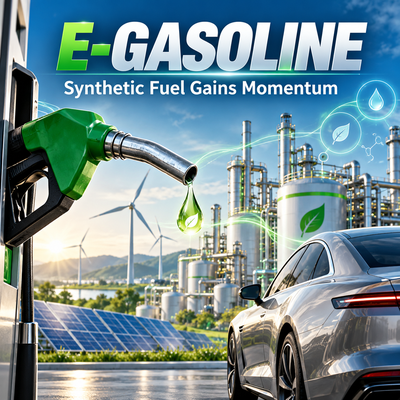
The technology is attracting interest from automotive manufacturers, energy companies, motorsport organizations, and fuel technology developers seeking to reduce lifecycle greenhouse gas emissions associated with existing combustion-engine vehicles.
Although commercial production remains limited and manufacturing costs are relatively high, recent developments in Europe and Chile demonstrate growing efforts to move synthetic fuel technologies beyond research and demonstration stages.
European Automotive Policy Developments Increase Attention on Synthetic Fuels
Recent developments in European automotive emissions policy have renewed discussions about the potential role of synthetic fuels in the transportation sector.
On October 20, 2026, European Union lawmakers reached a provisional agreement aimed at easing proposed carbon dioxide reduction requirements for new vehicles from 2035. The agreement included provisions that could recognize qualifying renewable-fuel vehicles within future emissions regulations.
The development follows the European Commission's December 2025 automotive package, which proposed greater flexibility for automakers and acknowledged a potential role for e-fuels and biofuels alongside electric vehicles.
However, the October agreement has not completed the European Union's full legislative approval process, and the final treatment of synthetic fuels remains subject to further decisions.
The policy discussion is significant for automotive manufacturers seeking long-term clarity regarding internal combustion technologies, renewable fuels, and vehicle investment strategies.
Chile's Haru Oni Facility Demonstrates Commercial E-Gasoline Production
Chile is emerging as an important center for synthetic fuel development, particularly through HIF Global's Haru Oni project in Punta Arenas.
The facility uses wind-generated electricity to produce renewable hydrogen through electrolysis. Hydrogen is then combined with captured carbon dioxide to manufacture synthetic fuels, including e-gasoline.
According to HIF Global, Haru Oni has an annual e-gasoline production capacity of approximately 130,000 liters, supported by a 3.4-megawatt wind turbine and a 1.2-megawatt electrolyzer.
In July 2026, the company announced the renewal of its ISCC EU certification for renewable fuels of non-biological origin, strengthening the project's position as an operating example of certified synthetic fuel production.
The certification covers important sustainability and traceability requirements involving renewable electricity, carbon dioxide sourcing, and synthetic fuel manufacturing.
While Haru Oni operates on a relatively small scale compared with traditional petroleum refineries, the project provides practical experience that could support future commercial facilities.
Motorsport and High-Performance Vehicles Support Early Adoption
Motorsport is becoming an important application area for synthetic gasoline because it provides opportunities to evaluate fuel performance under demanding operating conditions.
In August 2026, HIF Global and RUF Automobile demonstrated the use of renewable synthetic fuels in high-performance vehicles during Monterey Car Week.
The company has also supplied synthetic fuel for the Porsche Mobil 1 Supercup and other automotive events.
In October 2026, HIF Global announced another collaboration associated with international motorsport activities in Chile.
Such developments indicate that premium automotive and motorsport applications may provide early commercial opportunities for synthetic gasoline suppliers.
These markets can support fuel development and testing before larger-scale consumer adoption becomes economically practical.
However, motorsport demonstrations do not establish that e-gasoline is already affordable or widely available for ordinary passenger vehicles.
Renewable Hydrogen and Carbon Capture Shape Production Economics
Renewable hydrogen production is central to the future development of e-gasoline.
The Power-to-Liquid manufacturing process requires substantial electricity to produce hydrogen through water electrolysis. Hydrogen is subsequently combined with carbon-containing inputs to manufacture synthetic hydrocarbons.
Technology developers are working to improve electrolysis efficiency, fuel synthesis processes, and carbon dioxide capture systems.
Regions with competitive renewable electricity resources could become important production locations as companies seek to lower operating costs.
Wind-rich locations in South America and Northern Europe, along with solar-rich regions in the Middle East and other markets, may offer opportunities for future facilities.
However, electricity requirements remain a major challenge because producing synthetic gasoline involves several energy conversion stages.
The overall environmental benefit also depends on the carbon intensity of the electricity used, the source of captured carbon dioxide, and emissions across the full fuel lifecycle.
High Manufacturing Costs Remain the Biggest Commercial Challenge
Despite growing industry interest, e-gasoline continues to face significant economic barriers.
Production requires renewable electricity, specialized hydrogen equipment, carbon capture technology, chemical processing facilities, and fuel refining infrastructure.
These requirements generally make synthetic gasoline more expensive to manufacture than conventional fossil-derived gasoline.
Limited commercial production capacity also restricts near-term supply.
For large-scale adoption, developers will need to improve production efficiency, reduce capital costs, and secure stable supplies of competitively priced renewable electricity.
Long-term purchasing agreements and clear regulatory requirements may also play important roles in attracting investors.
E-gasoline will face competition from battery-electric vehicles, biofuels, hydrogen technologies, and other transportation decarbonization solutions.
Its future position will depend on whether producers can demonstrate competitive economics and meaningful lifecycle emissions reductions.
Automotive Applications Offer Opportunities for Existing Vehicle Fleets
One potential advantage of properly specified synthetic gasoline is its compatibility with certain existing combustion-engine systems and fuel infrastructure.
This characteristic may create opportunities for vehicle fleets that are difficult or costly to replace immediately.
Automotive manufacturers may consider synthetic gasoline as one component of broader transportation strategies, particularly for specialized vehicles, motorsport, and selected premium applications.
However, compatibility must be established through applicable fuel standards and manufacturer requirements.
E-gasoline combustion also releases carbon dioxide at the point of use. Therefore, any claim of lower environmental impact must be evaluated through lifecycle emissions rather than tailpipe emissions alone.
These considerations are expected to influence certification, commercial adoption, and government policy.
Europe and Asia-Pacific Expected to Influence Future Industry Development
Europe remains an important region for synthetic fuel research, automotive technology development, and regulatory discussions.
Germany, the Netherlands, Spain, and other European markets offer opportunities through their automotive manufacturing sectors, renewable energy investments, and engineering capabilities.
Asia-Pacific may also become increasingly important as China, Japan, South Korea, and India expand renewable energy and hydrogen-related activities.
Japan's automotive industry has shown continued interest in alternative liquid fuel technologies, while China's renewable electricity supply chain could support future production opportunities.
Latin America offers potential production advantages through renewable resources, particularly in Chile.
The geographic development of the industry will depend on electricity prices, available infrastructure, financing conditions, and long-term demand.
E-Gasoline Market Outlook: Commercial Growth Depends on Cost Reductions
The global e-gasoline industry is entering an important phase as early production facilities demonstrate technical feasibility and policymakers consider the future of renewable fuels.
According to research published by Acute Market Reports on October 10, 2026, the market is expected to expand from a relatively small commercial base as synthetic fuel technologies develop. Its illustrative forecast scenario indicates strong long-term growth potential, although actual market development will depend on project execution and production economics.
The coming years are likely to see increased attention on commercial-scale facilities, renewable hydrogen integration, fuel certification, and automotive industry partnerships.
While battery-electric vehicles remain a major pathway for reducing road transport emissions, renewable synthetic gasoline could serve selected applications where liquid fuel compatibility provides practical advantages.
The key question for the industry is no longer whether synthetic gasoline can be produced, but whether manufacturers can supply it at sufficient scale, with verified environmental benefits and commercially acceptable costs.