
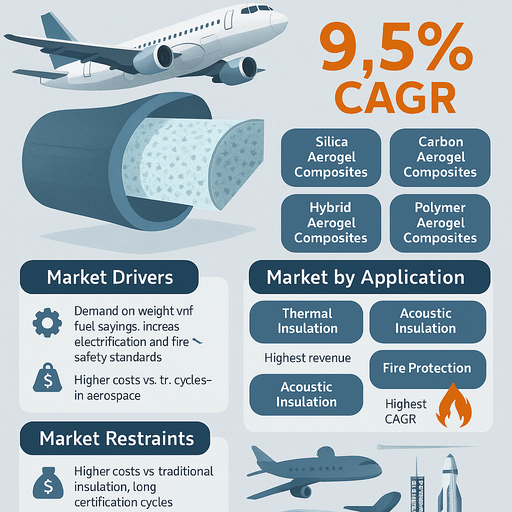
The aerogel composites for aerospace insulation market is growing at a 9.5% CAGR as aircraft and spacecraft manufacturers look for ultra-lightweight, high-performance insulation solutions that support fuel savings, extended range, and stricter thermal and fire safety standards. Aerogel composites deliver very low thermal conductivity, high temperature resistance, and weight reduction compared with traditional insulation blankets and foams. Within product types, silica aerogel composites currently generate the highest revenue because they are already qualified and widely used in aircraft thermal insulation blankets and ducting, while hybrid and polymer aerogel composites are expected to post the highest CAGR as next-generation airframes, space platforms, and eVTOL designs demand lighter, more flexible, and more durable materials. By application, thermal insulation contributes the highest revenue today due to its central role in cabin, fuselage, and systems insulation, whereas fire protection solutions based on aerogel composites are expected to record the highest CAGR as regulations tighten around flame, smoke, and toxicity performance in both commercial and defense aerospace.
Market Drivers
Market growth is driven by the constant pressure on aerospace OEMs and airlines to reduce weight and improve fuel efficiency, which directly translates into lower operating costs and emissions. Aerogel composites offer high thermal performance at a fraction of the weight of conventional materials, allowing designers to meet insulation targets while freeing up weight budgets for payload or range. Increasing electrification of systems, higher voltage architectures, and new propulsion concepts also raise the importance of thermal management and fire protection around batteries, power electronics, and wiring harnesses. Regulatory standards for cabin fire safety, flame spread, smoke density, and toxicity are becoming more stringent, driving interest in insulation materials with robust performance in both normal and emergency conditions. Growth in space, launch vehicles, satellites, and emerging eVTOL/urban air mobility platforms further supports demand, as these applications are extremely weight-sensitive and often operate in harsh thermal environments.
Market Restraints
Adoption is constrained by higher material and processing costs compared with traditional fiberglass, foams, and mineral wool solutions. Aerogel composites can require specialized handling and lamination processes, which may raise manufacturing complexity and limit use in cost-sensitive aircraft segments. Certification cycles in aerospace are long and demanding, requiring extensive flammability, toxicity, vibration, and durability testing before new materials are approved for use in primary programs. This makes OEMs cautious about large-scale substitutions and slows the pace of change in existing aircraft platforms. Mechanical fragility of some classic aerogel forms and dusting issues must be managed through robust composite designs, encapsulation, or reinforcement, adding to engineering effort. Supply chain maturity is still developing in some regions, with relatively few high-volume producers capable of meeting aerospace quality standards and documentation requirements.
Market by Product Type
Silica aerogel composites remain the most widely used products in aerospace insulation. They combine silica aerogel particles or blankets with fiber mats, films, or fabrics to create flexible insulation that can be cut and fitted around ducts, fuselage sections, and cabin structures. Within product types, silica aerogel composites currently generate the highest revenue because they have proven thermal performance, established qualification history, and are already integrated into multiple aircraft platforms. Carbon aerogel composites are used in more specialized applications where electrical conductivity, EMI shielding, or specific energy absorption characteristics are required, but they occupy a smaller niche compared with silica-based products. Hybrid aerogel composites, combining aerogels with other advanced fibers, foils, or intumescent layers, are emerging to provide multi-functionality such as combined thermal, acoustic, and fire protection in a single lightweight package. Polymer aerogel composites, including those based on polyimide and other high-temperature polymers, offer improved flexibility, mechanical robustness, and processability, making them attractive for complex shapes and components in advanced aircraft and space systems. From a growth perspective, hybrid and polymer aerogel composites are expected to post the highest CAGR as OEMs look for tailor-made solutions that integrate thermal insulation, fire protection, and acoustic or vibration performance in one material system.
Market by Application
Thermal insulation is the core application for aerogel composites in aerospace, covering cabin sidewalls, overhead areas, cargo holds, ducts, and systems where heat transfer must be controlled without adding weight. Within applications, thermal insulation currently generates the highest revenue due to its extensive use in both line-fit and retrofit programs across commercial, business, and military aircraft. Acoustic insulation uses aerogel composites to damp cabin noise from engines, airflow, and systems, especially in premium cabins and business jets where passenger comfort is critical; aerogel’s low density and porous structure help reduce noise without heavy mass layers. Fire protection is a fast-growing application, where aerogel-based panels and blankets are used to protect battery packs, fuel lines, engine nacelles, and critical systems from high temperatures and fire exposure. This segment is expected to record the highest CAGR as electrification and energy-dense systems proliferate and standards for fire containment and thermal runaway protection tighten. Vibration damping applications leverage aerogel composites in combination with elastomers or fiber structures to help control vibration and enhance component life and passenger comfort, often as part of a broader multi-functional insulation package.
Regional Insights
North America and Europe lead the aerogel composites for aerospace insulation market due to the presence of major aircraft OEMs, Tier-1 suppliers, and aerospace research centers. These regions drive the bulk of certification work, platform integration, and early adoption in both commercial and defense fleets. The United States, in particular, has strong activity in space and launch vehicles, which rely on high-performance insulation for cryogenic tanks and extreme thermal environments. Europe benefits from wide-body and narrow-body programs, regional aircraft, and growing space missions that create opportunities for advanced insulation materials. Asia Pacific is expected to show strong growth as regional OEMs in China, Japan, South Korea, and other countries expand their aircraft manufacturing capabilities, pursue local content targets, and invest in higher-performance materials for new platforms. The Middle East, Latin America, and other emerging aerospace regions create additional demand through fleets operated by major airlines and MRO providers that adopt aerogel-based solutions in retrofit insulation upgrades. Markets with active new aircraft programs, strong space investment, and high fuel-cost sensitivity will continue to see the fastest adoption of aerogel composite insulation.
Competitive Landscape
Aspen Aerogels, Inc. and Cabot Corporation are among the leading suppliers of aerogel materials and composites, providing insulation products that have already been deployed in energy and industrial sectors and adapted for aerospace applications. LG Chem, Armacell International, and Aerogel Technologies LLC contribute advanced polymer, foam, and composite technologies that can be combined with aerogels to meet aerospace mechanical, thermal, and fire performance targets. Blueshift Materials is known for high-performance polymer aerogel materials that offer low density and high thermal stability, making them suitable for demanding aerospace and space applications. Svenska Aerogel Holding AB, Active Aerogels, and Green Earth Aerogel Technologies focus on developing scalable processes and application-specific aerogel solutions for insulation, coatings, and composite systems. FLEXcon, EAS Fiberglass, Guangdong Alison Technology, Jucos Refractory, WH Thermal Energy Technology, and Wedge India participate through laminates, fiberglass backings, high-temperature materials, and engineered insulation assemblies that integrate aerogel layers for aerospace and high-temperature markets. Companies that can deliver certified, consistently manufactured aerogel composites, support OEMs through design and testing, and provide global supply and technical service are positioned to lead current revenue, while those that develop multi-functional hybrid and polymer aerogel systems tailored to next-generation aircraft, space platforms, and eVTOL fleets are likely to capture the highest CAGR in this market.
Historical & Forecast Period
This study report represents analysis of each segment from 2024 to 2034 considering 2025 as the base year. Compounded Annual Growth Rate (CAGR) for each of the respective segments estimated for the forecast period of 2026 to 2034.
The current report comprises of quantitative market estimations for each micro market for every geographical region and qualitative market analysis such as micro and macro environment analysis, market trends, competitive intelligence, segment analysis, porters five force model, top winning strategies, top investment markets, emerging trends and technological analysis, case studies, strategic conclusions and recommendations and other key market insights.
Research Methodology
The complete research study was conducted in three phases, namely: secondary research, primary research, and expert panel review. key data point that enables the estimation of Aerogel Composites for Aerospace Insulation Market By Product Type, By Application, By Temperature Range, By Form, By Manufacturing Process, By End Use - Global Market Analysis & Forecast, 2025 to 2033 market are as follows:
Market forecast was performed through proprietary software that analyzes various qualitative and quantitative factors. Growth rate and CAGR were estimated through intensive secondary and primary research. Data triangulation across various data points provides accuracy across various analyzed market segments in the report. Application of both top down and bottom-up approach for validation of market estimation assures logical, methodical and mathematical consistency of the quantitative data.
| ATTRIBUTE | DETAILS |
|---|---|
| Research Period | 2024-2034 |
| Base Year | 2025 |
| Forecast Period | 2026-2034 |
| Historical Year | 2024 |
| Unit | USD Million |
| Segmentation | |
Product Type
|
|
Application
|
|
Temperature Range
|
|
Form
|
|
Manufacturing Process
|
|
End Use
|
|
|
Region Segment (2024-2034; US$ Million)
|
Key questions answered in this report


