
The agricultural machinery maintenance services market is growing at a 9.0% CAGR as farms work to keep complex, high-value equipment running reliably while managing rising labor costs and tight planting and harvesting windows. Modern tractors, harvesters, planters, sprayers, and irrigation systems use electronics, sensors, and telematics that require specialist maintenance skills, pushing demand for dealer-led service contracts, on-site repair, and predictive maintenance programs. As equipment becomes more capital-intensive and replacement cycles lengthen, farmers and agri-businesses focus more on lifecycle support, uptime guarantees, and remote diagnostics. By equipment type, tractors and power units, along with harvesters, generate the highest revenue for maintenance services due to their high installed base and critical role in farm operations, while irrigation systems and spraying and application equipment are expected to record the highest CAGR as precision agriculture, environmental rules, and water constraints expand service needs. By ownership, individual farmers represent the largest share of maintenance service demand based on unit count, whereas corporate farms are expected to post the highest CAGR as they standardize fleets, outsource service, and sign long-term maintenance contracts.
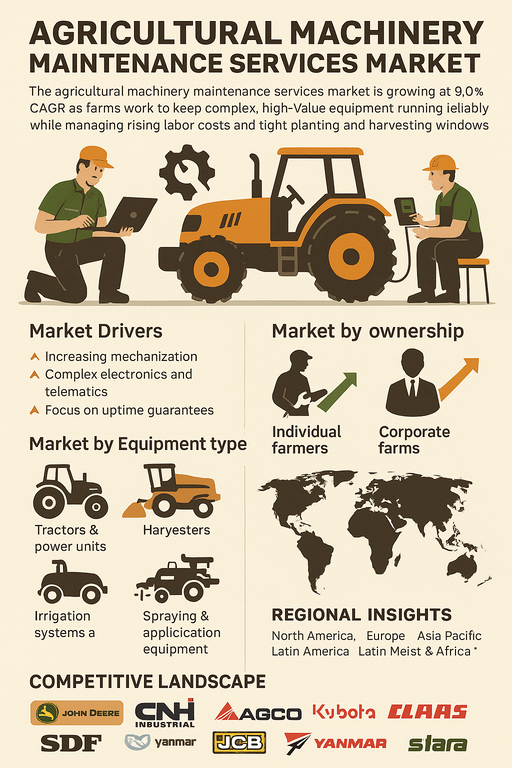
Market Drivers
Growth is driven by increasing mechanization in emerging markets and the rising complexity of agricultural machinery in developed regions. Modern equipment integrates GPS guidance, ISOBUS connectivity, telematics, variable-rate application, and automated steering, which raises performance but also makes do-it-yourself maintenance more difficult. Farmers aim to reduce unplanned downtime during critical periods, so they invest more in preventive maintenance, extended warranties, and dealer service packages. Longer operating hours and heavier implements put more stress on powertrains, hydraulics, and chassis components, increasing demand for scheduled inspections and component replacement. Digital tools that connect machines to dealers and OEMs support remote diagnostics, software updates, and early fault detection, which encourages service revenue beyond traditional parts and labor. At the same time, environmental and safety regulations push more regular checks on spraying systems, emissions components, and braking systems, further supporting maintenance demand. Consolidation of farms into larger units also encourages professionalized fleet management and formal service agreements.
Market Restraints
The market faces restraints from tight farm margins, seasonal income patterns, and limited skilled labor in some regions. When commodity prices are low, many farmers postpone non-critical maintenance or rely on lower-cost local workshops instead of authorized dealers, which can shift work away from OEM-linked networks. Seasonality in planting and harvesting creates peaks in service demand that are hard to staff and manage, leading to longer waiting times and possible dissatisfaction with service providers. Smaller farms may continue to perform their own basic maintenance, especially in regions where equipment is simpler and diagnostic tools are scarce. High labor costs, travel time for field service, and rising prices for genuine parts can make full-service packages expensive, limiting uptake in cost-sensitive markets. In some areas there is a shortage of trained technicians who can handle electronics, software, and hydraulic systems, which constrains the growth of advanced maintenance services. Parallel imports and non-genuine parts can also put pressure on OEM service revenues and complicate warranty management.
Market by Equipment Type
Tractors and power units form the backbone of agricultural machinery fleets and generate the largest share of maintenance service revenue. They are used across primary tillage, planting, spraying, transport, and many other tasks, which leads to high operating hours and frequent need for engine, transmission, hydraulic, and axle maintenance. Harvesters, including combine harvesters, forage harvesters, and specialty harvesters, require complex seasonal overhauls of threshing, cutting, cleaning, and separation systems as well as electronics and sensor calibration; this segment is critical for uptime because breakdowns during harvest can lead to direct yield losses. Tillage and soil preparation equipment, such as ploughs, cultivators, and disc harrows, drive demand for wear-part replacement, welding, and structural repairs, especially in intensive farming regions. Planting and seeding equipment, including precision planters and seed drills, require accurate maintenance and calibration of metering units, depth control systems, and electronics to ensure proper seed placement and spacing, which supports more specialized service offerings. Irrigation systems, including pumps, pivots, drip lines, and control units, are increasingly important maintenance targets as water scarcity and irrigation intensity increase; they are expected to show strong growth in service demand for pump overhauls, leak detection, sensor calibration, and control system updates. Spraying and application equipment, including self-propelled sprayers and mounted sprayers, require regular service for pumps, boom structures, nozzles, and control systems to ensure accurate application and compliance with environmental rules; this segment is expected to record one of the highest CAGRs as precision application, drift reduction requirements, and digital prescription maps drive more frequent calibration and system checks.
Market by Ownership
Individual farmers represent the largest share of the agricultural machinery maintenance services market in terms of the number of machines in operation and the spread of basic service needs across tractors, small harvesters, and implements. Many individual farms rely on a mix of dealer services and self-performed maintenance, with authorized dealers and local workshops handling more complex repairs, electronic diagnostics, and seasonal overhauls. Growth in this segment is supported by gradual adoption of service contracts, extended warranties, and remote support as equipment becomes more advanced. Corporate farms, including large commercial operations, agribusiness groups, and integrated producer-processor companies, operate larger and more standardized fleets, which supports more formal maintenance programs, fleet-wide service contracts, and predictive maintenance solutions. These customers often negotiate multi-year service agreements with OEMs and dealers that include uptime guarantees, parts availability commitments, and data-driven optimization of maintenance intervals. As farm consolidation continues and institutional investors enter the sector, the corporate farms segment is expected to record the highest CAGR for maintenance services, driven by professional asset management practices, central procurement, and a stronger focus on lifetime cost of ownership.
Regional Insights
North America and Europe account for a large share of the agricultural machinery maintenance services market due to the high penetration of tractors, harvesters, and advanced application equipment, as well as well-developed dealer networks. Farms in these regions use larger and more complex machines, which supports higher-value maintenance contracts, remote diagnostics, and telematics-based service programs. In North America, large row-crop farms and mixed operations rely heavily on dealer technicians and OEM-backed service tools, while in Europe, high equipment density and strict environmental and safety regulations drive regular inspections and certifications for sprayers and other systems. Asia Pacific, including India, China, and Southeast Asia, is expected to show one of the highest CAGRs as mechanization levels rise and fleets shift from small, basic tractors toward more powerful, feature-rich machines that require organized service support. In Latin America, large-scale soybean, corn, and sugarcane farms use heavy-duty tractors and harvesters, creating strong demand for field service, seasonal overhauls, and specialized repair centers. The Middle East and Africa see growing demand linked to irrigation systems, mechanized grain and horticulture projects, and government-backed farm modernization programs, although service infrastructure can still be uneven in some areas. Regions where OEM and dealer networks are strong, where telematics connectivity is widespread, and where farm consolidation leads to larger fleets will see faster expansion of structured maintenance service offerings.
Competitive Landscape
John Deere, CNH Industrial N.V., and AGCO Corporation play leading roles in agricultural machinery maintenance services by combining equipment sales with extensive dealer networks, telematics platforms, and branded service programs that include preventive maintenance, warranty extensions, and remote diagnostics. Kubota Corporation, Mahindra & Mahindra, Escorts Kubota Limited, SDF Group, JCB, Yanmar Holdings, and Stara support diverse regional markets with tractor, harvester, and implement fleets, expanding their service footprints through authorized dealerships, training programs for technicians, and mobile service units. CLAAS Group focuses strongly on harvesting machinery and related service solutions, including pre-season inspections, advanced diagnostics, and parts logistics that ensure uptime during critical harvest periods. Autonomous Tractor Corporation, FarmWise, Iron Ox, and other technology-focused companies contribute to a new wave of autonomous and robotic equipment, which requires specialized maintenance and software support as these systems move from pilots to commercial operation. Precision Planting and similar precision agriculture companies drive demand for specialized maintenance and calibration of planting, sensing, and control systems that integrate with existing machinery. As the market develops, companies that offer integrated service packages, strong parts supply chains, remote monitoring, and data-based maintenance planning are likely to lead revenue, while those that build expertise in supporting autonomous systems, precision application equipment, and irrigation technologies are positioned to capture the highest CAGR in the agricultural machinery maintenance services market.
Historical & Forecast Period
This study report represents analysis of each segment from 2024 to 2034 considering 2025 as the base year. Compounded Annual Growth Rate (CAGR) for each of the respective segments estimated for the forecast period of 2026 to 2034.
The current report comprises of quantitative market estimations for each micro market for every geographical region and qualitative market analysis such as micro and macro environment analysis, market trends, competitive intelligence, segment analysis, porters five force model, top winning strategies, top investment markets, emerging trends and technological analysis, case studies, strategic conclusions and recommendations and other key market insights.
Research Methodology
The complete research study was conducted in three phases, namely: secondary research, primary research, and expert panel review. key data point that enables the estimation of Agricultural Machinery Maintenance Services Market By Equipment Type, By Ownership, By Operational Size, By Service Type, By Application - Global Market Analysis & Forecast, 2025 to 2033 market are as follows:
Market forecast was performed through proprietary software that analyzes various qualitative and quantitative factors. Growth rate and CAGR were estimated through intensive secondary and primary research. Data triangulation across various data points provides accuracy across various analyzed market segments in the report. Application of both top down and bottom-up approach for validation of market estimation assures logical, methodical and mathematical consistency of the quantitative data.
| ATTRIBUTE | DETAILS |
|---|---|
| Research Period | 2024-2034 |
| Base Year | 2025 |
| Forecast Period | 2026-2034 |
| Historical Year | 2024 |
| Unit | USD Million |
| Segmentation | |
Equipment Type
|
|
Ownership
|
|
Operational Size
|
|
Application
|
|
Service Type
|
|
|
Region Segment (2024-2034; US$ Million)
|
Key questions answered in this report


