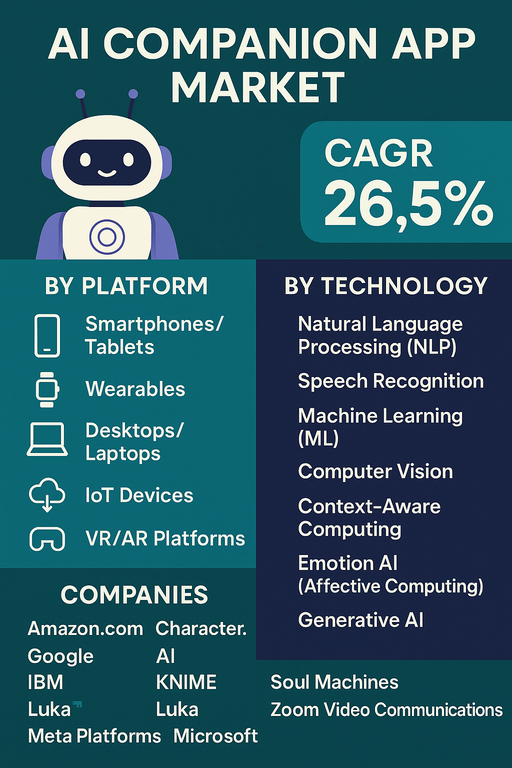
The global AI companion app market is expected to grow at an impressive CAGR of 26.5% during the forecast period from 2026 to 2034. This rapid growth is attributed to increasing user engagement with intelligent digital agents for mental wellness, productivity, companionship, and personal assistance. Advances in generative AI, emotion detection, and contextual understanding are transforming AI companions from simple chatbots to highly interactive and personalized virtual entities. The market is driven by demand for mental health support tools, lifestyle assistance, and conversational agents across devices and platforms.
Market Drivers
Increasing Demand for Virtual Companionship and Wellness Tools
Rising mental health concerns, social isolation, and digital adoption are pushing users to seek virtual agents for emotional support, stress relief, and daily productivity management. AI companion apps, capable of empathetic conversation and proactive suggestions, are gaining widespread adoption among Gen Z and Millennials. Features such as memory retention, daily check-ins, and mood tracking are enhancing long-term engagement with AI-powered companions. These apps are being increasingly used for personalized conversations, meditation coaching, mental journaling, and friendly interactions in lieu of human contact.
Advancements in Multimodal AI and Human-AI Interaction
The integration of technologies like NLP, emotion AI, and generative AI enables real-time and emotionally aware communication between users and their digital companions. Users now expect more natural, voice-enabled, and contextually intelligent interactions that adapt to their emotional state and behavioral history. AI companions powered by models like ChatGPT, Claude, and Gemini are being embedded across smart devices, creating seamless cross-platform experiences. Voice modulation, avatar personalization, and human-like expressions are further enhancing user trust and comfort.
Market Restraint
Data Privacy Concerns and Ethical Challenges
Despite rising usage, concerns about data ownership, emotional manipulation, and algorithmic bias continue to affect market penetration, particularly among privacy-conscious users and in regulated regions. The handling of sensitive user data such as emotional patterns, relationship preferences, and behavioral history requires strict compliance with evolving data protection laws like GDPR and CCPA. Ethical debates on emotional dependency, misinformation risks, and AI’s psychological influence are also raising concerns among healthcare professionals and regulators.
Market Segmentation by Platform
The AI companion app market is segmented by platform into Smartphones/Tablets, Wearables, Desktops/Laptops, IoT Devices, and VR/AR Platforms. In 2025, smartphones/tablets held the largest market share due to their ubiquity and app-based ecosystems. However, wearables and VR/AR platforms are expected to grow at the fastest pace, with AI companions embedded in smart glasses, smartwatches, and immersive environments. These platforms enable real-time tracking, gesture recognition, and multimodal interaction, ideal for AI-driven personal coaching and companionship.
Market Segmentation by Technology
By technology, the market is categorized into NLP, Speech Recognition, Machine Learning, Computer Vision, Context-Aware Computing, Emotion AI, and Generative AI. NLP and speech recognition form the core of conversational experience, while emotion AI and context-aware computing help personalize interaction by understanding tone, behavior, and mood. Generative AI is the fastest-growing segment, revolutionizing how AI companions create narratives, personalized advice, and dynamic responses, enhancing long-term user satisfaction and engagement.
Geographic Trends
North America led the market in 2025, driven by high smartphone penetration, early adoption of AI technologies, and the presence of major companies like OpenAI, Google, and Meta. Asia Pacific is projected to exhibit the highest CAGR through 2034, fueled by tech-savvy populations, growing mental health awareness, and increasing investment in consumer AI by companies in China, Japan, and South Korea. Europe follows with significant adoption in Germany, the UK, and France, aided by increasing integration of AI in wellness and digital therapy platforms.
Competitive Trends
The AI companion app market features both big tech companies and emerging AI-first startups. OpenAI, Google, Amazon.com, and Microsoft dominate with their large language models (LLMs), AI APIs, and cloud deployment infrastructure. Meta Platforms and Zoom Video Communications are investing in avatar-based AI interaction and video-based companion tools. Character.AI, Nomi AI, and Luka are known for personality-driven AI agents that allow customization, emotional memory, and long-form conversations. Soul Machines leads in lifelike digital avatars powered by emotion and gesture synthesis. Competitive differentiation revolves around emotional intelligence, personalization, real-time responsiveness, privacy safeguards, and cross-device integration.
Historical & Forecast Period
This study report represents analysis of each segment from 2024 to 2034 considering 2025 as the base year. Compounded Annual Growth Rate (CAGR) for each of the respective segments estimated for the forecast period of 2026 to 2034.
The current report comprises of quantitative market estimations for each micro market for every geographical region and qualitative market analysis such as micro and macro environment analysis, market trends, competitive intelligence, segment analysis, porters five force model, top winning strategies, top investment markets, emerging trends and technological analysis, case studies, strategic conclusions and recommendations and other key market insights.
Research Methodology
The complete research study was conducted in three phases, namely: secondary research, primary research, and expert panel review. key data point that enables the estimation of AI Companion App market are as follows:
Market forecast was performed through proprietary software that analyzes various qualitative and quantitative factors. Growth rate and CAGR were estimated through intensive secondary and primary research. Data triangulation across various data points provides accuracy across various analyzed market segments in the report. Application of both top down and bottom-up approach for validation of market estimation assures logical, methodical and mathematical consistency of the quantitative data.
| ATTRIBUTE | DETAILS |
|---|---|
| Research Period | 2024-2034 |
| Base Year | 2025 |
| Forecast Period | 2026-2034 |
| Historical Year | 2024 |
| Unit | USD Million |
| Segmentation | |
Component
|
|
Platform
|
|
Technology
|
|
Application
|
|
End Use
|
|
|
Region Segment (2024-2034; US$ Million)
|
Key questions answered in this report