
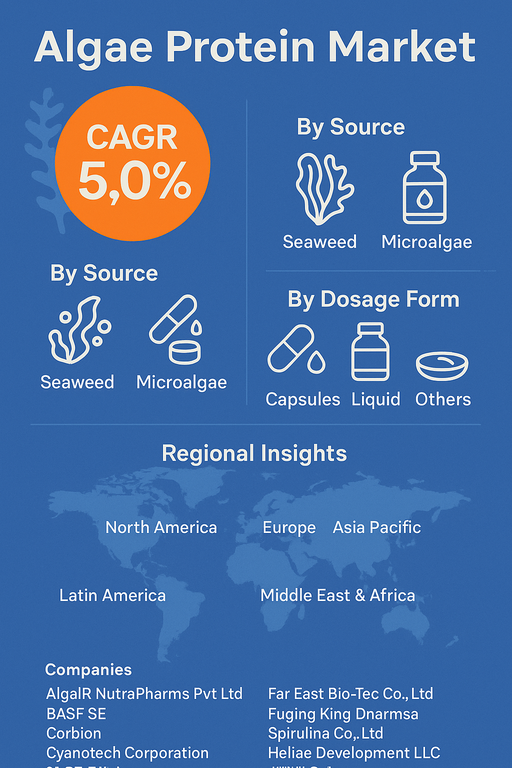
The global algae protein market is projected to grow at a CAGR of 5.0% from 2026 to 2034, driven by rising demand for plant-based proteins, increasing adoption of sustainable food sources, and growing applications across nutraceuticals, food & beverages, cosmetics, and animal feed. Algae proteins, derived from seaweed and microalgae, are rich in essential amino acids, antioxidants, vitamins, and minerals, making them a popular choice for health-conscious consumers and industries shifting toward sustainable and functional ingredients.
Rising Demand for Sustainable and Plant-Based Nutrition
The algae protein market is expanding as consumers increasingly seek environmentally sustainable alternatives to animal-based proteins. Growing vegan and vegetarian populations, coupled with rising awareness of algae’s health benefits such as immunity support, weight management, and cardiovascular health, are boosting demand. Food and beverage companies are incorporating algae protein into functional foods, protein powders, and beverages, while nutraceutical firms are developing capsule and liquid formulations targeting health-conscious consumers. In addition, its applications in aquaculture and animal feed are strengthening market penetration.
Challenges: High Production Costs and Limited Awareness
Despite strong potential, the algae protein market faces challenges such as high cultivation and extraction costs, which limit affordability and large-scale commercialization. Awareness about algae protein remains low in certain emerging markets, restricting consumer adoption. Technical hurdles in large-scale production and supply chain inconsistencies also pose barriers. However, ongoing investments in biotechnology, cost-efficient cultivation methods, and government support for sustainable food sources are expected to overcome these challenges.
Market Segmentation by Source
By source, the market is divided into seaweed and microalgae. Seaweed accounts for the largest share due to its abundant availability, low production cost, and high use in food and nutraceutical applications. Microalgae, while smaller in market share, is gaining traction due to its higher protein concentration and growing use in specialized health supplements and animal feed.
Market Segmentation by Dosage Form
By dosage form, the market is segmented into capsules, liquid, powder, and others. Powder form dominates the market due to its ease of incorporation into foods, beverages, and supplements. Capsules are popular in nutraceuticals and dietary supplements, offering convenience and precise dosing. Liquid formulations are expanding in functional beverages and health drinks, while other forms include bars and novel delivery systems.
Regional Insights
In 2025, Europe led the algae protein market, supported by strong consumer demand for plant-based diets, sustainability initiatives, and innovation in algae-based foods and supplements. North America followed, driven by growing health and wellness trends and a strong nutraceutical industry. Asia Pacific is expected to grow the fastest, supported by abundant seaweed resources in countries such as China, Japan, and South Korea, along with rising investments in algae cultivation. Latin America and Middle East & Africa (MEA) represent emerging regions, where increasing awareness of sustainable protein sources is gradually expanding adoption.
Competitive Landscape
The 2025 market was shaped by global nutrition companies and specialized algae producers. BASF SE, Corbion, and Roquette Freres lead with strong investments in algae-based nutrition and functional food applications. Nutrex Hawaii Inc, Cyanotech Corporation, and ENERGYbits Inc are key players in the nutraceutical and dietary supplement segments, focusing on spirulina- and chlorella-based products. AlgalR NutraPharms, JUNE Spirulina, and Fuqing King Dnarmsa Spirulina strengthen their presence in Asia with cost-effective offerings. Heliae Development LLC and Veramaris focus on technological innovations and sustainable large-scale algae production. Far East Bio-Tec Co. Ltd is expanding its portfolio in both supplements and animal feed. Competitive strategies emphasize innovation in cultivation methods, partnerships with food and nutraceutical companies, and the development of sustainable protein alternatives.
Historical & Forecast Period
This study report represents analysis of each segment from 2024 to 2034 considering 2025 as the base year. Compounded Annual Growth Rate (CAGR) for each of the respective segments estimated for the forecast period of 2026 to 2034.
The current report comprises of quantitative market estimations for each micro market for every geographical region and qualitative market analysis such as micro and macro environment analysis, market trends, competitive intelligence, segment analysis, porters five force model, top winning strategies, top investment markets, emerging trends and technological analysis, case studies, strategic conclusions and recommendations and other key market insights.
Research Methodology
The complete research study was conducted in three phases, namely: secondary research, primary research, and expert panel review. key data point that enables the estimation of Algae Protein Market By Source, By Dosage Form, By Application - Growth, Share, Opportunities & Competitive Analysis, 2026 - 2034 market are as follows:
Market forecast was performed through proprietary software that analyzes various qualitative and quantitative factors. Growth rate and CAGR were estimated through intensive secondary and primary research. Data triangulation across various data points provides accuracy across various analyzed market segments in the report. Application of both top down and bottom-up approach for validation of market estimation assures logical, methodical and mathematical consistency of the quantitative data.
| ATTRIBUTE | DETAILS |
|---|---|
| Research Period | 2024-2034 |
| Base Year | 2025 |
| Forecast Period | 2026-2034 |
| Historical Year | 2024 |
| Unit | USD Million |
| Segmentation | |
Source
|
|
Dosage Form
|
|
Application
|
|
|
Region Segment (2024-2034; US$ Million)
|
Key questions answered in this report


