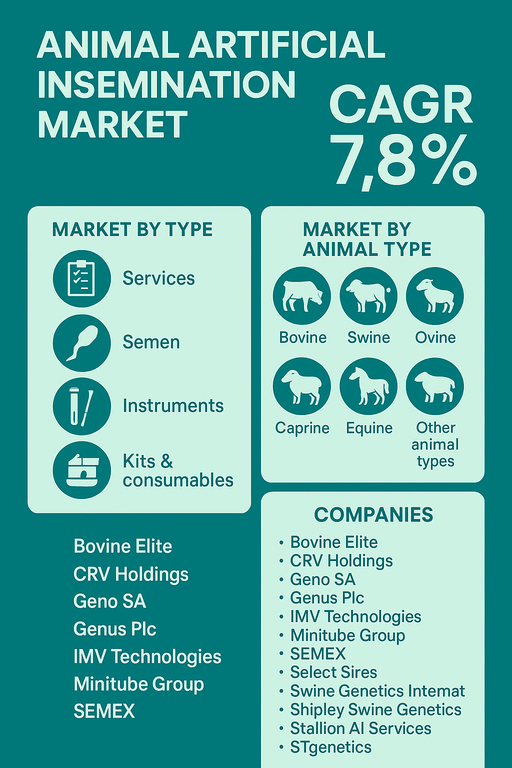
The animal artificial insemination market is projected to grow at a CAGR of 7.8% from 2026 to 2034, driven by increasing demand for genetic improvement in livestock, higher productivity in meat and dairy production, and the widespread adoption of assisted reproductive technologies in both commercial and breeding farms. Artificial insemination (AI) offers cost-effective and controlled breeding, facilitating the dissemination of superior genetics while reducing the risk of disease transmission associated with natural mating.
Market Drivers
Rising Demand for Genetic Enhancement and Productivity Gains
Farmers and livestock producers are increasingly adopting artificial insemination to improve milk yield, growth rate, disease resistance, and reproductive efficiency. With genomic selection and data-driven breeding programs, AI enables rapid dissemination of high-value genetics across herds and generations, contributing to enhanced farm profitability.
Expansion of Commercial Dairy and Meat Industries
Global meat and dairy consumption trends, especially in developing economies, are pushing farms to scale operations and standardize breeding practices. AI provides an efficient, scalable solution for large-scale animal production systems, minimizing the need for maintaining live males and enabling tight control over reproduction schedules.
Technological Advancements in Reproductive Instruments and Semen Handling
Advancements in AI equipment such as cryopreservation tools, automated semen injectors, heat detection systems, and estrus synchronization kits have significantly improved conception rates and reduced breeding cycle variability. The development of species-specific semen extenders and kits is supporting the diversification of AI across animal types beyond bovine.
Market Restraint
Limited Access to Skilled Technicians and Infrastructure in Rural Areas
Despite growing adoption, the lack of trained personnel for semen handling and insemination procedures, especially in emerging economies, continues to restrict market expansion. Inadequate cold-chain infrastructure, improper AI technique, and lack of awareness among smallholder farmers often result in reduced conception success and underutilization of AI programs.
Market Segmentation by Type
The market is segmented into Services, Semen, Instruments, and Kit & Consumables. In 2025, semen accounted for the largest revenue share, driven by increasing use of frozen and sexed semen in bovine and swine breeding. The services segment, including insemination procedures and veterinary support, is growing steadily as farms outsource AI to professional technicians. Instruments such as pipettes, sheathes, and cryo-cylinders are widely used by commercial breeding operations. Kits & consumables including semen straws, extenders, and sterilization supplies are in demand for ensuring quality control and efficient handling.
Market Segmentation by Animal Type
By animal type, the market is segmented into Bovine, Swine, Ovine, Caprine, Equine, and Other Animal Types. In 2025, bovine dominated the market due to the extensive use of AI in dairy and beef cattle production. Swine AI is gaining momentum, especially in North America and Europe, for improving litter size and genetics. Ovine and caprine segments are growing in regions where small ruminants contribute significantly to the local economy. Equine AI remains niche, primarily used in sport horse and racehorse breeding, while other animal types include species such as rabbits and dogs for genetic preservation and niche breeding programs.
Geographic Trends
In 2025, North America led the animal artificial insemination market, driven by widespread dairy farm mechanization, genetic improvement programs, and access to professional AI services. Europe followed, with strong participation from countries like France, Germany, and the Netherlands, known for organized breeding systems and export of elite semen. Asia Pacific is expected to register the highest CAGR from 2026 to 2034, supported by large livestock populations, improving farm infrastructure, and growing demand for dairy products in China and India. Latin America (especially Brazil and Argentina) and Middle East & Africa are emerging markets, benefiting from government-led initiatives and international livestock development programs.
Competitive Trends
In 2025, the competitive landscape featured key players offering comprehensive AI solutions across various livestock categories. Genus Plc, SEMEX, Select Sires, and STgenetics led the market with global distribution networks, proprietary genetics, and advanced semen sexing technologies. CRV Holdings, VikingGenetics, and URUS Group maintained strong presence in Europe through national and regional breeding cooperatives. Bovine Elite, Swine Genetics International, and Shipley Swine Genetics focused on the North American market with elite swine and bovine semen offerings. IMV Technologies, Minitube Group, and Stallion AI Services led the instrumentation and laboratory solutions segment with innovations in cryopreservation, storage, and automated insemination. Market players are increasingly investing in AI analytics, mobile breeding apps, and cloud-based herd genetic management platforms to drive long-term engagement and service differentiation.
Historical & Forecast Period
This study report represents analysis of each segment from 2024 to 2034 considering 2025 as the base year. Compounded Annual Growth Rate (CAGR) for each of the respective segments estimated for the forecast period of 2026 to 2034.
The current report comprises of quantitative market estimations for each micro market for every geographical region and qualitative market analysis such as micro and macro environment analysis, market trends, competitive intelligence, segment analysis, porters five force model, top winning strategies, top investment markets, emerging trends and technological analysis, case studies, strategic conclusions and recommendations and other key market insights.
Research Methodology
The complete research study was conducted in three phases, namely: secondary research, primary research, and expert panel review. key data point that enables the estimation of Animal Artificial Insemination market are as follows:
Market forecast was performed through proprietary software that analyzes various qualitative and quantitative factors. Growth rate and CAGR were estimated through intensive secondary and primary research. Data triangulation across various data points provides accuracy across various analyzed market segments in the report. Application of both top down and bottom-up approach for validation of market estimation assures logical, methodical and mathematical consistency of the quantitative data.
| ATTRIBUTE | DETAILS |
|---|---|
| Research Period | 2024-2034 |
| Base Year | 2025 |
| Forecast Period | 2026-2034 |
| Historical Year | 2024 |
| Unit | USD Million |
| Segmentation | |
Type
|
|
Animal Type
|
|
Technique
|
|
End Use
|
|
|
Region Segment (2024-2034; US$ Million)
|
Key questions answered in this report