
The artificial intelligence for accounting market is projected to grow at a Compound Annual Growth Rate (CAGR) of 25.5% from 2026 to 2034, driven by the automation of repetitive financial tasks, the rising demand for real-time data analytics, and the increasing complexity of regulatory compliance in financial reporting. AI technologies such as machine learning, natural language processing, and robotic process automation are reshaping traditional accounting functions by enhancing data accuracy, reducing human error, and enabling predictive insights. As CFOs and finance teams shift from transactional roles to strategic advisory, AI-powered tools are becoming integral in streamlining operations, fraud detection, audit efficiency, and decision-making across businesses of all sizes.
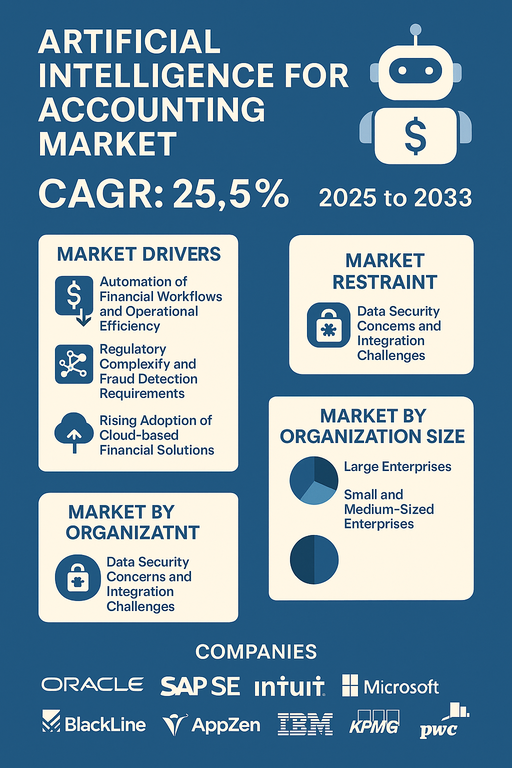
Market Drivers
Automation of Financial Workflows and Operational Efficiency
The rising volume of transactional data in organizations and the pressure to enhance operational efficiency have accelerated the integration of AI in accounting systems. Applications such as automated invoice processing, bank reconciliation, expense categorization, and ledger management are replacing manual and time-intensive processes, leading to reduced cycle times and improved accuracy. AI systems are increasingly being embedded into enterprise resource planning (ERP) platforms and accounting software suites, supporting real-time transaction validation, cash flow forecasting, and compliance tracking thus enabling finance departments to shift focus from recordkeeping to strategy formulation.
Regulatory Complexity and Fraud Detection Requirements
Accounting teams face a growing challenge in navigating evolving tax codes, audit regulations, and financial disclosures across jurisdictions. AI-powered tools enable rule-based monitoring, exception flagging, and automated audit trails that help organizations comply with standards such as IFRS, GAAP, and SOX. Moreover, AI applications in forensic accounting are being widely adopted to detect anomalies, suspicious transactions, and potential fraud by leveraging behavioral analytics and real-time monitoring. Enterprises are prioritizing AI tools to mitigate risks, particularly in sectors such as banking, insurance, and retail, where transaction frequency is high.
Rising Adoption of Cloud-based Financial Solutions
The proliferation of cloud computing has enabled easier access to AI-powered accounting systems with scalable infrastructure and real-time collaboration features. Cloud-based platforms offer flexibility, reduced IT maintenance, and cost efficiency, especially for small and medium-sized enterprises (SMEs) adopting digital transformation. Moreover, integration with AI-powered APIs, data lakes, and predictive dashboards allows organizations to derive timely business insights from their financial data. Vendors are increasingly offering Software-as-a-Service (SaaS) models that incorporate AI tools for accounts payable/receivable, general ledger management, payroll, and tax filing with enhanced data security and compliance capabilities.
Market Restraint
Data Security Concerns and Integration Challenges
Despite the benefits, AI adoption in accounting systems is often constrained by concerns over data privacy, cybersecurity, and system interoperability. Financial data is highly sensitive and subject to stringent regulations, making CFOs cautious about cloud migration and third-party AI vendors. Additionally, legacy accounting systems often lack compatibility with modern AI modules, resulting in integration bottlenecks, data silos, and increased implementation costs. For large enterprises, transitioning from traditional software to intelligent platforms involves significant change management, user training, and operational downtime, which can hinder adoption momentum, particularly in regulated industries.
Market Segmentation by Deployment
The Deployment segment is bifurcated into Cloud-based and On-premises. In 2025, cloud-based solutions led the market in revenue and are expected to grow at the fastest pace from 2026 to 2034. Their scalability, remote access capabilities, and lower upfront cost structure make them highly attractive to SMEs and digitally mature organizations. Vendors such as Intuit, Oracle, and Microsoft have launched AI-embedded SaaS accounting platforms that support seamless updates, advanced analytics, and secure data storage. On-premises solutions continue to serve enterprises with legacy systems or stringent internal data control requirements, particularly in industries such as financial services, healthcare, and government sectors, though their market share is expected to decline gradually.
Market Segmentation by Organization Size
By Organization Size, the market is segmented into Small and Medium-Sized Enterprises (SMEs) and Large Enterprises. In 2025, large enterprises accounted for the dominant revenue share owing to their greater financial capacity to invest in AI-driven accounting platforms and their need to manage complex, multi-entity financial operations. These organizations are actively implementing AI tools to streamline intercompany reconciliations, global tax compliance, and predictive financial planning. However, SMEs are expected to register the highest CAGR from 2026 to 2034, spurred by affordable cloud-based tools, regulatory digitalization mandates, and increasing awareness of AI’s benefits in accounting productivity and error minimization.
Geographic Trends
Geographically, North America held the leading position in the artificial intelligence for accounting market in 2025, driven by early adoption, robust digital infrastructure, and a highly competitive software ecosystem. The U.S. continues to lead in terms of solution innovation, supported by tech giants and a mature financial services sector. However, the Asia Pacific region is expected to witness the fastest CAGR from 2026 to 2034 due to rapid digitization of SMEs, regulatory modernization, and growing demand for efficient accounting systems in countries like China, India, Japan, and South Korea. Europe remains a significant contributor, especially in regulatory compliance and data privacy-oriented AI applications across Germany, the UK, and the Nordics. Meanwhile, Latin America and the Middle East & Africa are gradually adopting AI accounting tools, with digital accounting mandates and SME-led growth driving demand in Brazil, Mexico, UAE, and South Africa.
Competitive Trends
The artificial intelligence for accounting market in 2025 was shaped by the presence of global software providers and specialized AI startups, each focusing on usability, integration capabilities, and regulatory compliance. Oracle, SAP SE, Microsoft, and IBM led the market with AI-embedded financial management platforms integrated into enterprise systems and cloud infrastructure. Intuit and BlackLine focused on mid-market and SME clients with automation in reconciliation, invoicing, and expense tracking. Vic.ai and AppZen emerged as key innovators offering intelligent invoice processing and spend analysis through machine learning algorithms. Professional services firms such as PwC and KPMG leveraged proprietary AI tools to enhance audit, advisory, and risk management services, especially for large multinational clients. Going forward, collaborations between accounting software vendors, fintech platforms, and AI solution providers are expected to drive technological maturity, while investments in explainable AI, real-time decision engines, and data security will shape competitive differentiation through 2034.
Historical & Forecast Period
This study report represents analysis of each segment from 2024 to 2034 considering 2025 as the base year. Compounded Annual Growth Rate (CAGR) for each of the respective segments estimated for the forecast period of 2026 to 2034.
The current report comprises of quantitative market estimations for each micro market for every geographical region and qualitative market analysis such as micro and macro environment analysis, market trends, competitive intelligence, segment analysis, porters five force model, top winning strategies, top investment markets, emerging trends and technological analysis, case studies, strategic conclusions and recommendations and other key market insights.
Research Methodology
The complete research study was conducted in three phases, namely: secondary research, primary research, and expert panel review. key data point that enables the estimation of Artificial Intelligence for Accounting Market By Component, By Deployment, By Organization Size, By Application, By End Use - Growth, Share, Opportunities & Competitive Analysis, 2026 - 2034 market are as follows:
Market forecast was performed through proprietary software that analyzes various qualitative and quantitative factors. Growth rate and CAGR were estimated through intensive secondary and primary research. Data triangulation across various data points provides accuracy across various analyzed market segments in the report. Application of both top down and bottom-up approach for validation of market estimation assures logical, methodical and mathematical consistency of the quantitative data.
| ATTRIBUTE | DETAILS |
|---|---|
| Research Period | 2024-2034 |
| Base Year | 2025 |
| Forecast Period | 2026-2034 |
| Historical Year | 2024 |
| Unit | USD Million |
| Segmentation | |
Deployment
|
|
Organization Size
|
|
Application
|
|
End Use
|
|
|
Region Segment (2024-2034; US$ Million)
|
Key questions answered in this report


