Connected mobility and intelligent transportation systems are accelerating demand for high-speed automotive communication hardware.
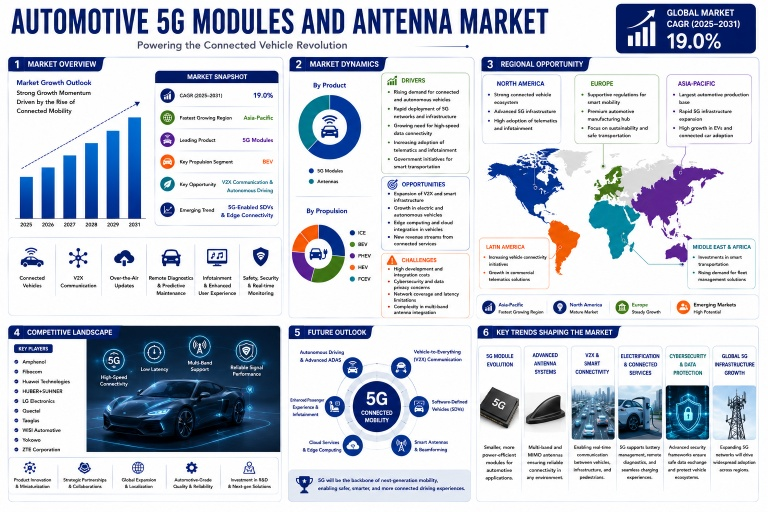
The global Automotive 5G Modules and Antenna Market is witnessing strong growth driven by rising adoption of connected vehicles, increasing demand for real-time vehicle communication, and growing deployment of advanced driver assistance and autonomous driving technologies. 5G modules and antennas enable faster data transfer, low-latency communication, vehicle-to-everything connectivity, infotainment services, fleet monitoring, and remote diagnostics. As automakers shift toward software-defined and connected vehicle platforms, the market is projected to register a CAGR of 19.0% during the forecast period.
Key Growth Driver
Expansion of connected vehicle ecosystems and V2X communication is strengthening market adoption worldwide.
Automotive manufacturers are increasingly integrating 5G-enabled communication systems to support advanced navigation, over-the-air updates, cloud-based vehicle services, predictive maintenance, and enhanced passenger experiences. The growth of electric vehicles, smart mobility platforms, and intelligent traffic infrastructure is further increasing the need for reliable 5G modules and high-performance antennas. In addition, rising investments in autonomous driving and smart city projects are creating favorable opportunities for market expansion.
Segment Highlight
Product innovation and vehicle connectivity requirements continue to create strong growth opportunities.
Based on product type, 5G Modules account for a significant share of the market due to their critical role in enabling high-speed cellular connectivity, telematics, infotainment, and V2X communication. Antennas are also witnessing strong demand as vehicles require advanced multi-band, compact, and high-efficiency antenna systems to support reliable connectivity across different driving environments.
By propulsion type, BEVs represent a key growth segment due to their strong dependence on connected software platforms, battery monitoring, navigation systems, and remote vehicle services. ICE vehicles continue to adopt 5G-enabled telematics and infotainment systems, while PHEVs, HEVs, and FCEVs are expected to generate additional demand as connected mobility features become standard across vehicle categories.
Regional Opportunity
Asia-Pacific is emerging as the fastest-growing market supported by strong EV production and rapid 5G infrastructure deployment.
North America maintains a strong market presence due to advanced connected vehicle adoption, smart mobility investments, and strong presence of automotive technology companies. Europe benefits from connected mobility regulations, premium vehicle production, and growing focus on intelligent transportation systems. Meanwhile, Asia-Pacific is expected to witness accelerated growth driven by large-scale vehicle production, fast 5G rollout, expanding EV manufacturing, and growing connected car demand across China, Japan, South Korea, and India.
Competitive Landscape
Companies are focusing on compact design, signal reliability, and automotive-grade connectivity solutions.
Leading market participants are investing in high-performance 5G modules, multi-band antenna systems, V2X-compatible hardware, and ruggedized automotive-grade designs. Strategic partnerships between telecom suppliers, automotive OEMs, semiconductor providers, and mobility technology companies continue to shape the competitive landscape. Companies are also emphasizing thermal performance, network compatibility, miniaturization, and integration with advanced telematics control units.
Key companies operating in the market include Amphenol, Fibocom, Huawei Technologies, HUBER+SUHNER, LG Electronics, Quectel, Taoglas, WISI Automotive, Yokowo, and ZTE Corporation.
Historical & Forecast Period
This study report represents analysis of each segment from 2024 to 2034 considering 2025 as the base year. Compounded Annual Growth Rate (CAGR) for each of the respective segments estimated for the forecast period of 2026 to 2034.
The current report comprises of quantitative market estimations for each micro market for every geographical region and qualitative market analysis such as micro and macro environment analysis, market trends, competitive intelligence, segment analysis, porters five force model, top winning strategies, top investment markets, emerging trends and technological analysis, case studies, strategic conclusions and recommendations and other key market insights.
Research Methodology
The complete research study was conducted in three phases, namely: secondary research, primary research, and expert panel review. key data point that enables the estimation of Automotive 5G Modules and Antenna market are as follows:
Market forecast was performed through proprietary software that analyzes various qualitative and quantitative factors. Growth rate and CAGR were estimated through intensive secondary and primary research. Data triangulation across various data points provides accuracy across various analyzed market segments in the report. Application of both top down and bottom-up approach for validation of market estimation assures logical, methodical and mathematical consistency of the quantitative data.
| ATTRIBUTE | DETAILS |
|---|---|
| Research Period | 2024-2034 |
| Base Year | 2025 |
| Forecast Period | 2026-2034 |
| Historical Year | 2024 |
| Unit | USD Million |
| Segmentation | |
Product
|
|
Propulsion
|
|
Application
|
|
Vehicle
|
|
Sales Channel
|
|
|
Region Segment (2024-2034; US$ Million)
|
Frequently Asked Questions
Q1. What is driving the growth of the Automotive 5G Modules and Antenna Market?
The market is primarily driven by rising connected vehicle adoption, increasing demand for V2X communication, growth of electric vehicles, and expanding use of telematics, infotainment, and autonomous driving technologies.
Q2. What is the expected growth rate of the Automotive 5G Modules and Antenna Market?
The global Automotive 5G Modules and Antenna Market is projected to expand at a CAGR of 19.0% during the forecast period.
Q3. What are automotive 5G modules?
Automotive 5G modules are communication hardware components that enable vehicles to connect with cellular networks and support high-speed data transfer, telematics, V2X communication, remote diagnostics, and connected services.
Q4. Why are antennas important in connected vehicles?
Antennas enable stable wireless communication between vehicles, networks, satellites, devices, and roadside infrastructure. Advanced antennas help maintain connectivity across multiple frequency bands and driving conditions.
Q5. Which product segment holds a significant market share?
5G Modules hold a significant share due to their central role in enabling cellular connectivity, infotainment, telematics, and real-time vehicle communication.
Q6. Which propulsion segment is expected to create strong demand?
BEVs are expected to create strong demand because electric vehicles rely heavily on connected software systems, battery monitoring, navigation, charging support, and remote vehicle management services.
Q7. Which region is expected to witness the fastest market growth?
Asia-Pacific is expected to witness the fastest growth due to strong EV manufacturing, rapid 5G infrastructure deployment, large vehicle production volumes, and rising connected car adoption.
Q8. What technologies are influencing this market?
Key technologies include V2X communication, smart antennas, telematics control units, edge computing, autonomous driving platforms, software-defined vehicles, and automotive cybersecurity systems.
Q9. What challenges could affect market expansion?
High development costs, network coverage limitations, cybersecurity risks, integration complexity, and evolving telecom standards may affect market growth.
Q10. Who are the leading companies operating in the Automotive 5G Modules and Antenna Market?
Major companies include Amphenol, Fibocom, Huawei Technologies, HUBER+SUHNER, LG Electronics, Quectel, Taoglas, WISI Automotive, Yokowo, and ZTE Corporation.