
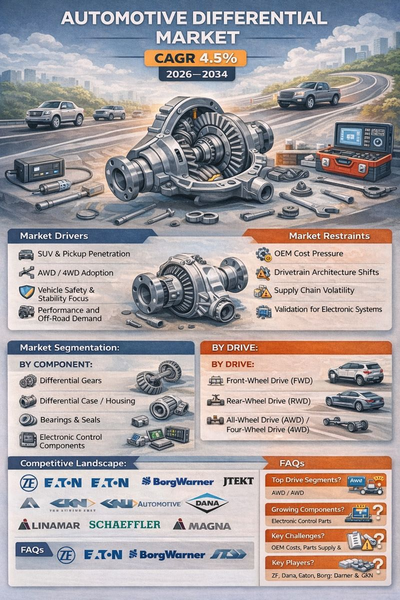
The automotive differential market is expected to grow at a CAGR of 4.5% during 2026–2034, driven by steady global vehicle production, higher penetration of SUVs and pickups, and rising adoption of AWD/4WD drivetrains in both passenger and commercial vehicles. Differentials remain core drivetrain components that enable smooth wheel-speed variation during cornering and improve traction management. Growth is also supported by increasing use of electronically controlled differentials and torque management systems, especially in performance vehicles, off-road capable models, and premium SUVs where handling and stability are key buying factors.
Market Drivers
Market growth is driven by demand for SUVs, crossovers, and light trucks, which typically show higher adoption of AWD/4WD and require robust differential assemblies. Increasing consumer focus on safety, vehicle stability, and all-weather capability is supporting drivetrain upgrades, including limited-slip and electronically controlled variants in selected segments. Electrification is also influencing the market, as many hybrid and electric platforms still require differential and gear components within e-axles and drive units, along with tighter requirements for efficiency, NVH control, and durability. In commercial vehicles, demand is supported by fleet replacement cycles and continued need for reliable driveline components to handle higher load and torque conditions. OEMs are also improving drivetrain control strategies, supporting demand for electronic control components and integration with vehicle dynamics systems.
Market Restraints
The market faces restraints from pricing pressure in high-volume vehicle platforms and ongoing cost optimization by OEMs and Tier-1 suppliers. Design shifts toward integrated e-axles and compact drive units can change the bill of materials, potentially reducing standalone differential content in certain architectures, even though differential functions remain required. Supply chain volatility for bearings, seals, and precision-machined components can impact lead times and cost. Higher complexity differentials with electronic actuation require stricter validation, software integration, and durability testing, increasing engineering and warranty risk. In addition, regional production swings and platform lifecycle changes can cause volume variability for suppliers tied to specific OEM programs.
Market Segmentation
By Component
By component, the market is segmented into differential gears, differential case/housing, bearings & seals, and electronic control components. Differential gears represent the core value and precision requirement, with demand linked to torque capacity, efficiency targets, and NVH performance. Differential case/housing remains significant due to material selection and manufacturing complexity, especially for lightweighting and thermal management needs. Bearings & seals show consistent recurring demand driven by durability requirements and replacement cycles in the aftermarket, with performance linked to friction reduction and long-life sealing. Electronic control components are a growing segment as OEMs increase adoption of electronically controlled limited-slip differentials, torque vectoring, and integration with stability and traction control systems.
By Drive
By drive, the market is segmented into front-wheel drive (FWD), rear-wheel drive (RWD), and all-wheel drive (AWD)/four-wheel drive (4WD). FWD holds strong volume share due to its dominance in passenger cars and compact SUVs, supporting stable demand for differential assemblies integrated within transaxles. RWD remains important in pickups, performance vehicles, and many commercial platforms where load handling and driveline layout requirements drive configuration. AWD/4WD is a key growth area supported by SUV and crossover penetration, increasing consumer preference for traction and safety, and broader availability of AWD variants across mid-range vehicle segments. Growth in AWD/4WD also supports higher demand for advanced differentials and electronic control features.
Regional Insights
Asia Pacific represents a major production base for passenger vehicles and SUVs, supporting high-volume demand for differential components and localized supply chains. North America shows steady demand driven by strong pickup and SUV sales and higher AWD/4WD penetration in key vehicle categories. Europe is stable to moderately growing, supported by premium vehicle production and technology-driven adoption of advanced drivetrain control solutions, along with increasing electrified drivetrain integration. Latin America shows demand linked to regional vehicle production and commercial vehicle activity, with adoption influenced by platform localization and cost sensitivity. The Middle East & Africa shows selective growth driven by SUV/4WD preference in many markets and commercial vehicle demand, with supply largely influenced by imports and regional assembly programs.
Competitive Landscape
The market is competitive and OEM-program driven, with differentiation based on durability, efficiency, NVH performance, advanced control capability, and manufacturing scale. Tier-1 suppliers compete through integrated driveline portfolios, long-term OEM relationships, and ability to deliver complete axle and differential modules with validated performance. Technology focus areas include lightweight housings, friction reduction in bearings and seals, improved thermal management, and electronic control integration for torque vectoring and traction optimization. Key strategies include expanding localized manufacturing near OEM plants, securing multi-year platform awards, investing in precision machining and validation, and increasing offerings aligned to electrified drive units and e-axle architectures.
Key companies operating in the market include ZF, Eaton, BorgWarner, JTEKT, American Axle & Manufacturing, Dana, GKN Automotive, Linamar, Schaeffler, and Magna.
Historical & Forecast Period
This study report represents analysis of each segment from 2024 to 2034 considering 2025 as the base year. Compounded Annual Growth Rate (CAGR) for each of the respective segments estimated for the forecast period of 2026 to 2034.
The current report comprises of quantitative market estimations for each micro market for every geographical region and qualitative market analysis such as micro and macro environment analysis, market trends, competitive intelligence, segment analysis, porters five force model, top winning strategies, top investment markets, emerging trends and technological analysis, case studies, strategic conclusions and recommendations and other key market insights.
Research Methodology
The complete research study was conducted in three phases, namely: secondary research, primary research, and expert panel review. key data point that enables the estimation of Automotive Differential Market By Differential, By Component, By Vehicle, By Drive, By Propulsion, By Sales Channel - Growth, Share, Opportunities & Competitive Analysis, 2026 - 2034 market are as follows:
Market forecast was performed through proprietary software that analyzes various qualitative and quantitative factors. Growth rate and CAGR were estimated through intensive secondary and primary research. Data triangulation across various data points provides accuracy across various analyzed market segments in the report. Application of both top down and bottom-up approach for validation of market estimation assures logical, methodical and mathematical consistency of the quantitative data.
| ATTRIBUTE | DETAILS |
|---|---|
| Research Period | 2024-2034 |
| Base Year | 2025 |
| Forecast Period | 2026-2034 |
| Historical Year | 2024 |
| Unit | USD Million |
| Segmentation | |
Differential
|
|
Vehicle
|
|
Drive
|
|
Propulsion
|
|
Sales Channel
|
|
|
Region Segment (2024-2034; US$ Million)
|
Frequently Asked Questions
What is the growth outlook for the automotive differential market?
The market is expected to grow at a CAGR of 4.5% during 2026–2034, supported by steady vehicle production and rising AWD/4WD adoption.
Which drive segment is supporting market growth?
AWD/4WD is a key growth segment due to higher SUV and pickup penetration and increasing availability of AWD variants.
Which component segment is growing in importance?
Electronic control components are growing as vehicles adopt electronically controlled differentials and torque management features.
What are the key challenges in this market?
Key challenges include OEM cost pressure, supply chain volatility for precision parts, higher validation needs for electronically controlled systems, and architecture shifts toward integrated drive units.
Who are the key players in this market?
Key participants include ZF, Dana, Eaton, BorgWarner, GKN Automotive, American Axle & Manufacturing, JTEKT, Schaeffler, Magna, and Linamar.


