
The automotive digital factory automation market is growing at a 10.4% CAGR as vehicle manufacturers and Tier-1 suppliers move toward connected, data-driven plants to improve productivity, quality, and flexibility. As product mixes shift to electric and hybrid vehicles and model lifecycles shorten, traditional fixed automation is no longer sufficient. Digital factory automation, built on robotics, industrial IoT, AI, digital twins, and cloud-based systems, enables faster changeovers, real-time quality control, and better coordination between engineering and production.
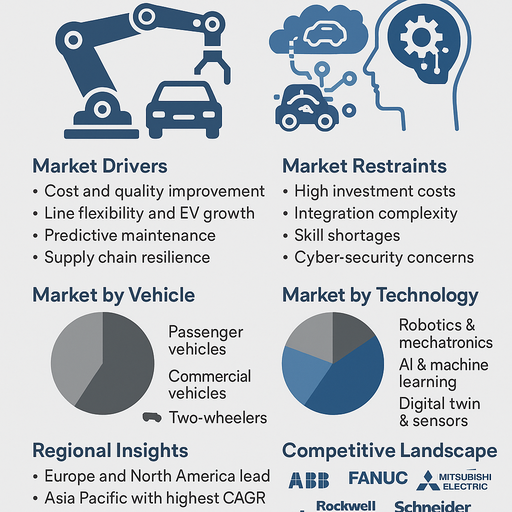
Market Drivers
Growth is driven by the need to reduce production costs, improve line flexibility, and raise quality in a competitive automotive environment. OEMs are under pressure to launch more variants, including EVs and hybrids, without expanding footprint or headcount, and digital factory automation allows robots, conveyors, and test equipment to be reprogrammed quickly and coordinated through centralized control and MES systems. Real-time data from connected assets supports predictive maintenance, which lowers unplanned downtime and maintenance costs, while stricter quality and safety standards for powertrains, batteries, and driver assistance systems push the use of automated inspection, vision systems, and closed-loop control to reduce defects. Supply chain disruptions, regionalization strategies, and the need to build flexible capacity closer to demand further encourage investment in digital factory tools that keep plants productive across different volumes and model mixes.
Market Restraints
Adoption is restrained by high upfront investment, integration complexity, and skill shortages. Full digital factory deployments require capital spending on robots, controllers, sensors, software, networks, and cyber-security measures, which can be difficult to justify in plants with older equipment or uncertain volumes. Integrating new digital systems with legacy PLCs, SCADA, MES, and ERP platforms is technically complex and carries risk for ongoing production. Many plants lack engineers with experience in industrial networking, data analytics, AI, and digital twin modeling, increasing dependence on external integrators and lengthening project timelines. Concerns about cyber-security, data ownership, and cloud connectivity also slow decision-making, and in smaller plants or supplier tiers with tight margins, low-cost manual processes and traditional automation continue to compete with digital factory investments.
Market by Vehicle
Passenger vehicles represent the largest revenue segment in the automotive digital factory automation market because high production volumes, frequent model updates, and complex trim and option combinations push OEMs to deploy advanced robotics, flexible body-in-white lines, automated paint shops, and digital quality systems at scale, while commercial vehicles and two-wheelers start from smaller installed bases but are expected to post the highest CAGR as truck, bus, and two-wheeler manufacturers adopt modular platforms, increase EV output, and introduce more robotics, AGVs, and digital planning tools to standardize assembly, improve traceability, and bring consistency to welding, painting, engine and e-powertrain assembly, and end-of-line testing.
Market by Technology
Robotics and mechatronics account for the highest revenue share in the automotive digital factory automation market because articulated robots, gantries, conveyors, and mechatronic modules form the core of automated welding, painting, sealing, handling, and assembly operations, while AI and machine learning together with digital twin and simulation technologies are expected to record the highest CAGR as manufacturers increasingly use AI models for predictive maintenance, anomaly detection, and vision inspection, and rely on digital twins to simulate robot paths, line balancing, and material flow before physical changes, supported by industrial IoT and sensors that feed real-time data into cloud and edge computing platforms for continuous monitoring, analytics, and cross-plant performance optimization.
Regional Insights
Europe and North America are early adopters of automotive digital factory automation, supported by strong OEM and Tier-1 presence, established robotics and automation suppliers, and a focus on high productivity and quality across body-in-white, paint, final assembly, and powertrain lines, including new EV and battery plants that are designed around high levels of automation and data capture. Asia Pacific is expected to record one of the highest CAGRs, driven by large automotive production bases in China, Japan, South Korea, India, and Southeast Asia, where many greenfield plants and EV factories are built with digital architectures from the outset, using high robot density, advanced IoT connectivity, and centralized control systems. Other regions such as Latin America and Eastern Europe are gradually increasing investments as global OEMs upgrade regional plants to support new platforms and electrified models, with the depth of digital factory deployment often depending on the plant role in the global network, local labor costs, and the mix of vehicles produced.
Competitive Landscape
ABB, FANUC, Mitsubishi Electric, Rockwell Automation, Schneider Electric, Siemens, and Yokogawa Electric provide core automation platforms, robotics, PLCs, drives, safety systems, and control software that form the backbone of automotive digital factories, and increasingly bundle these with MES, analytics, and digital twin solutions. Emerson Electric and Honeywell International contribute advanced control systems, industrial software, and energy and utility management solutions used in paint shops, powertrain lines, and plant utilities, helping optimize process-intensive sections and reduce energy use. JR Automation Technologies acts as a system integrator, delivering turnkey welding, assembly, testing, and material handling cells that combine robots, fixtures, conveyors, and controls into ready-to-run modules for OEMs and Tier-1 suppliers. Across the competitive landscape, vendors are moving from standalone products to integrated digital factory platforms that connect robotics, controls, IoT connectivity, analytics, and lifecycle services; companies that offer open architectures, strong support for EV and battery manufacturing, and smooth integration with existing plant IT/OT environments are positioned to lead revenue, while those that build advanced AI, digital twin, and cloud–edge solutions on top of their automation portfolios are likely to capture the highest CAGR in the automotive digital factory automation market.
Historical & Forecast Period
This study report represents analysis of each segment from 2024 to 2034 considering 2025 as the base year. Compounded Annual Growth Rate (CAGR) for each of the respective segments estimated for the forecast period of 2026 to 2034.
The current report comprises of quantitative market estimations for each micro market for every geographical region and qualitative market analysis such as micro and macro environment analysis, market trends, competitive intelligence, segment analysis, porters five force model, top winning strategies, top investment markets, emerging trends and technological analysis, case studies, strategic conclusions and recommendations and other key market insights.
Research Methodology
The complete research study was conducted in three phases, namely: secondary research, primary research, and expert panel review. key data point that enables the estimation of Automotive Digital Factory Automation Market By Component, By Vehicle, By Technology, By Application, By End Use - Global Market Analysis & Forecast, 2025 to 2033 market are as follows:
Market forecast was performed through proprietary software that analyzes various qualitative and quantitative factors. Growth rate and CAGR were estimated through intensive secondary and primary research. Data triangulation across various data points provides accuracy across various analyzed market segments in the report. Application of both top down and bottom-up approach for validation of market estimation assures logical, methodical and mathematical consistency of the quantitative data.
| ATTRIBUTE | DETAILS |
|---|---|
| Research Period | 2024-2034 |
| Base Year | 2025 |
| Forecast Period | 2026-2034 |
| Historical Year | 2024 |
| Unit | USD Million |
| Segmentation | |
Component
|
|
Vehicle
|
|
Technology
|
|
Application
|
|
End Use
|
|
|
Region Segment (2024-2034; US$ Million)
|
Key questions answered in this report


