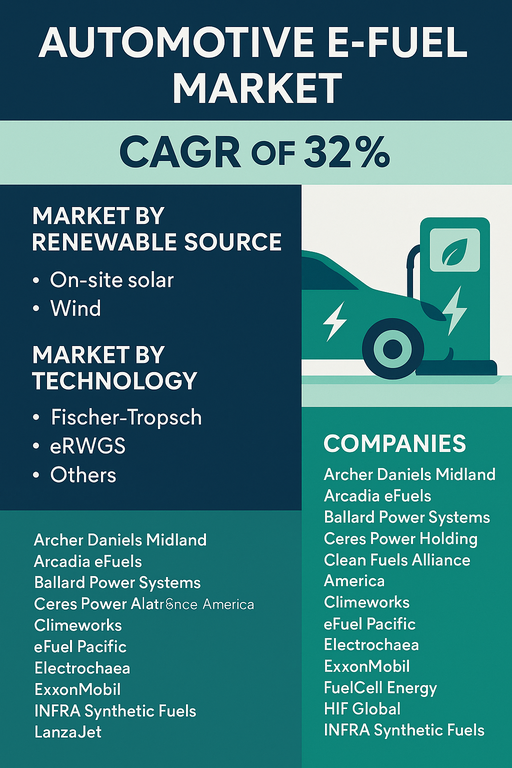
The automotive e-fuel market is projected to grow at a CAGR of 32% from 2026 to 2034, driven by the global transition toward decarbonized mobility, increasing regulatory mandates on carbon neutrality, and advancements in renewable energy integration and fuel synthesis technologies. E-fuels produced from renewable electricity, water, and captured CO₂ are positioned as a sustainable alternative to traditional fossil fuels for internal combustion engines, offering compatibility with existing fueling infrastructure and long-haul transport requirements.
Market Drivers
Global Decarbonization Policies and ICE Carbon Neutrality Goals
As countries set net-zero carbon targets, e-fuels provide a viable path to decarbonize the existing internal combustion engine (ICE) fleet. The European Union, Japan, and Germany are supporting e-fuel pilot projects and regulatory frameworks to ensure that low-carbon liquid fuels can play a complementary role alongside electrification in achieving climate targets.
Compatibility with Existing Infrastructure and ICE Fleets
Unlike electric vehicles that require major infrastructure overhauls, e-fuels are drop-in replacements compatible with current refueling stations and engines. This makes them particularly attractive for legacy vehicles, aviation, motorsport, and heavy-duty applications where electrification remains technically or economically challenging.
Advancements in Renewable Power-to-Liquid Technologies
Emerging electrolysis, CO₂ capture, and fuel synthesis technologies such as Fischer-Tropsch and eRWGS are becoming more scalable and cost-competitive, especially when paired with low-cost renewable electricity sources such as solar and wind. These innovations are enabling commercial-scale e-fuel production with significantly reduced carbon intensity.
Market Restraint
High Production Costs and Limited Commercialization
Despite strong potential, e-fuels remain significantly more expensive than fossil fuels and even many alternative fuels. The reliance on high-purity CO₂ capture, electrolysis infrastructure, and multi-step synthesis pathways drives up production costs. As of 2025, commercial-scale production is limited to pilot or demonstration facilities, which restricts short-term adoption and scalability.
Market Segmentation by Renewable Source
The renewable source segment includes On-site Solar and Wind. In 2025, on-site solar projects dominated pilot-scale implementations due to their modularity and suitability for decentralized fuel production in sun-rich regions. However, wind-powered e-fuel plants especially in coastal and high-latitude regions such as Northern Europe and Patagonia are expected to grow rapidly owing to more consistent energy yields, which enhance fuel plant efficiency and grid integration.
Market Segmentation by Technology
By technology, the market is segmented into Fischer-Tropsch, eRWGS (electroreduction of water-gas shift), and Others. The Fischer-Tropsch process held the largest market share in 2025, benefiting from maturity, scalability, and wide compatibility with existing fuel supply chains. The eRWGS segment is projected to grow at the fastest rate from 2026 to 2034, supported by its direct conversion efficiency in synthesizing syngas from water and captured CO₂. Other technologies include novel thermochemical processes, catalytic hydrogenation, and microbial conversion systems in early development stages.
Geographic Trends
In 2025, Europe led the automotive e-fuel market due to strong policy support, high fuel taxes, and aggressive decarbonization targets. Germany, Norway, and Denmark are actively hosting pilot plants and scaling renewable hydrogen projects to support e-fuel synthesis. From 2026 to 2034, Asia Pacific is expected to witness the highest CAGR, driven by increasing interest from Japan, South Korea, and China to decarbonize hard-to-electrify segments such as shipping and heavy-duty transport. North America also shows strong potential with developments in the U.S. and Canada leveraging renewable energy assets and clean fuel mandates. Latin America and Middle East & Africa are emerging as production hubs for green hydrogen and synthetic fuels, leveraging abundant solar and wind resources.
Competitive Trends
In 2025, the e-fuel industry landscape was led by partnerships between renewable energy developers, oil & gas majors, and advanced fuel technology firms. HIF Global, Liquid Wind, Norsk e-Fuel, and Sunfire were pioneers in building e-methanol and e-gasoline pilot plants across Europe and South America. Porsche invested heavily in e-fuel development for motorsports and performance vehicles. Archer Daniels Midland, LanzaJet, and Clean Fuels Alliance America focused on integrating biomass-based CO₂ sources with renewable hydrogen. ExxonMobil, MAN Energy Solutions, and INFRA Synthetic Fuels explored scalability and downstream integration through existing fuel networks. Electrochaea, Climeworks, and Ballard Power Systems contributed to CO₂ capture and renewable hydrogen generation, while Ceres Power, FuelCell Energy, and eFuel Pacific worked on electrochemical platforms and electrolyzer solutions. Strategic efforts are expected to center on improving fuel economics, securing long-term power purchase agreements (PPAs), and scaling production capacity through government-supported consortia.
Historical & Forecast Period
This study report represents analysis of each segment from 2024 to 2034 considering 2025 as the base year. Compounded Annual Growth Rate (CAGR) for each of the respective segments estimated for the forecast period of 2026 to 2034.
The current report comprises of quantitative market estimations for each micro market for every geographical region and qualitative market analysis such as micro and macro environment analysis, market trends, competitive intelligence, segment analysis, porters five force model, top winning strategies, top investment markets, emerging trends and technological analysis, case studies, strategic conclusions and recommendations and other key market insights.
Research Methodology
The complete research study was conducted in three phases, namely: secondary research, primary research, and expert panel review. key data point that enables the estimation of Automotive E-Fuel market are as follows:
Market forecast was performed through proprietary software that analyzes various qualitative and quantitative factors. Growth rate and CAGR were estimated through intensive secondary and primary research. Data triangulation across various data points provides accuracy across various analyzed market segments in the report. Application of both top down and bottom-up approach for validation of market estimation assures logical, methodical and mathematical consistency of the quantitative data.
| ATTRIBUTE | DETAILS |
|---|---|
| Research Period | 2024-2034 |
| Base Year | 2025 |
| Forecast Period | 2026-2034 |
| Historical Year | 2024 |
| Unit | USD Million |
| Segmentation | |
Renewable Source
|
|
Technology
|
|
Product
|
|
|
Region Segment (2024-2034; US$ Million)
|
Key questions answered in this report