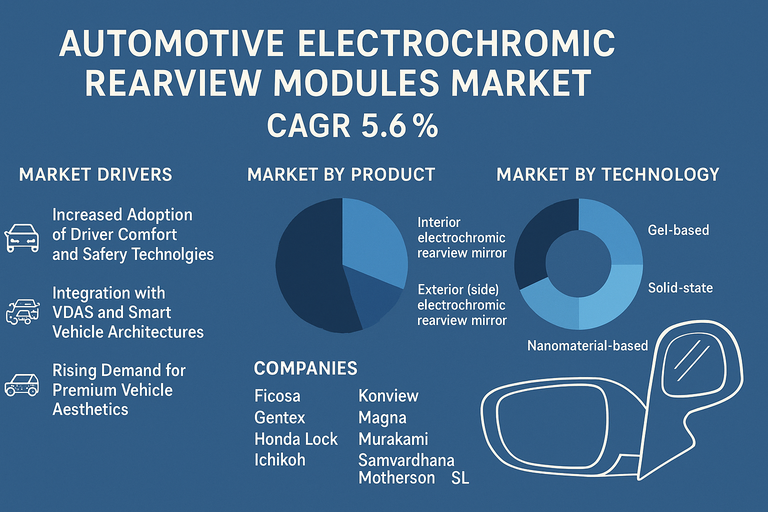
The automotive electrochromic rearview modules market is projected to grow at a CAGR of 5.6% from 2026 to 2034, supported by the rising demand for smart safety systems, premium vehicle features, and driver comfort. Electrochromic rearview modules provide automatic dimming functionality to reduce glare from trailing vehicle headlights, improving visibility and reducing driver fatigue. As automakers focus on enhancing cabin ergonomics and integrating ADAS (Advanced Driver Assistance Systems), electrochromic mirrors are becoming a key component in modern automotive design, especially in mid- to high-end passenger vehicles.
Market Drivers
Increased Adoption of Driver Comfort and Safety Technologies
Electrochromic rearview mirrors improve driving safety by automatically adjusting mirror tint levels based on ambient lighting conditions. This reduces glare at night and enhances visibility, thereby minimizing the risk of accidents. The growing emphasis on enhancing driver comfort and reducing distractions has led to rising adoption, particularly in developed automotive markets.
Integration with ADAS and Smart Vehicle Architectures
Electrochromic rearview modules are increasingly being integrated with sensors, displays, and cameras to support features such as blind-spot detection, rearview video feeds, and automatic parking assistance. These multi-functional modules are aligned with the automotive industry’s transition toward connected and autonomous vehicles, where interior and exterior mirrors serve as sensor hubs and display interfaces.
Rising Demand for Premium Vehicle Aesthetics
As automakers compete on design and user experience, electrochromic mirrors add a premium, high-tech appeal to both interiors and exteriors. These mirrors complement the sleek styling of modern vehicles while offering minimalistic integration with electronic control units (ECUs) and touch interfaces. Premium electric vehicles and luxury SUVs are increasingly offering electrochromic mirrors as a standard or optional feature.
Market Restraint
Higher Cost Compared to Conventional Mirrors
The cost of electrochromic rearview mirrors remains significantly higher than standard manual or day/night mirrors due to the inclusion of specialized coatings, sensors, and electronic control systems. This cost differential limits adoption in entry-level vehicle segments, especially in cost-sensitive regions. Additionally, repair and replacement costs post-collision are higher, potentially deterring insurance providers and aftermarket upgrades.
Market Segmentation by Product
The product segment includes Interior Electrochromic Rearview Mirrors, Exterior (Side) Electrochromic Rearview Mirrors, and Integrated Rearview Modules with Sensors/Displays. In 2025, interior mirrors held the largest market share due to their widespread adoption in mid-range and premium vehicles. Exterior mirrors, although gaining traction, face slower growth due to exposure to environmental conditions and regulatory complexity. However, integrated modules with displays and sensors are expected to witness the fastest growth from 2026 to 2034, driven by the shift toward smart, multifunctional automotive systems.
Market Segmentation by Technology
The technology segment includes Gel-based, Solid-state, and Nanomaterial-based electrochromic solutions. Gel-based mirrors accounted for the highest share in 2025, owing to their proven performance, cost-effectiveness, and ease of manufacturing. Solid-state technology, offering faster switching speeds and improved durability, is gaining ground, particularly in high-end applications. Nanomaterial-based solutions, although still in early stages of commercialization, are projected to exhibit the highest CAGR due to their potential for improved clarity, longer life span, and enhanced design flexibility.
Geographic Trends
In 2025, North America led the market in revenue terms, primarily due to strong automotive production in the U.S. and high penetration of electrochromic rearview mirrors in luxury and electric vehicles. Europe followed, with stringent automotive safety standards and strong demand for premium vehicle features in Germany, France, and the UK. From 2026 to 2034, Asia Pacific is projected to register the highest CAGR, supported by rapid vehicle electrification, rising consumer income levels, and expanding automotive OEM production in China, Japan, South Korea, and India. Latin America and Middle East & Africa represent emerging markets, with slow but steady adoption in upper-tier vehicle segments.
Competitive Trends
In 2025, the market was moderately consolidated with key players focusing on innovation, OEM partnerships, and vertical integration. Gentex, a pioneer in automotive electrochromic mirror technologies, maintained a dominant position through continuous product innovation and strong OEM relationships across the U.S., Europe, and Japan. Ficosa and Magna expanded their electrochromic offerings as part of their smart mirror and camera-integrated solutions. Murakami, Samvardhana Motherson, and SL catered to the Asia Pacific market, leveraging local manufacturing and supply chain strengths. Ichikoh, Honda Lock, and Konview focused on OEM-specific customization, particularly for Japanese and Korean vehicle brands. Moving forward, technology differentiation, adoption of nanomaterials, and integration with augmented reality (AR) and camera displays are expected to define the next wave of competition in the sector.
Historical & Forecast Period
This study report represents analysis of each segment from 2024 to 2034 considering 2025 as the base year. Compounded Annual Growth Rate (CAGR) for each of the respective segments estimated for the forecast period of 2026 to 2034.
The current report comprises of quantitative market estimations for each micro market for every geographical region and qualitative market analysis such as micro and macro environment analysis, market trends, competitive intelligence, segment analysis, porters five force model, top winning strategies, top investment markets, emerging trends and technological analysis, case studies, strategic conclusions and recommendations and other key market insights.
Research Methodology
The complete research study was conducted in three phases, namely: secondary research, primary research, and expert panel review. key data point that enables the estimation of Automotive Electrochromic Rearview Modules market are as follows:
Market forecast was performed through proprietary software that analyzes various qualitative and quantitative factors. Growth rate and CAGR were estimated through intensive secondary and primary research. Data triangulation across various data points provides accuracy across various analyzed market segments in the report. Application of both top down and bottom-up approach for validation of market estimation assures logical, methodical and mathematical consistency of the quantitative data.
| ATTRIBUTE | DETAILS |
|---|---|
| Research Period | 2024-2034 |
| Base Year | 2025 |
| Forecast Period | 2026-2034 |
| Historical Year | 2024 |
| Unit | USD Million |
| Segmentation | |
Product
|
|
Vehicle
|
|
Technology
|
|
Sales Channel
|
|
|
Region Segment (2024-2034; US$ Million)
|
Key questions answered in this report