
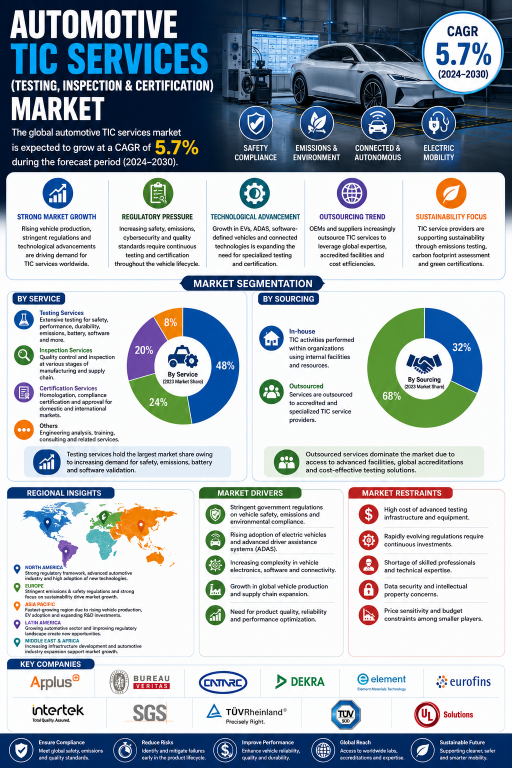
The global Automotive Testing, Inspection, and Certification (TIC) Services Market is expected to grow at a CAGR of 5.7% during the forecast period. Market growth is being driven by increasingly stringent vehicle safety regulations, growing adoption of electric and autonomous vehicles, rising emissions compliance requirements, and expanding vehicle production worldwide. Automotive TIC services help manufacturers ensure product quality, regulatory compliance, performance validation, and safety standards throughout the vehicle lifecycle. The growing complexity of modern vehicles, particularly those equipped with advanced electronics, software, connectivity, and battery systems, is further fueling demand for TIC services.
Market Drivers
Increasing Regulatory Compliance and Vehicle Safety Requirements
Governments and regulatory agencies worldwide continue to strengthen vehicle safety, cybersecurity, emissions, and environmental regulations. Automotive manufacturers increasingly rely on TIC service providers to validate compliance with evolving standards and homologation requirements. The expansion of electric vehicles (EVs), advanced driver assistance systems (ADAS), connected vehicles, and autonomous technologies is creating significant demand for specialized testing and certification services.
Market Restraints
High Cost of Advanced Testing Infrastructure
Modern vehicle technologies require sophisticated testing facilities, specialized equipment, simulation environments, and highly trained personnel. Establishing and maintaining such infrastructure requires significant investment. Smaller manufacturers and suppliers may face challenges in managing testing costs, while evolving regulations often necessitate continuous upgrades to testing capabilities.
Automotive TIC Services Market Trends
The market is witnessing growing demand for EV battery testing, cybersecurity validation, software verification, autonomous vehicle assessment, and connected vehicle certification. Digital testing technologies, virtual simulation platforms, artificial intelligence-based validation tools, and remote inspection services are becoming increasingly important. TIC providers are also expanding capabilities in sustainability certification, carbon footprint assessment, and lifecycle compliance services to support industry decarbonization initiatives.
Market Segmentation
By Service
Based on service, the market is segmented into Testing Services, Inspection Services, Certification Services, and Others. Testing services account for the largest market share due to extensive requirements for safety validation, emissions testing, battery performance evaluation, crash testing, durability assessment, and software verification. Inspection services continue to witness strong demand for manufacturing quality control and regulatory compliance. Certification services remain critical for vehicle homologation, market approval, and international trade requirements.
By Sourcing
Based on sourcing, the market is segmented into In-house and Outsourced. Outsourced TIC services hold a significant market share due to the specialized expertise, accredited facilities, and cost efficiencies offered by independent testing organizations. In-house testing remains important among major automotive OEMs that require dedicated validation capabilities for product development, research, and proprietary technology assessment.
Regional Insights
North America represents a significant market due to stringent vehicle safety standards, strong automotive manufacturing activity, and increasing investments in electric and autonomous vehicle development. Europe remains a leading market driven by rigorous regulatory frameworks, emissions standards, and advanced automotive engineering capabilities. Asia Pacific is expected to witness the fastest growth owing to expanding vehicle production, growing EV adoption, and increasing investments in automotive research and development across China, Japan, South Korea, and India. Latin America and the Middle East & Africa are experiencing steady growth supported by rising vehicle sales, industrial development, and regulatory modernization initiatives.
Competitive Landscape
The automotive TIC services market is highly competitive, with leading companies focusing on advanced testing technologies, global accreditation capabilities, digital validation platforms, and specialized expertise in emerging automotive technologies. Strategic acquisitions, laboratory expansion, EV testing investments, and cybersecurity assessment services remain key competitive strategies. Companies are increasingly developing integrated service portfolios covering testing, inspection, certification, compliance, and homologation support.
Key companies operating in the market include Applus+, Bureau Veritas, CATARC, DEKRA, Element Materials Technology, Eurofins, Intertek, SGS, TUV Rheinland, TUV SUD, and UL Solutions.
Automotive TIC Services Industry News
The industry is witnessing significant investments in electric vehicle battery testing facilities, autonomous vehicle validation centers, and cybersecurity assessment laboratories. TIC providers are expanding capabilities in software testing, functional safety certification, and connected vehicle compliance services. The growing adoption of digital twins, virtual testing platforms, and AI-powered validation tools is helping improve testing efficiency and reduce product development timelines.
Historical & Forecast Period
This study report represents analysis of each segment from 2024 to 2034 considering 2025 as the base year. Compounded Annual Growth Rate (CAGR) for each of the respective segments estimated for the forecast period of 2026 to 2034.
The current report comprises of quantitative market estimations for each micro market for every geographical region and qualitative market analysis such as micro and macro environment analysis, market trends, competitive intelligence, segment analysis, porters five force model, top winning strategies, top investment markets, emerging trends and technological analysis, case studies, strategic conclusions and recommendations and other key market insights.
Research Methodology
The complete research study was conducted in three phases, namely: secondary research, primary research, and expert panel review. key data point that enables the estimation of Automotive TIC Services Market - Growth, Share, Opportunities & Competitive Analysis, 2026 - 2034 market are as follows:
Market forecast was performed through proprietary software that analyzes various qualitative and quantitative factors. Growth rate and CAGR were estimated through intensive secondary and primary research. Data triangulation across various data points provides accuracy across various analyzed market segments in the report. Application of both top down and bottom-up approach for validation of market estimation assures logical, methodical and mathematical consistency of the quantitative data.
| ATTRIBUTE | DETAILS |
|---|---|
| Research Period | 2024-2034 |
| Base Year | 2025 |
| Forecast Period | 2026-2034 |
| Historical Year | 2024 |
| Unit | USD Million |
| Segmentation | |
Service
|
|
Sourcing
|
|
Vehicle
|
|
Application
|
|
|
Region Segment (2024-2034; US$ Million)
|
Frequently Asked Questions
What is the expected growth rate of the automotive TIC services market?
The market is expected to grow at a CAGR of 5.7% during the forecast period.
Which service segment holds the largest market share?
Testing services hold the largest market share due to extensive requirements for vehicle safety, emissions, performance, battery, and software validation.
Which sourcing segment dominates the market?
Outsourced TIC services account for a significant share due to access to accredited facilities, specialized expertise, and cost-effective testing capabilities.
What are the major growth drivers?
Key growth drivers include stringent safety regulations, rising EV adoption, increasing vehicle complexity, growing demand for autonomous technologies, and expanding compliance requirements.
Who are the major companies operating in the market?
Major companies include Applus+, Bureau Veritas, CATARC, DEKRA, Element Materials Technology, Eurofins, Intertek, SGS, TÜV Rheinland, TUV SUD, and UL Solutions.


