
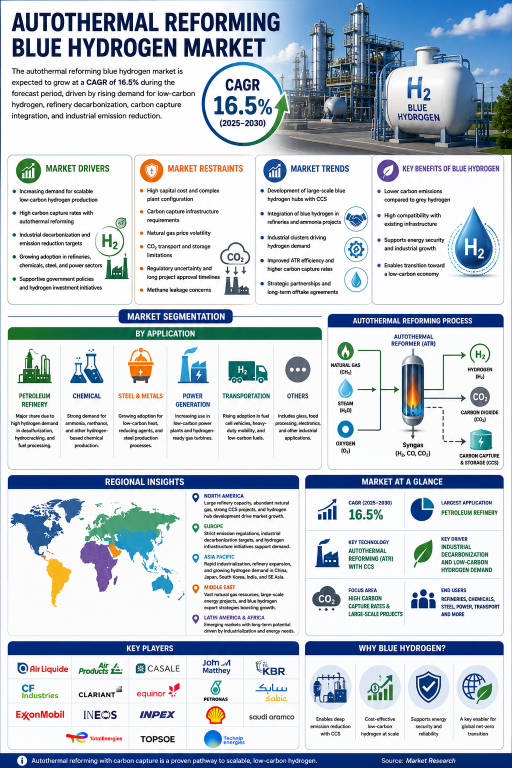
The autothermal reforming blue hydrogen market is expected to grow at a CAGR of 16.5% during the forecast period, driven by rising demand for low-carbon hydrogen, refinery decarbonization, carbon capture integration, and industrial emission reduction.
Market Drivers
The market is mainly driven by increasing demand for scalable low-carbon hydrogen production. Autothermal reforming is gaining attention because it can produce hydrogen at large scale while allowing high carbon capture rates.
Refineries, chemical producers, steel plants, and power generators are adopting blue hydrogen to reduce carbon intensity without fully shifting away from existing natural gas-based infrastructure.
Market Restraints
The market faces challenges related to high capital cost, carbon capture infrastructure needs, natural gas price volatility, and CO₂ transport and storage limitations.
Regulatory uncertainty, methane leakage concerns, and long project approval timelines may also affect investment decisions.
Market Trends
The market is witnessing increasing development of large-scale blue hydrogen hubs linked with carbon capture and storage.
Industrial clusters, refinery hydrogen replacement, ammonia production, and low-carbon fuel projects are key trends. Technology providers are focusing on improving reformer efficiency, carbon capture rates, and project economics.
Market Segmentation
By Application
By application, the market is segmented into petroleum refinery, chemical, steel & metals, power generation, transportation, and others.
Petroleum refinery holds a major share due to high hydrogen consumption in desulfurization, hydrocracking, and fuel processing. Chemical applications are also significant, supported by ammonia, methanol, and other hydrogen-based chemical production.
Steel & metals are expected to grow strongly as producers explore low-carbon fuel and reducing agents. Power generation and transportation are emerging applications as hydrogen use expands in clean power, fuel cells, and low-carbon mobility.
Regional Insights
North America holds a significant share due to large refinery capacity, natural gas availability, carbon capture projects, and hydrogen hub development.
Europe is driven by industrial decarbonization targets, strict emission policies, and hydrogen infrastructure planning. Asia Pacific is expected to witness strong growth due to refinery expansion, chemical production, and rising hydrogen demand in Japan, South Korea, China, India, and Southeast Asia.
The Middle East is becoming an important market due to large-scale energy projects, natural gas resources, and blue hydrogen export plans. Latin America and Africa are emerging markets with long-term growth potential.
Competitive Landscape
The autothermal reforming blue hydrogen market is competitive, with companies focusing on reforming technology, carbon capture integration, large-scale project execution, hydrogen purity, and cost efficiency.
Competition is based on plant scale, capture rate, energy efficiency, gas feedstock access, project partnerships, and end-user offtake agreements.
Key companies operating in the market include Air Liquide, Air Products, Casale, CF Industries, Clariant AG, Equinor, ExxonMobil, Ineos, INPEX, Johnson Matthey, KBR, Linde, Petronas, SABIC, Saudi Aramco, Shell, Sinopec, Technip Energies, Topsoe, and TotalEnergies.
Autothermal Reforming Blue Hydrogen Industry News
The industry is witnessing increasing investment in blue hydrogen production plants, carbon capture facilities, hydrogen hubs, and low-carbon ammonia projects.
Energy companies, industrial gas suppliers, and technology licensors are forming partnerships to develop integrated hydrogen and carbon storage value chains.
Historical & Forecast Period
This study report represents analysis of each segment from 2024 to 2034 considering 2025 as the base year. Compounded Annual Growth Rate (CAGR) for each of the respective segments estimated for the forecast period of 2026 to 2034.
The current report comprises of quantitative market estimations for each micro market for every geographical region and qualitative market analysis such as micro and macro environment analysis, market trends, competitive intelligence, segment analysis, porters five force model, top winning strategies, top investment markets, emerging trends and technological analysis, case studies, strategic conclusions and recommendations and other key market insights.
Research Methodology
The complete research study was conducted in three phases, namely: secondary research, primary research, and expert panel review. key data point that enables the estimation of Autothermal Reforming Blue Hydrogen Market - Growth, Share, Opportunities & Competitive Analysis, 2026 - 2034 market are as follows:
Market forecast was performed through proprietary software that analyzes various qualitative and quantitative factors. Growth rate and CAGR were estimated through intensive secondary and primary research. Data triangulation across various data points provides accuracy across various analyzed market segments in the report. Application of both top down and bottom-up approach for validation of market estimation assures logical, methodical and mathematical consistency of the quantitative data.
| ATTRIBUTE | DETAILS |
|---|---|
| Research Period | 2024-2034 |
| Base Year | 2025 |
| Forecast Period | 2026-2034 |
| Historical Year | 2024 |
| Unit | USD Million |
| Segmentation | |
Application
|
|
|
Region Segment (2024-2034; US$ Million)
|
Frequently Asked Questions
What is the growth outlook for the autothermal reforming blue hydrogen market?
The market is expected to grow at a CAGR of 16.5% during the forecast period.
Which application holds a major share?
Petroleum refinery holds a major share due to high hydrogen demand in fuel processing.
What are the major growth drivers?
Refinery decarbonization, carbon capture integration, industrial emission reduction, and low-carbon hydrogen demand are major growth drivers.
What are the major challenges?
High capital cost, carbon capture infrastructure requirements, natural gas price volatility, and CO₂ storage limitations are key challenges.
Who are the key players?
Major companies include Air Liquide, Air Products, ExxonMobil, Johnson Matthey, KBR, Linde, Shell, Technip Energies, Topsoe, TotalEnergies, Saudi Aramco, and Sinopec.


