
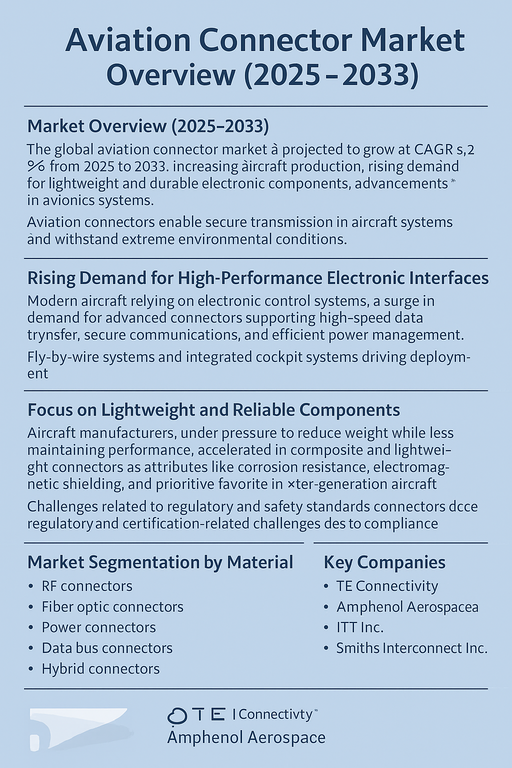
The global aviation connector market is projected to grow at a CAGR of 5.2% from 2026 to 2034, driven by increasing aircraft production, rising demand for lightweight and durable electronic components, and advancements in avionics systems. Aviation connectors are critical components that enable secure transmission of signals, data, and power across aircraft systems. They are engineered to withstand extreme environmental conditions such as high altitudes, vibrations, and temperature fluctuations, making them essential for commercial, military, and private aircraft applications.
Rising Demand for High-Performance Electronic Interfaces
As modern aircraft increasingly rely on electronic control systems, the demand for advanced connectors that support high-speed data transfer, secure communications, and efficient power management has surged. From in-flight entertainment systems to critical avionics, connectors play a key role in ensuring seamless functionality. Furthermore, the adoption of fly-by-wire systems, real-time diagnostics, and integrated cockpit systems is driving the deployment of advanced connector types capable of supporting complex signal and data transmission.
Focus on Lightweight and Reliable Components
Aircraft manufacturers are under continuous pressure to reduce weight while maintaining performance and safety standards. This has accelerated the adoption of composite and lightweight connectors that help minimize fuel consumption and increase payload capacity. Composite/plastic connectors offer advantages such as corrosion resistance, electromagnetic shielding, and reduced installation complexity. These attributes are increasingly favored in next-generation aircraft designs, especially in single-aisle commercial and unmanned aerial platforms. Meanwhile, metal connectors continue to be used where high mechanical strength and thermal performance are required, particularly in defense and high-load systems.
Challenges Related to Regulatory and Safety Standards
Despite strong growth potential, the aviation connector market faces regulatory and certification-related challenges. Connectors must comply with stringent aerospace standards such as DO-160, MIL-DTL, and ARINC, which govern performance under shock, vibration, humidity, and EMI conditions. The cost and time associated with developing and certifying compliant products can be a barrier to new entrants and innovation. Additionally, long product lifecycle requirements and high reliability expectations limit the pace of design changes, which may restrict faster adoption of emerging technologies in certain segments.
Market Segmentation by Product Type
By product type, the market is segmented into RF connectors, fiber optic connectors, power connectors, data bus connectors, and hybrid connectors. In 2025, RF and power connectors held the largest market share due to their essential role in navigation, communication, and propulsion control systems. Fiber optic connectors are expected to grow at the fastest rate during the forecast period, owing to their superior data transfer capabilities, EMI resistance, and increasing use in advanced avionics and in-flight systems. Hybrid connectors, combining power and signal functionalities, are also gaining traction in space-constrained applications such as drones and modern cockpit systems.
Market Segmentation by Material
Based on material, the market is segmented into metal and composite/plastic connectors. Metal connectors dominated in 2025 due to their robust mechanical and thermal properties, making them ideal for mission-critical military and aerospace applications. However, composite/plastic connectors are projected to witness higher growth from 2026 to 2034, especially in commercial aviation and lightweight unmanned aerial systems. These connectors are increasingly being adopted due to their ease of manufacturing, weight benefits, and resistance to corrosion and chemicals.
Regional Market Insights
North America led the global aviation connector market in 2025, supported by the presence of key aircraft manufacturers, defense contractors, and aerospace OEMs. The U.S. remains a dominant market, driven by strong investments in military modernization, commercial fleet upgrades, and avionics innovation. Europe followed, with significant demand coming from Airbus and regional defense programs. The Asia Pacific region is expected to experience the highest growth rate through 2034, driven by expanding aircraft fleets in China, India, and Southeast Asia, and rising demand for connectivity and safety systems. Latin America and the Middle East & Africa are emerging markets where commercial aviation growth and airport modernization are fostering demand for aviation connectors.
Competitive Landscape
The aviation connector market in 2025 was dominated by a concentrated group of globally recognized manufacturers offering high-reliability interconnect solutions. TE Connectivity led the market with a broad portfolio of aerospace-grade connectors supporting power, signal, and hybrid interfaces. Amphenol Aerospace offered specialized solutions for harsh environments and was a key supplier for both commercial and defense applications. ITT Inc. maintained strong capabilities in circular and rectangular connectors tailored for avionics, propulsion, and airframe systems. Smiths Interconnect Inc. focused on high-frequency RF and fiber optic connectors, serving mission-critical applications in defense and aerospace electronics. Market competition is increasingly centered around miniaturization, EMI shielding, modularity, and compliance with evolving aerospace standards, positioning connector technology as a vital enabler in the digitization and electrification of the aviation sector.
Historical & Forecast Period
This study report represents analysis of each segment from 2024 to 2034 considering 2025 as the base year. Compounded Annual Growth Rate (CAGR) for each of the respective segments estimated for the forecast period of 2026 to 2034.
The current report comprises of quantitative market estimations for each micro market for every geographical region and qualitative market analysis such as micro and macro environment analysis, market trends, competitive intelligence, segment analysis, porters five force model, top winning strategies, top investment markets, emerging trends and technological analysis, case studies, strategic conclusions and recommendations and other key market insights.
Research Methodology
The complete research study was conducted in three phases, namely: secondary research, primary research, and expert panel review. key data point that enables the estimation of Aviation Connector Market By Product Type, By Material, By End Use - Growth, Share, Opportunities & Competitive Analysis, 2026 - 2034 market are as follows:
Market forecast was performed through proprietary software that analyzes various qualitative and quantitative factors. Growth rate and CAGR were estimated through intensive secondary and primary research. Data triangulation across various data points provides accuracy across various analyzed market segments in the report. Application of both top down and bottom-up approach for validation of market estimation assures logical, methodical and mathematical consistency of the quantitative data.
| ATTRIBUTE | DETAILS |
|---|---|
| Research Period | 2024-2034 |
| Base Year | 2025 |
| Forecast Period | 2026-2034 |
| Historical Year | 2024 |
| Unit | USD Million |
| Segmentation | |
Product Type
|
|
Material
|
|
End Use
|
|
|
Region Segment (2024-2034; US$ Million)
|
Key questions answered in this report


