
The global aviation cybersecurity market is projected to grow at a CAGR of 11.1% between 2026 and 2034, driven by the rising complexity of digital systems in aviation, increasing cyberattacks targeting airlines and airports, and the growing need for secure communication, navigation, and passenger data protection. The digitization of aviation infrastructure, including connected aircraft, IoT-enabled airport systems, and reliance on cloud-based platforms, is creating both opportunities and risks, making cybersecurity a critical area of investment for the industry.
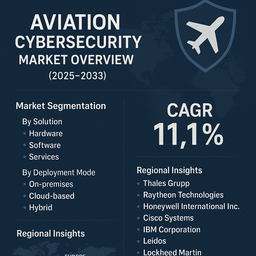
Rising Demand for Aviation Cyber Defense
The aviation sector is undergoing rapid digital transformation with advanced avionics, in-flight connectivity, cloud-enabled operations, and real-time data exchange across stakeholders. These advancements, while improving efficiency and passenger experience, increase exposure to cyber threats. Attacks on navigation systems, flight operations, and passenger data are driving the need for robust cybersecurity measures. Airlines and airports are investing in both preventive and responsive solutions, including firewalls, intrusion detection systems, and AI-driven threat monitoring. Additionally, the expansion of regulatory frameworks by aviation authorities is accelerating adoption of advanced cybersecurity solutions across the global aviation ecosystem.
Challenges: High Costs, Legacy Systems, and Integration
Despite strong growth, the market faces challenges related to the high costs of implementation, particularly for smaller airlines and regional airports. Legacy IT and OT systems in aviation infrastructure make integration with modern cybersecurity tools complex and resource-intensive. Shortages of skilled cybersecurity professionals in aviation further restrict adoption. Additionally, balancing strong cybersecurity measures with operational efficiency and passenger convenience is a persistent challenge. However, growing collaboration between airlines, aerospace manufacturers, and cybersecurity providers is helping overcome these barriers through shared threat intelligence and standardized frameworks.
Market Segmentation by Solution
By solution, the market is segmented into hardware, software, and services. Software solutions hold the largest share due to rising demand for threat detection, encryption, identity management, and endpoint security. Services are expected to grow fastest as airlines and airports increasingly rely on managed security services, consulting, and continuous monitoring to counter evolving cyber threats. Hardware solutions, including firewalls and secure communication devices, remain critical to safeguarding aviation networks.
Market Segmentation by Deployment Mode
By deployment mode, the market is divided into on-premises, cloud-based, and hybrid. On-premises solutions dominate in critical aviation systems that require high security and compliance, such as air traffic management and navigation. Cloud-based solutions are rapidly gaining traction, offering scalability and cost-effectiveness for passenger data, ticketing, and operational systems. Hybrid deployment is emerging as the preferred model, enabling organizations to balance secure on-premises operations with flexible cloud-based services.
Regional Insights
In 2025, North America led the aviation cybersecurity market, supported by advanced aviation infrastructure, strong presence of defense contractors, and increasing cyber threats targeting airlines and airports. Europe followed closely, with the UK, France, and Germany emphasizing regulatory compliance and cross-border cybersecurity frameworks. Asia Pacific is the fastest-growing region, with China, India, and Japan driving adoption through rapid aviation growth, digitization, and rising investments in cyber defense. Latin America and Middle East & Africa (MEA) are emerging markets where increasing air travel demand, modernization of airports, and growing cyber risk awareness are gradually boosting demand for aviation cybersecurity solutions.
Competitive Landscape
The 2025 aviation cybersecurity market was shaped by a mix of aerospace leaders, defense contractors, and technology firms. Thales Group, Raytheon Technologies, Lockheed Martin, Northrop Grumman, and BAE Systems lead in providing defense-grade cybersecurity solutions tailored to aviation systems. Honeywell International Inc. and Airbus leverage their strong aerospace portfolios to integrate cybersecurity into aircraft manufacturing and operations. Cisco Systems and IBM Corporation play a key role in network protection, cloud security, and AI-powered threat intelligence. Leidos continues to strengthen its position with cybersecurity services for critical infrastructure and air traffic control systems. Competitive differentiation is being driven by AI and machine learning integration, cloud-based threat intelligence platforms, real-time monitoring, and partnerships with airlines and airport operators to develop comprehensive cyber defense frameworks.
Historical & Forecast Period
This study report represents analysis of each segment from 2024 to 2034 considering 2025 as the base year. Compounded Annual Growth Rate (CAGR) for each of the respective segments estimated for the forecast period of 2026 to 2034.
The current report comprises of quantitative market estimations for each micro market for every geographical region and qualitative market analysis such as micro and macro environment analysis, market trends, competitive intelligence, segment analysis, porters five force model, top winning strategies, top investment markets, emerging trends and technological analysis, case studies, strategic conclusions and recommendations and other key market insights.
Research Methodology
The complete research study was conducted in three phases, namely: secondary research, primary research, and expert panel review. key data point that enables the estimation of Aviation Cybersecurity Market By Solution, By Security Type, By Deployment Mode, By End Use - Growth, Share, Opportunities & Competitive Analysis, 2026 - 2034 market are as follows:
Market forecast was performed through proprietary software that analyzes various qualitative and quantitative factors. Growth rate and CAGR were estimated through intensive secondary and primary research. Data triangulation across various data points provides accuracy across various analyzed market segments in the report. Application of both top down and bottom-up approach for validation of market estimation assures logical, methodical and mathematical consistency of the quantitative data.
| ATTRIBUTE | DETAILS |
|---|---|
| Research Period | 2024-2034 |
| Base Year | 2025 |
| Forecast Period | 2026-2034 |
| Historical Year | 2024 |
| Unit | USD Million |
| Segmentation | |
Solution
|
|
Security Type
|
|
Deployment Mode
|
|
End Use
|
|
|
Region Segment (2024-2034; US$ Million)
|
Key questions answered in this report


