
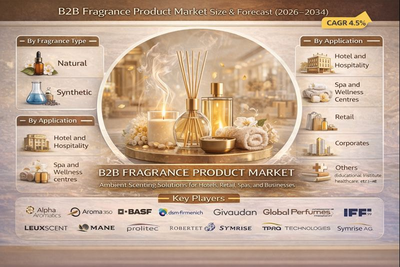
The B2B fragrance product market is expected to grow at a CAGR of 4.5% during 2026–2034, driven by rising demand for branded ambient scenting, stronger focus on customer experience in commercial spaces, and increased adoption of fragrance-based wellness positioning. B2B fragrance products are used by hotels, spas, retailers, and corporates to improve perceived quality, strengthen brand identity, and create consistent in-store or in-building experiences. Growth is also supported by expansion of premium hospitality and organized retail, rising demand for scent delivery systems with controlled intensity, and increasing preference for standardized scent programs that can be deployed across multiple locations.
Market Drivers
Market growth is driven by higher use of scent marketing and signature scents as a brand tool, especially in hotels, luxury retail, and corporate spaces where customer experience and recall matter. Demand is rising for wellness-linked fragrances used in spa and wellness centres to support relaxation, mood setting, and premium positioning. Multi-site operators are adopting centralized fragrance programs to maintain consistency across locations, which increases repeat purchasing and long-term contracts. Product innovation in diffusion formats, longer-lasting formulations, and safer low-residue scent systems is improving adoption in public spaces. Sustainability and compliance requirements are also supporting demand for traceable ingredient sourcing, allergen-aware formulations, and better indoor air quality compatibility.
Market Restraints
The market faces restraints related to indoor air quality concerns, sensitivity to allergens, and varying compliance requirements across regions, which can increase product approval and deployment time. Natural fragrances can face supply variability and price volatility due to dependence on agricultural inputs, while synthetic fragrances face scrutiny around chemical safety and perception in wellness-led environments. Performance expectations differ across locations, and achieving consistent diffusion in large or open spaces can require additional equipment and tuning, increasing total cost for customers. Smaller buyers may delay adoption due to budget constraints or limited awareness of measurable ROI from scenting programs. Brand risk is also a factor, as poorly selected fragrances can lead to negative customer feedback, requiring careful testing and customization.
Market Segmentation
By Fragrance Type
By fragrance type, the market is segmented into natural and synthetic. Synthetic fragrances hold a major share due to cost efficiency, stable supply, formulation consistency, and the ability to replicate complex profiles at scale for multi-site deployments. Natural fragrances are growing steadily as hotels, spas, and premium brands adopt clean-label positioning and prefer plant-based sourcing, especially in wellness-focused environments. Hybrid product strategies are also common in practice, where customers balance natural positioning with performance, stability, and cost control through partial synthetic blending.
By Application
By application, the market is segmented into hotel and hospitality, spa and wellness centres, retail, corporates, and others (educational institutes, healthcare, etc.). Hotel and hospitality holds a major share due to strong use of signature scents in lobbies, corridors, rooms, and amenities to support premium branding and guest experience. Retail is growing steadily as brands use scent to increase dwell time, improve store ambience, and support seasonal campaigns, particularly in fashion, beauty, and luxury categories. Spa and wellness centres are witnessing strong growth due to increasing consumer spending on wellness experiences and the role of fragrance in relaxation and treatment environments. Corporates are adopting fragrance programs in reception areas, meeting spaces, and shared zones to improve workplace experience and brand identity, with stronger demand in premium offices and co-working. Others, including healthcare and educational institutes, remain selective users where compliance, sensitivity, and safety requirements are higher, but demand is expanding where odor control and ambience improvement are priorities.
Regional Insights
North America represents a major market due to strong adoption of scent marketing in retail and hospitality, higher penetration of commercial scenting solutions, and mature B2B service models. Europe shows steady demand supported by premium hospitality, strong fragrance industry presence, and higher focus on compliance, ingredient transparency, and sustainability positioning. Asia Pacific is expected to grow at a healthy pace as organized retail expands, premium hospitality capacity rises, and corporates invest more in customer and workplace experience in major cities. Latin America is an emerging market supported by growth in modern retail and hospitality, with adoption expanding first in premium and tourist-focused locations. The Middle East & Africa is developing as luxury hospitality, large malls, and premium commercial real estate projects expand, supporting demand for signature scenting and scent branding.
Competitive Landscape
The market is competitive, with global fragrance houses, specialty scenting firms, and solution providers focusing on scent design, diffusion performance, and long-term service contracts. Key strategies include launching branded signature scent programs, offering fragrance libraries with customization, improving diffuser technology and remote control, and expanding into wellness-linked and clean-label fragrance lines. Differentiation is driven by fragrance development capabilities, ingredient sourcing and compliance documentation, ability to deliver consistent scenting across multi-site portfolios, and service quality including installation, maintenance, and scent optimization. Vendors are also investing in sustainability claims, IFRA-aligned compliance support, and analytics to help customers justify ROI through experience metrics and brand outcomes.
Key companies operating in the market include Alpha Aromatics, Aroma360, BASF SE, dsm-firmenich, Givaudan SA, Global Perfumes Company, International Flavors & Fragrances (IFF), LEUXSCENT, Mane SA, Prolitec, Robertet SA, Sensient Technologies, Symrise AG, Takasago International Corporation, and Vioryl S.A.
Historical & Forecast Period
This study report represents analysis of each segment from 2024 to 2034 considering 2025 as the base year. Compounded Annual Growth Rate (CAGR) for each of the respective segments estimated for the forecast period of 2026 to 2034.
The current report comprises of quantitative market estimations for each micro market for every geographical region and qualitative market analysis such as micro and macro environment analysis, market trends, competitive intelligence, segment analysis, porters five force model, top winning strategies, top investment markets, emerging trends and technological analysis, case studies, strategic conclusions and recommendations and other key market insights.
Research Methodology
The complete research study was conducted in three phases, namely: secondary research, primary research, and expert panel review. key data point that enables the estimation of B2B Fragrance Product Market By Product Type, By Fragrance Type, By Application, By Distribution Channel - Growth, Share, Opportunities & Competitive Analysis, 2026 - 2034 market are as follows:
Market forecast was performed through proprietary software that analyzes various qualitative and quantitative factors. Growth rate and CAGR were estimated through intensive secondary and primary research. Data triangulation across various data points provides accuracy across various analyzed market segments in the report. Application of both top down and bottom-up approach for validation of market estimation assures logical, methodical and mathematical consistency of the quantitative data.
| ATTRIBUTE | DETAILS |
|---|---|
| Research Period | 2024-2034 |
| Base Year | 2025 |
| Forecast Period | 2026-2034 |
| Historical Year | 2024 |
| Unit | USD Million |
| Segmentation | |
Fragrance Type
|
|
Application
|
|
Distribution Channel
|
|
|
Region Segment (2024-2034; US$ Million)
|
Frequently Asked Questions
What is the growth outlook for the B2B fragrance product market?
The market is expected to grow at a CAGR of 4.5% during 2026–2034, supported by rising scent marketing adoption and growth in hospitality, retail, and workplace experience spending.
Which fragrance type segment is larger?
Synthetic fragrances hold a major share due to cost efficiency, stable supply, and consistent performance for large-scale deployments, while natural fragrances grow steadily in wellness and premium segments.
Which application segment leads the market?
Hotel and hospitality leads due to high adoption of signature scents and consistent demand across guest touchpoints, followed by retail and spa and wellness centres.
Which region is a key demand center?
North America and Europe are major markets, while Asia Pacific is a key growth region supported by expanding premium commercial spaces and organized retail.
What are the key challenges in this market?
Indoor air quality concerns, allergen sensitivity, compliance variation, supply volatility for natural inputs, and ensuring consistent diffusion performance across different spaces are major challenges.


