
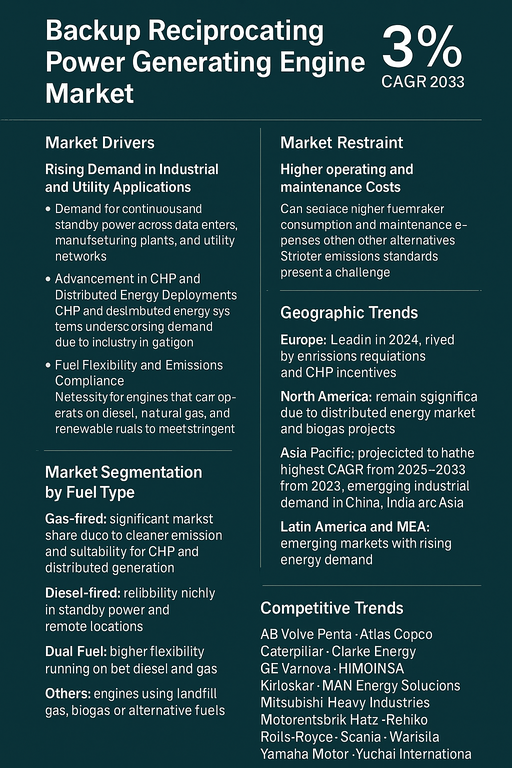
The backup reciprocating power generating engine market is projected to grow at a CAGR of 3% during the forecast period 2026 to 2034, driven by increasing demand for dependable, efficient, and fuel-flexible power generation solutions across diverse end-use sectors. Reciprocating engines, powered by gas, diesel, or dual-fuel configurations, offer a proven and cost-effective option for standby power, distributed energy systems, CHP (combined heat and power), and landfill or biogas energy recovery. Their rapid-start capabilities, scalability, and resilience to fluctuations in grid supply make them vital to industries that require uninterrupted power, especially in remote or off-grid locations. Growing investments in industrial capacity, stricter grid-reliability standards, and sustainability goals continue to boost interest in these versatile engines worldwide.
Market Drivers
Rising Demand in Industrial and Utility Applications
The need for standby and continuous power across process industries, factories, data centers, and utility networks is increasing as energy consumption grows and extreme weather events create risks of power disruption. Reciprocating engines deliver rapid response times and stable performance during outages, providing critical power to maintain operations, minimize downtime, and protect sensitive assets.
Advancement in CHP and Distributed Energy Deployments
The growing adoption of CHP and distributed energy models is supporting demand for reciprocating engines, which can efficiently produce both electricity and usable heat. In addition, these engines integrate seamlessly into microgrids and help utilities reduce transmission losses. Many industrial and commercial operators are also leveraging reciprocating engines to support renewable energy installations, smoothing variable output and ensuring a continuous, balanced energy flow.
Fuel Flexibility and Emissions Compliance
End-users require engines that can switch between diesel, natural gas, biogas, and other fuels to reduce emissions and ensure long-term energy security. Dual-fuel engines, in particular, allow seamless operation under varying fuel availability, aligning with global sustainability and decarbonization goals. Manufacturers are also investing in advanced combustion technologies and after-treatment systems to meet stringent regional emissions standards.
Market Restraint
Higher Operating and Maintenance Costs
While they offer strong reliability and flexibility, reciprocating engines can incur higher maintenance and fuel consumption costs compared to other distributed energy options like batteries or fuel cells. Moreover, evolving emissions regulations require continuous technology upgrades and monitoring to remain compliant, which can be resource-intensive, especially for smaller operators and aging assets.
Market Segmentation by Fuel Type
Gas-Fired Engines accounted for a significant market share in 2025 due to their cleaner emissions, fuel cost advantages, and widespread deployment across industrial, CHP, and utility applications. Gas engines offer quick ramp rates and low NOx emissions, making them ideal for distributed energy and grid-balancing applications.
Diesel-Fired Engines remain an important segment due to their fuel availability, durability, and ease of service, especially in remote locations or developing markets where fuel infrastructure for gas or dual-fuel engines is still limited. Dual-Fuel Engines are projected to grow at the highest CAGR during the forecast period as they offer the flexibility to switch between diesel and gas depending on price, supply, and emissions considerations. Operators in energy-intensive industries value dual-fuel engines for their resilience and adaptability under diverse operating conditions. Others, including engines running on landfill gas, biogas, or other renewable fuels, are steadily gaining traction as sustainability and waste-to-energy solutions become more prevalent worldwide.
Market Segmentation by Application
Industrial led the market in 2025 due to the demand for continuous and backup power across factories, processing plants, mining, and remote facilities. Reciprocating engines help ensure business continuity, enhance energy independence, and manage energy cost volatility. CHP (Combined Heat and Power) is expected to register significant growth from 2026 to 2034 as operators recognize the energy efficiency benefits of capturing and utilizing heat from engines. CHP enables facilities such as district heating networks and commercial complexes to reduce energy bills and emissions footprint. Energy & Utility applications are anticipated to expand steadily as utilities deploy reciprocating engines to support grid stabilization, peak shaving, and emergency power services. This segment benefits from demand for flexible generation assets that can quickly respond to supply-demand fluctuations. Landfill & Biogas is also gaining momentum as engines designed to run on renewable biogas support sustainability goals, converting methane from landfills and agricultural waste into usable power while preventing harmful emissions. Others include commercial and residential backup power as well as specialized niches like mobile gensets, military deployments, and off-grid communities.
Geographic Trends
Europe led the market in 2025, driven by stringent emissions regulations, investments in renewable power projects, and established CHP incentives across Germany, France, Italy, and the Nordics. The European Union’s focus on sustainability and energy security supports demand for low-emission gas-fired and dual-fuel engines. North America remained a significant region due to its strong distributed energy market, utility resilience requirements, and the rapid growth of biogas and landfill-gas-to-energy installations. The United States and Canada continue to invest in natural gas and dual-fuel engines to support grid modernization and extreme-weather preparedness. Asia Pacific is projected to record the highest CAGR between 2026 and 2034, driven by industrial growth in China, India, and Southeast Asia, rapid urbanization, and the need for affordable, reliable electricity in rural areas. Government electrification schemes and renewable energy policies encourage deployment of fuel-flexible engines. Latin America and MEA are also witnessing growing adoption due to grid unreliability, increased industrial activity, and the search for cost-effective distributed power solutions. Countries across the Middle East & Africa and Latin America are investing in gas and diesel engines to meet rising energy demand and reduce dependency on large-scale, centralized power plants.
Competitive Trends
The backup reciprocating power generating engine market is moderately consolidated, with key players leveraging global distribution networks, regional service partnerships, and modular product platforms. In 2025, leading companies included AB Volvo Penta, Atlas Copco, Caterpillar, Clarke Energy, GE Vernova, HIMOINSA, Kirloskar, MAN Energy Solutions, Mitsubishi Heavy Industries, Motorenfabrik Hatz, Rehlko, Rolls-Royce, Scania, Wärtsilä, Yamaha Motor, and Yuchai International. Caterpillar and Wärtsilä maintain leadership through broad product portfolios and aftermarket services. MAN Energy Solutions and Mitsubishi Heavy Industries drive innovation in high-efficiency gas and dual-fuel engines, while Kirloskar and Himoinsa strengthen regional presence in emerging markets. Rolls-Royce and Scania focus on emissions control and lifecycle optimization, helping customers meet sustainability targets. Going forward, competitive differentiation will center on digital solutions for predictive maintenance, engines capable of running on alternative fuels, modular design for rapid deployment, and long-term service packages to enhance uptime and asset value.
Historical & Forecast Period
This study report represents analysis of each segment from 2024 to 2034 considering 2025 as the base year. Compounded Annual Growth Rate (CAGR) for each of the respective segments estimated for the forecast period of 2026 to 2034.
The current report comprises of quantitative market estimations for each micro market for every geographical region and qualitative market analysis such as micro and macro environment analysis, market trends, competitive intelligence, segment analysis, porters five force model, top winning strategies, top investment markets, emerging trends and technological analysis, case studies, strategic conclusions and recommendations and other key market insights.
Research Methodology
The complete research study was conducted in three phases, namely: secondary research, primary research, and expert panel review. key data point that enables the estimation of Backup Reciprocating Power Generating Engine Market By Fuel Type, By Rated Power, By Application - Growth, Share, Opportunities & Competitive Analysis, 2026 - 2034 market are as follows:
Market forecast was performed through proprietary software that analyzes various qualitative and quantitative factors. Growth rate and CAGR were estimated through intensive secondary and primary research. Data triangulation across various data points provides accuracy across various analyzed market segments in the report. Application of both top down and bottom-up approach for validation of market estimation assures logical, methodical and mathematical consistency of the quantitative data.
| ATTRIBUTE | DETAILS |
|---|---|
| Research Period | 2024-2034 |
| Base Year | 2025 |
| Forecast Period | 2026-2034 |
| Historical Year | 2024 |
| Unit | USD Million |
| Segmentation | |
Fuel Type
|
|
Rated Power
|
|
Application
|
|
|
Region Segment (2024-2034; US$ Million)
|
Key questions answered in this report


