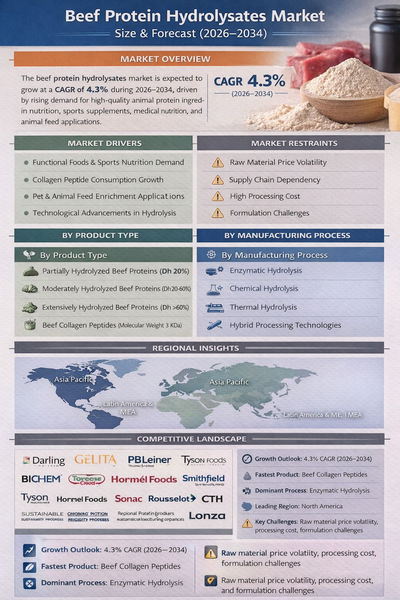
The beef protein hydrolysates market is expected to grow at a CAGR of 4.3% during 2026–2034, driven by rising demand for high-quality animal protein ingredients in nutrition, sports supplements, medical nutrition, and animal feed applications. Beef protein hydrolysates offer high digestibility, fast absorption, and rich amino acid profiles, making them suitable for clinical, elderly, and performance nutrition. Increasing focus on protein fortification and functional nutrition is supporting steady market expansion. Utilization of meat by-products for value-added protein recovery is also strengthening sustainability-driven growth.
Market Drivers
Market growth is driven by increasing demand for protein-rich functional foods, sports nutrition, and medical nutrition products. Rising awareness of muscle recovery, joint health, and digestive benefits of hydrolyzed proteins is boosting adoption. Growth in collagen peptide consumption for skin, bone, and joint health is further supporting demand. Expansion of pet food and animal feed protein enrichment applications also contributes to market growth. Technological improvements in hydrolysis control and peptide profiling are improving product consistency and application range.
Market Restraints
The market faces restraints related to raw material price volatility, supply chain dependency on meat processing industries, and high processing cost. Regulatory compliance for food and pharmaceutical-grade products increases production complexity. Consumer shift toward plant-based proteins in certain regions can limit growth potential. In addition, odor, taste, and solubility challenges can restrict formulation flexibility.
Market Segmentation
By Product Type
By product type, the market is segmented into partially hydrolyzed beef proteins (Dh 20%), moderately hydrolyzed beef proteins (Dh 20–60%), extensively hydrolyzed beef proteins (Dh >60%), and beef collagen peptides (molecular weight 3 KDa). Moderately hydrolyzed beef proteins hold a major share due to balanced digestibility and functional properties. Extensively hydrolyzed proteins are preferred in medical and infant nutrition applications. Beef collagen peptides are witnessing strong growth due to rising demand in beauty, joint health, and functional nutrition products.
By Manufacturing Process
By manufacturing process, the market is segmented into enzymatic hydrolysis, chemical hydrolysis, thermal hydrolysis, and hybrid processing technologies. Enzymatic hydrolysis dominates due to better peptide control, higher nutritional quality, and lower degradation risk. Chemical and thermal methods remain in use for cost-sensitive applications. Hybrid processing technologies are gaining adoption for optimized yield, efficiency, and product customization.
Regional Insights
North America leads the beef protein hydrolysates market due to strong meat processing infrastructure, high protein consumption, and advanced nutraceutical industries. Europe follows with rising collagen peptide demand and clinical nutrition usage. Asia Pacific shows steady growth driven by sports nutrition, elderly nutrition, and expanding food processing industries. Latin America and the Middle East & Africa represent emerging markets supported by livestock availability and growing feed applications.
Competitive Landscape
The market is moderately fragmented, with companies focusing on peptide purity, functional performance, and application-specific formulations. Vertical integration with meat processing facilities and investment in enzymatic processing technologies are key strategies. Expansion into medical nutrition, pet nutrition, and collagen peptide markets is shaping competition.
Key companies operating in the market include Darling Ingredients Inc, Gelita AG, Tessenderlo Group (PB Leiner), Tyson Foods Inc, Hormel Foods Corporation, Rousselot (Darling Ingredients), Sonac (Darling Ingredients), CTH (Darling Ingredients), Smithfield Foods Inc, Specialty Protein Processors, Bioactive Peptide Developers, Sustainable Processing Companies, Regional Feed Ingredient Suppliers, Emerging Technology Companies, and Contract Manufacturing Organizations.
Historical & Forecast Period
This study report represents analysis of each segment from 2024 to 2034 considering 2025 as the base year. Compounded Annual Growth Rate (CAGR) for each of the respective segments estimated for the forecast period of 2026 to 2034.
The current report comprises of quantitative market estimations for each micro market for every geographical region and qualitative market analysis such as micro and macro environment analysis, market trends, competitive intelligence, segment analysis, porters five force model, top winning strategies, top investment markets, emerging trends and technological analysis, case studies, strategic conclusions and recommendations and other key market insights.
Research Methodology
The complete research study was conducted in three phases, namely: secondary research, primary research, and expert panel review. key data point that enables the estimation of Beef Protein Hydrolysates market are as follows:
Market forecast was performed through proprietary software that analyzes various qualitative and quantitative factors. Growth rate and CAGR were estimated through intensive secondary and primary research. Data triangulation across various data points provides accuracy across various analyzed market segments in the report. Application of both top down and bottom-up approach for validation of market estimation assures logical, methodical and mathematical consistency of the quantitative data.
| ATTRIBUTE | DETAILS |
|---|---|
| Research Period | 2024-2034 |
| Base Year | 2025 |
| Forecast Period | 2026-2034 |
| Historical Year | 2024 |
| Unit | USD Million |
| Segmentation | |
Product Type
|
|
Manufacturing Process
|
|
End Use Application
|
|
|
Region Segment (2024-2034; US$ Million)
|
Frequently Asked Questions
What is the growth outlook for the beef protein hydrolysates market?
The market is expected to grow at a CAGR of 4.3% during 2026–2034, supported by functional nutrition and collagen peptide demand.
Which product type is growing fastest?
Beef collagen peptides are growing fastest due to beauty, joint health, and functional nutrition applications.
Which manufacturing process dominates the market?
Enzymatic hydrolysis dominates due to better peptide quality and nutritional retention.
Which region leads the market?
North America leads the market, followed by Europe and Asia Pacific.
What are the key challenges in this market?
Raw material price volatility, processing cost, and formulation challenges are major challenges.