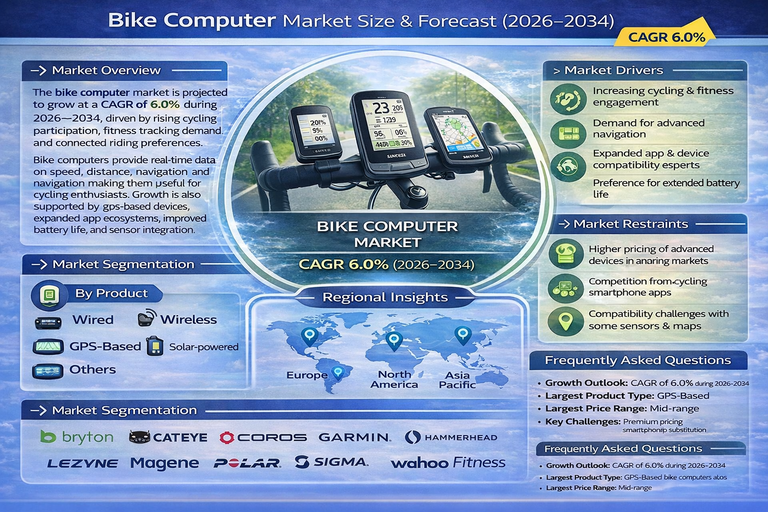
The bike computer market is expected to grow at a CAGR of 6.0% during 2026–2034, driven by rising participation in cycling for fitness, commuting, and competitive sports, along with increasing demand for performance tracking and connected riding experiences. Bike computers support real-time monitoring of speed, distance, cadence, heart rate, elevation, and navigation, making them useful for both recreational and professional riders. Growth is also supported by the expanding adoption of GPS-based devices, integration with training platforms, and improving sensor and connectivity ecosystems across cycling accessories.
Market Drivers
Market growth is driven by increasing health and fitness awareness, expansion of cycling communities, and higher spending on sports electronics and smart accessories. Growth in endurance cycling and racing is increasing demand for advanced GPS-based computers with route guidance, performance analytics, and training load monitoring. Wider use of e-bikes is also supporting adoption, as riders prefer data-driven tracking for range and ride optimization. Technological improvements in battery life, display clarity, and multi-sensor pairing are enhancing user experience. Expansion of app ecosystems and compatibility with platforms for training and mapping is further strengthening market demand.
Market Restraints
The market faces restraints related to high pricing of premium devices, competition from smartphone-based cycling apps, and compatibility issues across sensors, maps, and training platforms. Consumers in price-sensitive markets may limit adoption to basic models or alternative devices. Dependence on GPS accuracy and mapping availability can affect satisfaction in certain regions. In addition, product complexity and learning curve for advanced features can reduce adoption among casual riders.
Market Segmentation
By Product
By product, the market is segmented into wired, wireless, GPS-based, solar-powered, and others. GPS-based bike computers hold a major share due to strong demand for navigation, route planning, and performance analytics across road cycling, mountain biking, and long-distance riding. Wireless models remain widely adopted due to ease of installation and sensor pairing. Wired models continue to serve entry-level users who prefer affordability and simple tracking. Solar-powered models represent a developing segment, supported by demand for longer endurance usage and reduced charging frequency. Others include hybrid and application-specific computers designed for niche riding needs.
By Price Range
By price range, the market is segmented into basic, mid-range, and premium. Mid-range holds a major share due to balanced pricing and feature sets such as wireless connectivity, sensor integration, and limited navigation. Basic models remain important in mass markets where speed, distance, and cadence tracking are primary needs. Premium is witnessing strong growth due to demand for advanced navigation, large displays, training analytics, multi-band GPS accuracy, and integration with broader fitness ecosystems.
Regional Insights
Europe is a leading market due to high cycling adoption, strong commuter cycling culture, and growing sports cycling participation. North America follows with demand concentrated in performance cycling, endurance training, and connected fitness ecosystems. Asia Pacific shows steady growth driven by expanding cycling communities, rising disposable income, and increased e-bike adoption. Latin America and the Middle East & Africa represent emerging markets supported by gradual growth in cycling as a fitness and mobility option.
Competitive Landscape
The market is competitive, with players focusing on GPS accuracy, mapping and navigation quality, display and battery performance, and ecosystem compatibility with sensors and training platforms. Product differentiation is increasingly driven by software features such as route planning, structured workouts, training load metrics, and smartphone integration. Partnerships with map providers, fitness platforms, and sensor brands support ecosystem expansion. Continuous innovation in compact design, durability, and long battery life remains a key strategy.
Key companies operating in the market include Bryton, CatEye, COROS Wearables, Garmin, Hammerhead, Lezyne, Magene, Polar, Sigma, and Wahoo Fitness.
Historical & Forecast Period
This study report represents analysis of each segment from 2024 to 2034 considering 2025 as the base year. Compounded Annual Growth Rate (CAGR) for each of the respective segments estimated for the forecast period of 2026 to 2034.
The current report comprises of quantitative market estimations for each micro market for every geographical region and qualitative market analysis such as micro and macro environment analysis, market trends, competitive intelligence, segment analysis, porters five force model, top winning strategies, top investment markets, emerging trends and technological analysis, case studies, strategic conclusions and recommendations and other key market insights.
Research Methodology
The complete research study was conducted in three phases, namely: secondary research, primary research, and expert panel review. key data point that enables the estimation of Bike Computer market are as follows:
Market forecast was performed through proprietary software that analyzes various qualitative and quantitative factors. Growth rate and CAGR were estimated through intensive secondary and primary research. Data triangulation across various data points provides accuracy across various analyzed market segments in the report. Application of both top down and bottom-up approach for validation of market estimation assures logical, methodical and mathematical consistency of the quantitative data.
| ATTRIBUTE | DETAILS |
|---|---|
| Research Period | 2024-2034 |
| Base Year | 2025 |
| Forecast Period | 2026-2034 |
| Historical Year | 2024 |
| Unit | USD Million |
| Segmentation | |
Product
|
|
Sensor
|
|
Connectivity
|
|
Bike
|
|
Distribution Channel
|
|
Application
|
|
End Use
|
|
|
Region Segment (2024-2034; US$ Million)
|
Frequently Asked Questions
What is the growth outlook for the bike computer market?
The market is expected to grow at a CAGR of 6.0% during 2026–2034, supported by cycling participation and connected fitness demand.
Which product type holds the largest share?
GPS-based bike computers hold the largest share due to strong demand for navigation and performance analytics.
Which price range is largest in the market?
Mid-range is the largest segment due to balanced pricing and features.
Which region leads the market?
Europe leads the market, followed by North America and Asia Pacific.
What are the key challenges in this market?
High premium pricing, smartphone app substitution, and compatibility issues across sensors and platforms are major challenges.