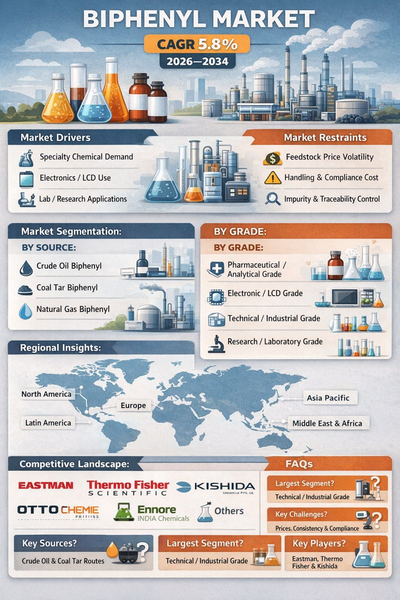
The biphenyl market is expected to grow at a CAGR of 5.8% during 2026–2034, driven by steady demand from chemical intermediates, specialty materials, and laboratory applications. Biphenyl is used as an intermediate in manufacturing and processing across industrial chemical value chains, and it is also used in controlled applications where purity and consistency are critical (analytical and research use). Growth is supported by rising demand for high-purity grades for electronics-related use cases, broader adoption of specialty chemicals in downstream manufacturing, and continued requirement for quality-controlled materials in pharmaceuticals, testing, and laboratories.
Market Drivers
Market growth is driven by expanding demand for specialty chemical intermediates and performance materials, where biphenyl is used as a building block in synthesis and formulation. Increasing focus on purity control and traceable supply supports demand for pharmaceutical/analytical and research/laboratory grades, especially in regulated and testing-intensive environments. In electronics value chains, growth is supported by demand for high-purity materials where contamination control and batch consistency matter, which supports uptake of electronic/LCD grade biphenyl. Industrial demand is supported by stable consumption of technical/industrial grade biphenyl in broader chemical processing, where reliability of supply and cost competitiveness are important. Producers and distributors are also investing in better packaging, documentation, and quality assurance to meet buyer expectations on specifications, safety data, and compliance.
Market Restraints
The market faces restraints from feedstock-linked price volatility and supply variability, especially for sourcing routes tied to crude oil, coal tar, and natural gas value chains. Handling and storage requirements, workplace safety practices, and regulatory compliance add cost and can limit adoption in smaller facilities without established chemical handling infrastructure. For high-purity grades, tight impurity limits and batch-to-batch consistency requirements increase production complexity and quality control cost. Demand in electronics-related grades can also be sensitive to end-market cycles and qualification timelines. In addition, import logistics, documentation requirements, and regional chemical regulations can increase lead times and create procurement friction for buyers that need consistent supply.
Market Segmentation
By Source
By source, the market is segmented into crude oil biphenyl, coal tar biphenyl, and natural gas biphenyl. Crude oil biphenyl represents a major source route because of its linkage to large petrochemical supply chains and established downstream integration in many regions. Coal tar biphenyl is relevant where coal tar processing infrastructure is present and can offer cost-competitive sourcing in certain markets, although availability is influenced by broader coal-chemical economics and local environmental controls. Natural gas biphenyl is tied to gas-based petrochemical value chains and can be attractive where gas-based feedstock economics are favorable and supply stability is high. Across all routes, buyers evaluate source options based on delivered cost, impurity profile, and supplier consistency.
By Grade
By grade, the market is segmented into pharmaceutical/analytical grade, electronic/LCD grade, technical/industrial grade, and research/laboratory grade. Technical/industrial grade holds a significant share due to broader applicability across industrial chemical processing where ultra-high purity is not always required and procurement is cost-sensitive. Pharmaceutical/analytical grade is driven by regulated applications and analytical testing environments where purity specifications, documentation, and traceability are critical. Electronic/LCD grade is a higher-value segment supported by electronics supply chains that require strict impurity limits and consistent performance, often involving longer qualification cycles and supplier audits. Research/laboratory grade remains an important segment due to continued laboratory demand from R&D, universities, and testing labs, where small-batch packaging, consistency, and reliable specifications drive purchasing decisions.
Regional Insights
Asia Pacific represents a major demand base due to strong chemical manufacturing capacity, expanding electronics production in selected countries, and broad laboratory and research activity. North America shows steady demand supported by specialty chemical production, regulated analytical use, and established distribution networks for laboratory chemicals. Europe is stable to moderately growing, supported by specialty chemicals, strict quality requirements for analytical grades, and strong compliance standards. Latin America shows selective growth driven by industrial chemical demand and import-based procurement for higher grades, with supply influenced by distributor networks and logistics. The Middle East & Africa shows developing demand linked to industrial expansion and chemical distribution growth, with adoption shaped by import logistics, documentation, and availability of local suppliers for technical grades.
Competitive Landscape
The market is competitive and quality-driven, with suppliers differentiating through purity levels, consistent specifications, documentation support, packaging formats, and reliability of delivery. For high-purity grades, competitive advantage is influenced by quality systems, impurity control capability, and ability to meet buyer qualification and audit requirements. Distributors and lab-chemical suppliers compete through product availability, small pack options, lead-time reliability, and after-sales technical documentation. Key strategies include expanding regional distribution partnerships, improving QC and traceability, maintaining multiple sourcing routes to reduce supply disruption risk, and offering grade-specific portfolios aligned to industrial, analytical, and electronics requirements. Key companies operating in the market include Eastman Chemical Company, Thermo Fisher Scientific, Kishida Chemical Co., Ltd., Otto Chemie Pvt. Ltd., Ennore India Chemicals, and others.
Historical & Forecast Period
This study report represents analysis of each segment from 2024 to 2034 considering 2025 as the base year. Compounded Annual Growth Rate (CAGR) for each of the respective segments estimated for the forecast period of 2026 to 2034.
The current report comprises of quantitative market estimations for each micro market for every geographical region and qualitative market analysis such as micro and macro environment analysis, market trends, competitive intelligence, segment analysis, porters five force model, top winning strategies, top investment markets, emerging trends and technological analysis, case studies, strategic conclusions and recommendations and other key market insights.
Research Methodology
The complete research study was conducted in three phases, namely: secondary research, primary research, and expert panel review. key data point that enables the estimation of Biphenyl market are as follows:
Market forecast was performed through proprietary software that analyzes various qualitative and quantitative factors. Growth rate and CAGR were estimated through intensive secondary and primary research. Data triangulation across various data points provides accuracy across various analyzed market segments in the report. Application of both top down and bottom-up approach for validation of market estimation assures logical, methodical and mathematical consistency of the quantitative data.
| ATTRIBUTE | DETAILS |
|---|---|
| Research Period | 2024-2034 |
| Base Year | 2025 |
| Forecast Period | 2026-2034 |
| Historical Year | 2024 |
| Unit | USD Million |
| Segmentation | |
Purity Grade
|
|
Physical Form
|
|
Application
|
|
End use Industry
|
|
Distribution Channel
|
|
|
Region Segment (2024-2034; US$ Million)
|
Frequently Asked Questions
What is the growth outlook for the biphenyl market?
The market is expected to grow at a CAGR of 5.8% during 2026–2034, supported by demand in specialty chemicals, analytical use, and electronics-related high-purity applications.
Which source segment is important in the market?
Crude oil and coal tar sourcing routes are widely used depending on regional infrastructure, while natural gas-linked routes are relevant where gas-based petrochemical economics are favorable.
Which grade segment has the largest demand base?
Technical/industrial grade typically represents a significant share due to wide industrial use and higher volume requirements compared to high-purity segments.
What are the key challenges in this market?
Major challenges include feedstock price volatility, supply consistency, compliance and handling requirements, and strict impurity control for pharmaceutical/analytical and electronic/LCD grades.
Who are the key players in this market?
Key participants include Eastman Chemical Company, Thermo Fisher Scientific, Kishida Chemical, Otto Chemie, and Ennore India Chemicals, along with other regional producers and distributors.