Growing emphasis on sustainable transportation and efficient urban logistics is driving the adoption of cargo bikes across commercial and personal mobility applications.
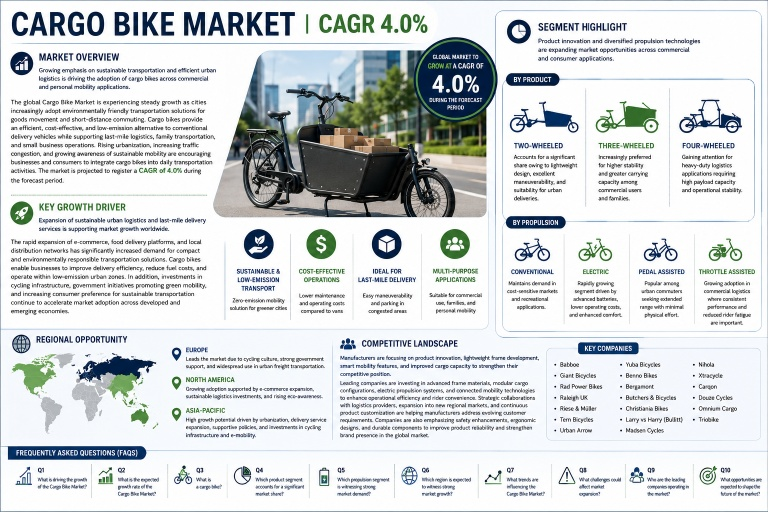
The global cargo bike market is experiencing steady growth as cities increasingly adopt environmentally friendly transportation solutions for goods movement and short-distance commuting. Cargo bikes provide an efficient, cost-effective, and low-emission alternative to conventional delivery vehicles while supporting last-mile logistics, family transportation, and small business operations. Rising urbanization, increasing traffic congestion, and growing awareness of sustainable mobility are encouraging businesses and consumers to integrate cargo bikes into daily transportation activities. The market is projected to register a CAGR of 4.0% during the forecast period.
Key Growth Driver
Expansion of sustainable urban logistics and last-mile delivery services is supporting market growth worldwide.
The rapid expansion of e-commerce, food delivery platforms, and local distribution networks has significantly increased demand for compact and environmentally responsible transportation solutions. Cargo bikes enable businesses to improve delivery efficiency, reduce fuel costs, and operate within low-emission urban zones. In addition, investments in cycling infrastructure, government initiatives promoting green mobility, and increasing consumer preference for sustainable transportation continue to accelerate market adoption across developed and emerging economies.
Segment Highlight
Product innovation and diversified propulsion technologies are expanding market opportunities across commercial and consumer applications.
Based on product type, Two-Wheeled Cargo Bikes account for a significant share of the market owing to their lightweight construction, excellent maneuverability, and suitability for urban deliveries. Three-Wheeled Cargo Bikes are increasingly preferred for applications requiring greater stability and higher carrying capacity, particularly among commercial users and families. Four-Wheeled Cargo Bikes are gaining attention for heavy-duty logistics applications where increased payload capacity and operational stability are essential.
By propulsion, Electric Cargo Bikes represent a rapidly growing segment due to improved battery technologies, reduced operating costs, and enhanced riding comfort. Conventional Cargo Bikes continue to maintain demand in cost-sensitive markets and recreational applications. Pedal Assisted Cargo Bikes remain popular among urban commuters seeking extended travel range with minimal physical effort, while Throttle Assisted Cargo Bikes are witnessing growing adoption in commercial logistics where consistent performance and reduced rider fatigue are important.
Regional Opportunity
Europe remains the leading market, while Asia-Pacific presents strong long-term growth opportunities.
Europe continues to dominate the Cargo Bike Market due to well-established cycling infrastructure, supportive government policies, widespread environmental awareness, and increasing deployment of cargo bikes for urban freight transportation. North America is witnessing growing adoption driven by expanding e-commerce activities, investments in sustainable logistics, and rising demand for alternative mobility solutions. Meanwhile, Asia-Pacific is expected to experience significant growth supported by rapid urbanization, expanding delivery services, increasing government focus on electric mobility, and growing investments in cycling infrastructure across China, Japan, India, and Southeast Asian countries.
Competitive Landscape
Manufacturers are focusing on product innovation, lightweight frame development, smart mobility features, and improved cargo capacity to strengthen their competitive position.
Leading companies are investing in advanced frame materials, modular cargo configurations, electric propulsion systems, and connected mobility technologies to enhance operational efficiency and rider convenience. Strategic collaborations with logistics providers, expansion into new regional markets, and continuous product customization are helping manufacturers address evolving customer requirements. Companies are also emphasizing safety enhancements, ergonomic designs, and durable components to improve product reliability and strengthen brand presence in the global market.
Key companies operating in the market include Babboe, Giant Bicycles, Rad Power Bikes, Raleigh UK, Riese & Muller, Tern Bicycles, Urban Arrow, Yuba Bicycles, Benno Bikes, Bergamont, Butchers & Bicycles, Christiania Bikes, Larry vs Harry (Bullitt), Madsen Cycles, Nihola, Xtracycle, Carqon, Douze Cycles, Omnium Cargo, and Triobike.
Historical & Forecast Period
This study report represents analysis of each segment from 2024 to 2034 considering 2025 as the base year. Compounded Annual Growth Rate (CAGR) for each of the respective segments estimated for the forecast period of 2026 to 2034.
The current report comprises of quantitative market estimations for each micro market for every geographical region and qualitative market analysis such as micro and macro environment analysis, market trends, competitive intelligence, segment analysis, porters five force model, top winning strategies, top investment markets, emerging trends and technological analysis, case studies, strategic conclusions and recommendations and other key market insights.
Research Methodology
The complete research study was conducted in three phases, namely: secondary research, primary research, and expert panel review. key data point that enables the estimation of Cargo Bike market are as follows:
Market forecast was performed through proprietary software that analyzes various qualitative and quantitative factors. Growth rate and CAGR were estimated through intensive secondary and primary research. Data triangulation across various data points provides accuracy across various analyzed market segments in the report. Application of both top down and bottom-up approach for validation of market estimation assures logical, methodical and mathematical consistency of the quantitative data.
| ATTRIBUTE | DETAILS |
|---|---|
| Research Period | 2024-2034 |
| Base Year | 2025 |
| Forecast Period | 2026-2034 |
| Historical Year | 2024 |
| Unit | USD Million |
| Segmentation | |
Product
|
|
Propulsion
|
|
Drive Systems
|
|
Load Capacity
|
|
Application
|
|
|
Region Segment (2024-2034; US$ Million)
|
Frequently Asked Questions
Q1. What is driving the growth of the Cargo Bike Market?
The market is primarily driven by increasing demand for sustainable transportation, expansion of urban logistics, growth in e-commerce deliveries, and government initiatives supporting low-emission mobility solutions.
Q2. What is the expected growth rate of the Cargo Bike Market?
The global Cargo Bike Market is projected to expand at a CAGR of 4.0% during the forecast period.
Q3. What is a cargo bike?
A cargo bike is a specially designed bicycle built to transport goods, equipment, or passengers through dedicated cargo compartments, making it suitable for commercial deliveries and personal transportation.
Q4. Which product segment accounts for a significant market share?
Two-Wheeled Cargo Bikes account for a significant market share due to their lightweight design, maneuverability, and suitability for urban transportation and last-mile delivery services.
Q5. Which propulsion segment is witnessing strong market demand?
Electric Cargo Bikes are witnessing strong demand owing to improved battery technologies, lower operating costs, enhanced riding comfort, and growing adoption of sustainable transportation solutions.
Q6. Which region is expected to witness strong market growth?
Asia-Pacific is anticipated to witness significant market growth due to increasing urbanization, expanding logistics services, rising investments in cycling infrastructure, and supportive government initiatives promoting sustainable mobility.
Q7. What trends are influencing the Cargo Bike Market?
Major trends include lightweight frame materials, modular cargo designs, smart connectivity features, electric propulsion systems, fleet management technologies, and growing adoption in urban logistics.
Q8. What challenges could affect market expansion?
Limited cycling infrastructure in certain regions, high upfront costs for electric cargo bikes, battery replacement expenses, and varying regulatory frameworks may restrain market growth.
Q9. Who are the leading companies operating in the Cargo Bike Market?
Major companies include Babboe, Giant Bicycles, Rad Power Bikes, Raleigh UK, Riese & Muller, Tern Bicycles, Urban Arrow, Yuba Bicycles, Benno Bikes, Bergamont, Butchers & Bicycles, Christiania Bikes, Larry vs Harry (Bullitt), Madsen Cycles, Nihola, Xtracycle, Carqon, Douze Cycles, Omnium Cargo, and Triobike.
Q10. What opportunities are expected to shape the future of the Cargo Bike Market?
Growing investments in urban cycling infrastructure, increasing adoption of sustainable logistics, expansion of e-commerce delivery networks, technological advancements in electric propulsion systems, and supportive government policies are expected to create significant growth opportunities during the forecast period.