Sustainable urban logistics and eco-friendly mobility solutions are transforming last-mile transportation worldwide.
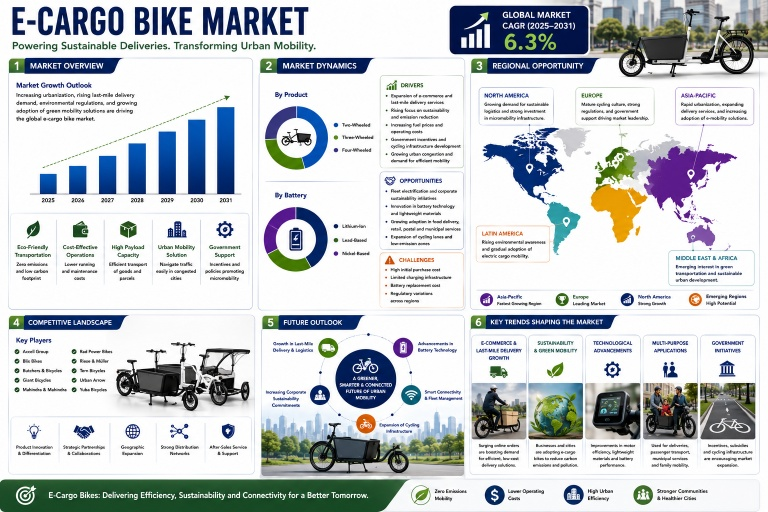
The global E-Cargo Bike Market is witnessing steady expansion driven by increasing urbanization, rising environmental concerns, and growing demand for efficient last-mile delivery solutions. Electric cargo bikes offer a low-emission alternative to conventional delivery vehicles while providing cost-effective and flexible transportation for goods and passengers. Governments and municipalities are increasingly promoting micromobility solutions to reduce traffic congestion, lower carbon emissions, and improve urban air quality. As businesses and consumers embrace sustainable transportation practices, the market is projected to register a CAGR of 6.3% during the forecast period.
Key Growth Driver
Expansion of urban delivery services and sustainability initiatives is accelerating market adoption globally.
Rapid growth in e-commerce activities, food delivery services, and urban logistics operations is increasing the demand for compact and energy-efficient cargo transportation solutions. E-cargo bikes enable businesses to optimize delivery efficiency, reduce operating expenses, and comply with low-emission zone regulations. In addition, government incentives, cycling infrastructure development, and growing consumer preference for environmentally responsible mobility options are further supporting market growth.
Segment Highlight
Product innovation and battery advancements continue to create new opportunities across urban mobility applications.
Based on product type, Two-Wheeled E-Cargo Bikes account for a significant share of the market owing to their maneuverability, lightweight design, and suitability for urban delivery applications. Three-Wheeled E-Cargo Bikes are gaining popularity due to their enhanced stability and higher payload capacity, making them ideal for commercial and family transportation purposes. Four-Wheeled E-Cargo Bikes are expected to create additional growth opportunities as logistics companies increasingly seek alternatives to small commercial vans.
By battery type, Lithium-Ion Batteries dominate the market because of their superior energy density, lightweight characteristics, and longer operational lifespan. Lead-Based Batteries continue to support cost-sensitive applications, while Nickel-Based Batteries maintain relevance in selected niche applications requiring reliable performance under varying environmental conditions.
Regional Opportunity
Europe remains a leading market, while Asia-Pacific is emerging as a high-growth region for electric cargo mobility.
Europe maintains a dominant position in the market due to strong cycling culture, favorable government incentives, expanding low-emission zones, and increasing adoption of sustainable urban logistics solutions. North America is witnessing growing demand supported by e-commerce expansion, investments in micromobility infrastructure, and rising awareness regarding carbon reduction initiatives. Meanwhile, Asia-Pacific is expected to witness accelerated growth driven by increasing urban populations, expanding delivery services, supportive government policies, and growing investments in electric mobility across China, Japan, India, and Southeast Asian countries.
Competitive Landscape
Industry participants are focusing on battery efficiency, payload optimization, and smart connectivity features.
Leading manufacturers are investing in lightweight frame materials, modular cargo compartments, connected fleet management platforms, and advanced battery technologies to improve operational efficiency and user experience. Strategic partnerships with logistics providers, expansion through direct-to-consumer channels, and development of customizable cargo configurations continue to influence the competitive environment. Companies are also emphasizing durability, safety enhancements, and ergonomic designs to strengthen their market position.
Key companies operating in the market include Accell Group, Blix Bikes, Butchers & Bicycles, Giant Bicycles, Mahindra & Mahindra, Rad Power Bikes, Riese & Müller, Tern Bicycles, Urban Arrow, and Yuba Bicycles.
Historical & Forecast Period
This study report represents analysis of each segment from 2024 to 2034 considering 2025 as the base year. Compounded Annual Growth Rate (CAGR) for each of the respective segments estimated for the forecast period of 2026 to 2034.
The current report comprises of quantitative market estimations for each micro market for every geographical region and qualitative market analysis such as micro and macro environment analysis, market trends, competitive intelligence, segment analysis, porters five force model, top winning strategies, top investment markets, emerging trends and technological analysis, case studies, strategic conclusions and recommendations and other key market insights.
Research Methodology
The complete research study was conducted in three phases, namely: secondary research, primary research, and expert panel review. key data point that enables the estimation of Cargo E-Bike market are as follows:
Market forecast was performed through proprietary software that analyzes various qualitative and quantitative factors. Growth rate and CAGR were estimated through intensive secondary and primary research. Data triangulation across various data points provides accuracy across various analyzed market segments in the report. Application of both top down and bottom-up approach for validation of market estimation assures logical, methodical and mathematical consistency of the quantitative data.
| ATTRIBUTE | DETAILS |
|---|---|
| Research Period | 2024-2034 |
| Base Year | 2025 |
| Forecast Period | 2026-2034 |
| Historical Year | 2024 |
| Unit | USD Million |
| Segmentation | |
Vehicle Type
|
|
Battery Technology
|
|
By Propulsion
|
|
By Range
|
|
By End Use
|
|
|
Region Segment (2024-2034; US$ Million)
|
Frequently Asked Questions
Q1. What is driving the growth of the E-Cargo Bike Market?
The market is primarily driven by increasing demand for sustainable transportation, expansion of e-commerce deliveries, growing urbanization, and government initiatives promoting low-emission mobility solutions.
Q2. What is the expected growth rate of the E-Cargo Bike Market?
The global E-Cargo Bike Market is projected to expand at a CAGR of 6.3% during the forecast period.
Q3. What is an e-cargo bike?
An e-cargo bike is an electrically assisted bicycle specifically designed to transport goods, parcels, or passengers using dedicated cargo compartments and battery-powered propulsion systems.
Q4. Which product segment accounts for a significant market share?
Two-Wheeled E-Cargo Bikes account for a notable market share due to their compact size, maneuverability, and suitability for urban delivery applications.
Q5. Why are lithium-ion batteries widely used in e-cargo bikes?
Lithium-ion batteries offer higher energy density, reduced weight, longer lifespan, and faster charging capabilities, making them the preferred choice for electric cargo bicycles.
Q6. Which region is expected to witness the fastest market growth?
Asia-Pacific is anticipated to emerge as a high-growth region due to increasing urban populations, expanding delivery services, and growing investments in electric mobility.
Q7. What trends are influencing the e-cargo bike industry?
Key trends include smart fleet management systems, modular cargo designs, connected mobility platforms, lightweight materials, and enhanced battery technologies.
Q8. What challenges could affect market expansion?
Limited charging infrastructure, high initial acquisition costs, battery replacement expenses, and regulatory differences across regions may influence market growth.
Q9. Who are the leading companies operating in the E-Cargo Bike Market?
Major companies include Accell Group, Blix Bikes, Butchers & Bicycles, Giant Bicycles, Mahindra & Mahindra, Rad Power Bikes, Riese & Müller, Tern Bicycles, Urban Arrow, and Yuba Bicycles.
Q10. What opportunities are expected to shape the future of the market?
Growing investments in cycling infrastructure, increasing preference for sustainable logistics, expansion of food delivery services, and advancements in battery technologies are expected to create substantial growth opportunities.