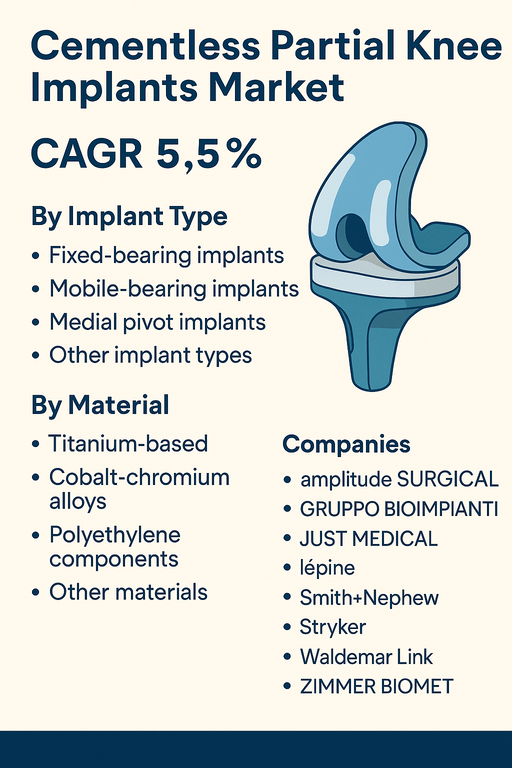
The global cementless partial knee implants market is projected to grow at a CAGR of 5.5% from 2026 to 2034, driven by an increasing aging population, rising incidence of osteoarthritis, and growing patient preference for minimally invasive and bone-preserving procedures. Cementless implants are designed to promote natural bone ingrowth, offering long-term fixation without the use of bone cement. These implants are especially favored among younger, active patients due to their potential for better long-term outcomes and ease of revision if needed in the future.
Rising Demand for Bone-Conserving, Minimally Invasive Solutions
As patients increasingly seek joint replacement options that allow for faster recovery, reduced complications, and preservation of healthy bone, cementless partial knee implants are gaining popularity. Unlike cemented implants, cementless alternatives rely on porous surfaces and specialized coatings that enable osseointegration, reducing the risks of cement loosening and long-term wear. Surgeons are increasingly adopting cementless designs to treat unicompartmental knee osteoarthritis, especially in medial compartments, allowing for better kinematics and reduced surgical trauma.
Technological Advancements in Implant Design and Material Science
Ongoing innovation in implant engineering, materials, and robotic-assisted surgery is further propelling market growth. Newer implant designs feature enhanced anatomical conformity, improved articulation surfaces, and fixation coatings such as titanium plasma spray and hydroxyapatite, which encourage bone in-growth. Robotic systems and navigation tools are enabling more accurate implant positioning and alignment, thereby increasing the success rates of cementless procedures. These technological advancements are also reducing surgical variability and enabling more personalized, patient-specific procedures.
Barriers to Adoption in Complex or Elderly Cases
Despite their clinical advantages, cementless partial knee implants face limitations in certain patient populations. Patients with poor bone quality, osteoporosis, or multi-compartmental arthritis may not be ideal candidates, as osseointegration may be compromised. Furthermore, surgeons require additional training and experience to adopt cementless techniques effectively. The higher upfront cost of these implants, along with the need for specialized instrumentation and longer operative times in some cases, can limit adoption in cost-sensitive or low-resource healthcare settings.
Market Segmentation by Implant Type
By implant type, the market is segmented into fixed-bearing implants, mobile-bearing implants, medial pivot implants, and other implant types. Fixed-bearing implants held the largest market share in 2025, owing to their simplicity, cost-effectiveness, and widespread adoption in standard clinical practice. Mobile-bearing implants are expected to grow steadily, particularly among younger patients due to their enhanced range of motion and reduced contact stress. Medial pivot implants are gaining traction for their ability to replicate natural knee motion and improve joint stability, especially in high-demand patients.
Market Segmentation by Material
By material, the market is segmented into titanium-based, cobalt-chromium alloys, polyethylene components, and other materials. In 2025, titanium-based implants were widely used due to their excellent biocompatibility, osseointegration properties, and corrosion resistance. Cobalt-chromium alloys are also prominent for their high strength and wear resistance, particularly in femoral components. Polyethylene components are crucial for articulating surfaces in knee implants and are evolving with cross-linking and antioxidant enhancements to improve longevity and performance.
Regional Market Insights
North America accounted for the largest share of the cementless partial knee implants market in 2025, driven by a high volume of knee replacement procedures, early adoption of cementless technology, and favorable reimbursement frameworks in the U.S. Europe followed, particularly in countries such as Germany, France, and the UK, where patient-specific implant technologies and robotic-assisted surgeries are gaining acceptance. Asia Pacific is anticipated to witness the fastest CAGR through 2034 due to rising healthcare infrastructure, increasing elderly population, and growing awareness about advanced orthopedic solutions in countries like India, China, and Japan. Latin America and the Middle East & Africa are emerging markets where urbanization, healthcare modernization, and medical tourism are expected to create new opportunities.
Competitive Landscape
The cementless partial knee implants market in 2025 was led by a mix of global orthopedic leaders and regional implant specialists. Stryker, Zimmer Biomet, and Smith+Nephew held dominant positions with extensive portfolios, advanced implant technologies, and integration with navigation and robotic platforms. Medacta and Waldemar Link focused on minimally invasive and patient-matched solutions for partial knee arthroplasty. Amplitude Surgical and GRUPPO BIOIMPIANTI offered innovative cementless implant designs catering to European and international markets. JUST MEDICAL and lépine targeted niche orthopedic segments with specialized instrumentation and implant customization. Strategic focus areas for key players include enhanced implant longevity, minimally invasive delivery systems, and digital integration to improve preoperative planning and postoperative outcomes.
Historical & Forecast Period
This study report represents analysis of each segment from 2024 to 2034 considering 2025 as the base year. Compounded Annual Growth Rate (CAGR) for each of the respective segments estimated for the forecast period of 2026 to 2034.
The current report comprises of quantitative market estimations for each micro market for every geographical region and qualitative market analysis such as micro and macro environment analysis, market trends, competitive intelligence, segment analysis, porters five force model, top winning strategies, top investment markets, emerging trends and technological analysis, case studies, strategic conclusions and recommendations and other key market insights.
Research Methodology
The complete research study was conducted in three phases, namely: secondary research, primary research, and expert panel review. key data point that enables the estimation of Cementless Partial Knee Implants market are as follows:
Market forecast was performed through proprietary software that analyzes various qualitative and quantitative factors. Growth rate and CAGR were estimated through intensive secondary and primary research. Data triangulation across various data points provides accuracy across various analyzed market segments in the report. Application of both top down and bottom-up approach for validation of market estimation assures logical, methodical and mathematical consistency of the quantitative data.
| ATTRIBUTE | DETAILS |
|---|---|
| Research Period | 2024-2034 |
| Base Year | 2025 |
| Forecast Period | 2026-2034 |
| Historical Year | 2024 |
| Unit | USD Million |
| Segmentation | |
Implant Type
|
|
Material
|
|
End Use
|
|
|
Region Segment (2024-2034; US$ Million)
|
Key questions answered in this report