
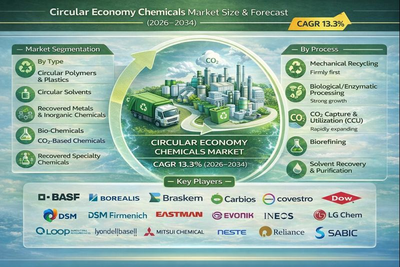
The circular economy chemicals market is expected to grow at a CAGR of 13.3% during 2026–2034, driven by increasing regulatory pressure on waste reduction, carbon neutrality targets, and rising demand for sustainable chemical production pathways. Circular chemicals enable reuse of materials, recovery of valuable resources, and conversion of waste and emissions into high-value chemical products. Adoption of circular polymers, solvents, bio-chemicals, and CO₂-based chemicals is supporting the transition from linear to regenerative chemical value chains. Growing corporate sustainability commitments and circular supply contracts are further strengthening market expansion.
Market Drivers
Market growth is driven by strict environmental regulations, extended producer responsibility programs, and strong demand for recycled and low-carbon chemical inputs. Packaging, automotive, construction, electronics, and consumer goods industries are increasing the use of circular polymers and solvents. Rising investment in chemical recycling, CCU, and biorefining technologies is improving commercial feasibility. Corporate net-zero commitments and ESG reporting requirements are accelerating adoption of circular chemical solutions across global supply chains.
Market Restraints
The market faces restraints related to high capital investment, process complexity, feedstock variability, and limited large-scale infrastructure. Cost competitiveness with virgin chemicals remains a challenge in several applications. Technology maturity differs across recycling and CCU pathways, increasing operational risk. Regulatory certification complexity and lack of uniform circular standards also limit faster market penetration.
Market Segmentation
By Type
By type, the market is segmented into circular polymers & plastics, circular solvents, recovered metals & inorganic chemicals, bio-chemicals, CO₂-based chemicals, and recovered specialty chemicals. Circular polymers & plastics hold a major share due to high demand from packaging, automotive, and consumer goods industries. Circular solvents are gaining adoption in pharmaceuticals, coatings, and electronics manufacturing. Recovered metals & inorganic chemicals support battery, electronics, and industrial applications. Bio-chemicals are witnessing strong growth driven by renewable feedstock utilization. CO₂-based chemicals are emerging as a key decarbonization route. Recovered specialty chemicals support high-value performance and electronic material applications.
By Process
By process, the market is segmented into mechanical recycling, chemical recycling, biological/enzymatic processing, CO₂ capture & utilization (CCU), biorefining, and solvent recovery & purification. Mechanical recycling dominates due to cost efficiency and established infrastructure. Chemical recycling is expanding rapidly for mixed and contaminated waste streams. Biological and enzymatic processing supports low-energy and bio-based pathways. CCU is gaining strong momentum under carbon neutrality strategies. Biorefining enables multi-product recovery from biomass. Solvent recovery and purification support closed-loop industrial solvent systems.
Regional Insights
Europe leads the circular economy chemicals market due to strong regulatory enforcement, advanced recycling infrastructure, and corporate sustainability mandates. North America follows with growing chemical recycling investments and industrial circular adoption. Asia Pacific shows fast growth supported by manufacturing scale, waste management reforms, and sustainability policies. Latin America and the Middle East & Africa represent emerging markets driven by industrial modernization and waste valorization initiatives.
Competitive Landscape
The market is moderately fragmented, with companies focusing on technology ownership, recycling efficiency, feedstock sourcing, and vertical integration. Strategic partnerships, pilot plant investments, digital material tracking, and scale-up of chemical recycling and CCU platforms are key competitive strategies. Expansion of circular product portfolios across polymers, solvents, and specialty chemicals is shaping competition.
Key companies operating in the market include BASF SE, Borealis AG, Braskem S.A., Carbios SA, Covestro AG, Dow Inc., DSM-Firmenich, Eastman Chemical Company, Evonik Industries AG, INEOS Group, LG Chem Ltd., Loop Industries Inc., LyondellBasell Industries N.V., Mitsubishi Chemical Group Corporation, Mitsui Chemicals Inc., Neste Oyj, Reliance Industries Limited, SABIC, Solvay S.A., and Veolia Environnement S.A.
Historical & Forecast Period
This study report represents analysis of each segment from 2024 to 2034 considering 2025 as the base year. Compounded Annual Growth Rate (CAGR) for each of the respective segments estimated for the forecast period of 2026 to 2034.
The current report comprises of quantitative market estimations for each micro market for every geographical region and qualitative market analysis such as micro and macro environment analysis, market trends, competitive intelligence, segment analysis, porters five force model, top winning strategies, top investment markets, emerging trends and technological analysis, case studies, strategic conclusions and recommendations and other key market insights.
Research Methodology
The complete research study was conducted in three phases, namely: secondary research, primary research, and expert panel review. key data point that enables the estimation of Circular Economy Chemicals Market By Type, By Process, By End Use - Growth, Share, Opportunities & Competitive Analysis, 2026 - 2034 market are as follows:
Market forecast was performed through proprietary software that analyzes various qualitative and quantitative factors. Growth rate and CAGR were estimated through intensive secondary and primary research. Data triangulation across various data points provides accuracy across various analyzed market segments in the report. Application of both top down and bottom-up approach for validation of market estimation assures logical, methodical and mathematical consistency of the quantitative data.
| ATTRIBUTE | DETAILS |
|---|---|
| Research Period | 2024-2034 |
| Base Year | 2025 |
| Forecast Period | 2026-2034 |
| Historical Year | 2024 |
| Unit | USD Million |
| Segmentation | |
Type
|
|
Process
|
|
End Use Industry
|
|
|
Region Segment (2024-2034; US$ Million)
|
Frequently Asked Questions
What is the growth outlook for the circular economy chemicals market?
The market is expected to grow at a CAGR of 13.3% during 2026–2034, supported by sustainability regulations and circular production adoption.
Which type segment is growing fastest?
CO₂-based chemicals and bio-chemicals are growing fastest due to decarbonization and renewable feedstock demand.
Which process dominates the market?
Mechanical recycling dominates due to cost efficiency and established infrastructure.
Which region leads the market?
Europe leads the market, followed by North America and Asia Pacific.
What are the key challenges in this market?
High capital cost, feedstock variability, technology scale-up, and regulatory complexity are major challenges.


