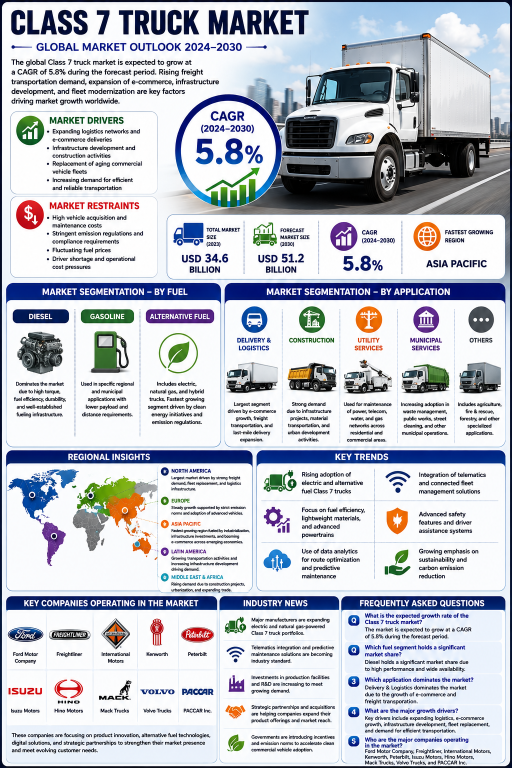
The global Class 7 truck market is expected to grow at a CAGR of 5.8% during the forecast period. Market growth is driven by increasing freight transportation demand, rapid expansion of e-commerce activities, rising investments in urban logistics infrastructure, and growing replacement of aging commercial vehicle fleets. Class 7 trucks serve as a critical link between medium-duty and heavy-duty transportation, offering high payload capacity, operational flexibility, and cost-efficient freight movement. Growing demand from delivery services, construction activities, utility operations, and municipal applications continues to support market expansion worldwide.
Market Drivers
Expanding Logistics Networks and Rising E-Commerce Deliveries
The continued growth of e-commerce, retail distribution, and last-mile delivery services is creating significant demand for Class 7 trucks across urban and regional transportation networks. Logistics operators are expanding fleet capacities to accommodate increasing shipment volumes and improve delivery efficiency. Investments in warehousing infrastructure, distribution centers, and transportation networks are further supporting market growth. Additionally, infrastructure development projects and construction activities are generating demand for medium-heavy commercial vehicles capable of transporting materials and equipment efficiently.
Market Restraints
High Vehicle Acquisition Costs and Emission Compliance Requirements
Class 7 trucks require substantial capital investment, particularly for fleets adopting advanced safety systems, fuel-efficient powertrains, and alternative fuel technologies. Stringent emission regulations across multiple regions are increasing compliance costs for manufacturers and fleet operators. Rising fuel prices, maintenance expenses, and driver shortages can also impact profitability and influence purchasing decisions within the commercial transportation sector.
Class 7 Truck Market Trends
The market is witnessing increasing adoption of alternative fuel vehicles, advanced telematics systems, connected fleet management technologies, and driver assistance features. Manufacturers are focusing on fuel efficiency improvements, electric and natural gas-powered trucks, predictive maintenance solutions, and enhanced vehicle safety technologies. Fleet operators are increasingly utilizing real-time tracking, route optimization, and data analytics platforms to improve operational efficiency and reduce transportation costs. Sustainability initiatives and carbon emission reduction targets are further encouraging the development of cleaner commercial vehicle technologies.
Market Segmentation
By Fuel
Based on fuel, the market is segmented into Diesel, Gasoline, and Alternative Fuel. Diesel-powered Class 7 trucks account for a significant market share due to their superior torque performance, widespread fueling infrastructure, and suitability for long-distance and heavy-load transportation applications. Gasoline-powered trucks continue to serve selected regional and municipal applications where operational requirements are less demanding. Alternative fuel trucks, including electric, natural gas, and hybrid-powered vehicles, are witnessing strong growth due to increasing environmental regulations, government incentives, and fleet sustainability initiatives.
By Application
Based on application, the market is segmented into Delivery & Logistics, Construction, Utility Services, Municipal Services, and Others. Delivery & Logistics holds a major market share owing to the rapid expansion of e-commerce activities, freight transportation demand, and regional distribution networks. Construction remains a significant segment supported by infrastructure development projects and urban expansion activities. Utility services continue to generate steady demand for specialized truck applications used in maintenance and service operations. Municipal services are increasingly adopting modern truck fleets for waste management, public works, and transportation-related activities.
Regional Insights
North America represents a major market for Class 7 trucks due to strong freight transportation activity, extensive logistics networks, and significant commercial vehicle replacement demand. The United States continues to dominate regional sales owing to expanding e-commerce operations, infrastructure investments, and fleet modernization initiatives. Europe is witnessing steady growth supported by commercial transportation demand, stricter emission standards, and increasing adoption of alternative fuel trucks. Asia Pacific is expected to record the fastest growth during the forecast period due to rapid industrialization, growing logistics sectors, infrastructure development projects, and expanding commercial vehicle demand across China, India, Japan, South Korea, and Southeast Asia. Latin America and the Middle East & Africa are also experiencing increasing demand as transportation infrastructure and commercial activities continue to expand.
Competitive Landscape
The Class 7 truck market is highly competitive, with manufacturers focusing on fuel efficiency, alternative fuel technologies, advanced safety systems, connected vehicle solutions, and fleet management capabilities. Companies are investing in electric truck development, telematics integration, autonomous driving technologies, and sustainability-focused innovations to strengthen their market positions. Strategic partnerships, dealer network expansion, product portfolio diversification, and after-sales service support remain critical growth strategies. Competitive differentiation increasingly depends on vehicle reliability, operating cost efficiency, technology integration, and compliance with evolving environmental regulations.
Key Companies Operating in the Market Include
Key companies operating in the Class 7 truck market include Ford Motor Company, Freightliner, International Motors, Kenworth, Peterbilt, Isuzu Motors, Hino Motors, Mack Trucks, Volvo Trucks, and PACCAR Inc. These companies are focusing on fuel-efficient powertrains, advanced telematics systems, alternative fuel vehicle technologies, enhanced safety features, and connected fleet solutions to strengthen their market positions. Continuous investments in vehicle innovation, sustainability initiatives, driver assistance technologies, and fleet optimization capabilities are helping these companies maintain strong competitive positions across global commercial transportation markets.
Class 7 Truck Industry News
The industry is witnessing increasing investments in electric commercial vehicles, connected fleet technologies, and advanced driver assistance systems. Manufacturers are introducing next-generation trucks equipped with telematics platforms, predictive maintenance capabilities, and enhanced fuel efficiency technologies to improve fleet performance. Fleet operators are increasingly adopting route optimization software and real-time vehicle monitoring systems to reduce operating costs and improve delivery efficiency. Growing sustainability commitments and stricter emission regulations are expected to accelerate adoption of alternative fuel and zero-emission Class 7 truck platforms during the forecast period.
Historical & Forecast Period
This study report represents analysis of each segment from 2024 to 2034 considering 2025 as the base year. Compounded Annual Growth Rate (CAGR) for each of the respective segments estimated for the forecast period of 2026 to 2034.
The current report comprises of quantitative market estimations for each micro market for every geographical region and qualitative market analysis such as micro and macro environment analysis, market trends, competitive intelligence, segment analysis, porters five force model, top winning strategies, top investment markets, emerging trends and technological analysis, case studies, strategic conclusions and recommendations and other key market insights.
Research Methodology
The complete research study was conducted in three phases, namely: secondary research, primary research, and expert panel review. key data point that enables the estimation of Class 7 Trucks market are as follows:
Market forecast was performed through proprietary software that analyzes various qualitative and quantitative factors. Growth rate and CAGR were estimated through intensive secondary and primary research. Data triangulation across various data points provides accuracy across various analyzed market segments in the report. Application of both top down and bottom-up approach for validation of market estimation assures logical, methodical and mathematical consistency of the quantitative data.
| ATTRIBUTE | DETAILS |
|---|---|
| Research Period | 2024-2034 |
| Base Year | 2025 |
| Forecast Period | 2026-2034 |
| Historical Year | 2024 |
| Unit | USD Million |
| Segmentation | |
Fuel
|
|
Application
|
|
Axle
|
|
Horsepower
|
|
Ownership
|
|
Transmission
|
|
|
Region Segment (2024-2034; US$ Million)
|
Frequently Asked Questions
What is the expected growth rate of the Class 7 truck market?
The Class 7 truck market is expected to grow at a CAGR of 5.8% during the forecast period.
Which fuel segment holds a significant market share?
Diesel-powered trucks hold a significant market share due to their strong performance, durability, and widespread fueling infrastructure.
Which application dominates the market?
Delivery & Logistics dominates the market owing to increasing freight transportation demand and the rapid growth of e-commerce distribution networks.
What are the major growth drivers?
Major growth drivers include expanding logistics infrastructure, increasing e-commerce deliveries, fleet modernization initiatives, infrastructure development projects, and growing demand for efficient freight transportation solutions.
Who are the major companies operating in the market?
Major companies include Ford Motor Company, Freightliner, International Motors, Kenworth, Peterbilt, Isuzu Motors, Hino Motors, Mack Trucks, Volvo Trucks, and PACCAR Inc.