Next-generation battery chemistries are accelerating the transition toward sustainable, cost-effective, and high-performance energy storage solutions.
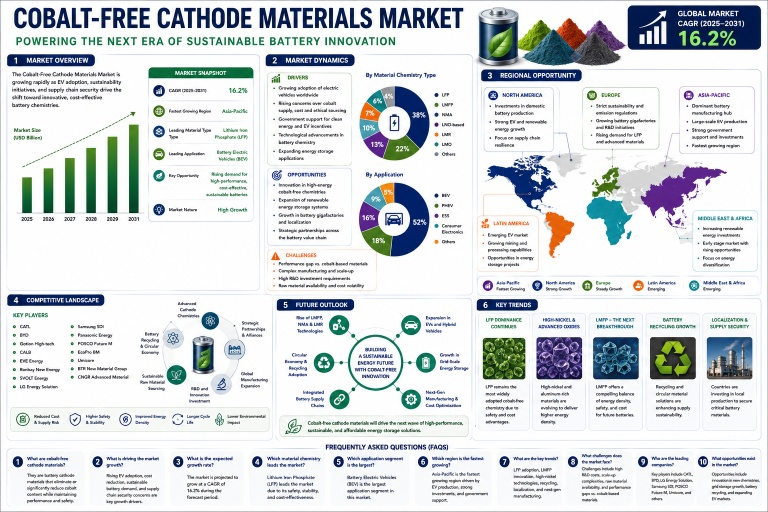
The global cobalt-free cathode materials market is experiencing robust growth as battery manufacturers and electric vehicle (EV) producers increasingly shift toward cathode chemistries that reduce dependence on cobalt while maintaining high energy density, safety, and cost efficiency. Growing concerns regarding cobalt supply chain risks, price volatility, ethical sourcing challenges, and geopolitical uncertainties are encouraging the development and commercialization of alternative cathode materials. Continuous innovation in battery technology, expanding electric vehicle production, and rising investments in renewable energy storage are expected to drive market expansion. As demand for sustainable battery materials continues to grow, the market is projected to register a CAGR of 16.2% during the forecast period.
Key Growth Driver
Increasing adoption of electric vehicles and demand for sustainable battery materials are driving market growth globally.
Automotive manufacturers and battery producers are actively investing in cobalt-free cathode technologies to improve supply chain resilience, reduce production costs, and address environmental and ethical concerns associated with cobalt mining. At the same time, government incentives supporting EV adoption, growing investments in battery manufacturing facilities, and expanding renewable energy storage infrastructure are accelerating the commercialization of cobalt-free battery chemistries across multiple applications.
Segment Highlight
Material innovation and battery chemistry advancements continue to reshape the future of lithium-ion batteries.
Based on material chemistry type, Lithium Iron Phosphate (LFP) accounts for a significant share of the market owing to its excellent thermal stability, long cycle life, enhanced safety, and cost-effectiveness. Lithium Manganese Iron Phosphate (LMFP) is gaining considerable attention by offering improved energy density while maintaining many of the advantages associated with LFP chemistry. Nickel-Manganese-Aluminum Oxide (NMA) and High-nickel Layered Oxides (LNO-based) are witnessing increased research and commercialization efforts to deliver higher battery performance with reduced cobalt content. Lithium-rich Layered Oxides (LMR) and Manganese-based Spinels (LMO) continue to provide promising opportunities for next-generation battery technologies, while other emerging chemistries further diversify the market.
By application, Battery Electric Vehicles (BEV) represent the largest market segment due to rapidly increasing global EV production and growing demand for longer-lasting, safer, and lower-cost batteries. Plug-in Hybrid Electric Vehicles (PHEV) continue to adopt advanced cobalt-free battery chemistries to improve efficiency and affordability. Stationary Energy Storage Systems (ESS) are emerging as a significant growth area driven by renewable energy integration and grid modernization. Consumer Electronics also contribute to market demand as manufacturers seek safer and more sustainable battery materials, while other industrial applications continue to expand.
Regional Opportunity
Asia-Pacific leads global production, while North America and Europe continue accelerating investments in localized battery supply chains.
Asia-Pacific maintains a dominant position in the cobalt-free cathode materials market due to its extensive battery manufacturing ecosystem, expanding electric vehicle production, strong government support, and significant investments in battery material processing across China, Japan, and South Korea. Europe is witnessing substantial growth driven by battery gigafactory investments, sustainability regulations, and increasing EV adoption. North America continues to strengthen its market position through investments in domestic battery manufacturing, critical mineral supply chains, and clean energy initiatives, while emerging economies continue expanding battery production capabilities.
Competitive Landscape
Industry participants are focusing on advanced battery chemistries, localized manufacturing, and strategic partnerships to strengthen competitive positioning.
Leading companies are investing in high-performance cobalt-free cathode materials, advanced manufacturing technologies, battery recycling, and sustainable raw material sourcing to improve battery safety, energy density, and affordability. Strategic collaborations between battery manufacturers, automotive OEMs, material suppliers, and research institutions continue to accelerate commercialization of next-generation cathode technologies. Companies are also expanding global production capacity, enhancing supply chain resilience, and increasing investment in research and development to support future battery innovation.
Key companies operating in the market include CATL, BYD, Gotion High-tech, CALB, EVE Energy, Ronbay New Energy, SVOLT Energy, LG Energy Solution, Samsung SDI, Panasonic Energy, POSCO Future M, EcoPro BM, Umicore, BTR New Material Group, and CNGR Advanced Material.
Historical & Forecast Period
This study report represents analysis of each segment from 2024 to 2034 considering 2025 as the base year. Compounded Annual Growth Rate (CAGR) for each of the respective segments estimated for the forecast period of 2026 to 2034.
The current report comprises of quantitative market estimations for each micro market for every geographical region and qualitative market analysis such as micro and macro environment analysis, market trends, competitive intelligence, segment analysis, porters five force model, top winning strategies, top investment markets, emerging trends and technological analysis, case studies, strategic conclusions and recommendations and other key market insights.
Research Methodology
The complete research study was conducted in three phases, namely: secondary research, primary research, and expert panel review. key data point that enables the estimation of Cobalt-Free Cathode Materials market are as follows:
Market forecast was performed through proprietary software that analyzes various qualitative and quantitative factors. Growth rate and CAGR were estimated through intensive secondary and primary research. Data triangulation across various data points provides accuracy across various analyzed market segments in the report. Application of both top down and bottom-up approach for validation of market estimation assures logical, methodical and mathematical consistency of the quantitative data.
| ATTRIBUTE | DETAILS |
|---|---|
| Research Period | 2024-2034 |
| Base Year | 2025 |
| Forecast Period | 2026-2034 |
| Historical Year | 2024 |
| Unit | USD Million |
| Segmentation | |
Material Chemistry Type
|
|
Application
|
|
End User
|
|
|
Region Segment (2024-2034; US$ Million)
|
Frequently Asked Questions
Q1. What is driving the growth of the Cobalt-Free Cathode Materials Market?
The market is primarily driven by increasing electric vehicle adoption, growing demand for sustainable battery materials, concerns regarding cobalt supply chains, advancements in battery technology, and expanding renewable energy storage applications.
Q2. What is the expected growth rate of the Cobalt-Free Cathode Materials Market?
The global Cobalt-Free Cathode Materials Market is projected to expand at a CAGR of 16.2% during the forecast period.
Q3. What are cobalt-free cathode materials?
Cobalt-free cathode materials are advanced battery materials designed to eliminate or significantly reduce cobalt content while maintaining battery performance, safety, durability, and energy storage efficiency in lithium-ion batteries.
Q4. Which material chemistry segment accounts for a significant market share?
Lithium Iron Phosphate (LFP) accounts for a significant market share due to its excellent safety profile, long operational life, thermal stability, and cost-effective manufacturing.
Q5. Why are manufacturers increasingly adopting cobalt-free battery chemistries?
Cobalt-free battery chemistries help reduce production costs, improve supply chain security, address ethical sourcing concerns, enhance thermal stability, and support long-term sustainability objectives.
Q6. Which application segment leads the market?
Battery Electric Vehicles (BEV) represent the leading application segment owing to rapidly growing global EV production and increasing demand for affordable, high-performance battery technologies.
Q7. Which region is expected to witness the fastest market growth?
Asia-Pacific is expected to maintain the fastest market growth due to its large-scale battery manufacturing capacity, expanding electric vehicle industry, strong government support, and continuous investments in battery innovation.
Q8. What trends are influencing the Cobalt-Free Cathode Materials Market?
Major trends include rapid adoption of LFP batteries, development of LMFP technologies, battery recycling, localized battery manufacturing, next-generation cathode research, and increasing investments in sustainable battery supply chains.
Q9. Who are the leading companies operating in the Cobalt-Free Cathode Materials Market?
Major companies include CATL, BYD, Gotion High-tech, CALB, EVE Energy, Ronbay New Energy, SVOLT Energy, LG Energy Solution, Samsung SDI, Panasonic Energy, POSCO Future M, EcoPro BM, Umicore, BTR New Material Group, and CNGR Advanced Material.
Q10. What opportunities are expected to shape the future of the market?
Growing investments in battery gigafactories, expansion of renewable energy storage, continuous innovation in cobalt-free chemistries, advancements in battery recycling, and increasing global EV adoption are expected to create substantial growth opportunities throughout the forecast period.