
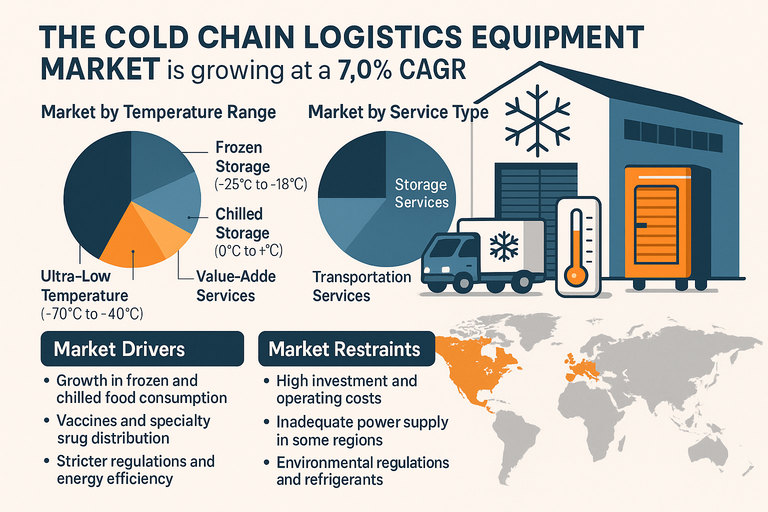
The cold chain logistics equipment market is growing at a 7.0% CAGR as food, pharmaceutical, and chemical supply chains expand temperature-sensitive distribution and tighten compliance with quality and safety standards. Growth is driven by rising trade in frozen and chilled foods, vaccine and biologics distribution, and the shift from simple cold rooms to integrated cold chain networks with monitoring, backup systems, and energy-efficient designs. Within temperature ranges, frozen storage (-25°C to -18°C) currently generates the highest revenue because it supports large volumes of frozen meat, seafood, ready meals, and ice cream, while ultra-low temperature (-70°C to -40°C) equipment is expected to post the highest CAGR as demand rises for biologics, specialty pharmaceuticals, and high-value ingredients. By service type, storage services account for the largest revenue share today due to large cold warehouses and distribution centers, whereas value-added services are expected to record the highest CAGR as operators bundle pre-cooling, repacking, kitting, labeling, and condition monitoring into premium offerings.
Market Drivers
Growth in the cold chain logistics equipment market is driven by higher consumption of frozen and chilled foods, urbanization, and the rise of organized retail and e-commerce in both developed and emerging regions. Supermarkets, quick-service restaurants, and last-mile delivery platforms require reliable temperature-controlled storage and transport to avoid spoilage and brand damage. In pharmaceuticals, vaccines, biologics, and specialty drugs must comply with strict temperature ranges from plant to patient, which pushes investment in cold rooms, ultra-low temperature systems, refrigerated containers, and truck refrigeration units. Regulatory pressure on food safety and Good Distribution Practice (GDP) for medicines leads to tighter qualification and validation of equipment, driving upgrades from basic systems to fully monitored, alarmed, and automated facilities. Energy efficiency is another driver: operators seek newer refrigeration systems, advanced controls, and well-insulated panels to lower power bills and improve sustainability, which supports replacement of older assets.
Market Restraints
Despite strong demand, the market faces restraints from high initial capital investment and operating costs. Building and maintaining cold warehouses, blast freezers, and refrigerated transport fleets requires significant spending on equipment, insulation, land, and energy infrastructure. In many emerging markets, unstable power supply and high electricity tariffs raise operating risk and cost. Skilled technicians for refrigeration, controls, and maintenance are in short supply in some regions, which can lead to downtime and poor utilization. Fragmented ownership of small cold stores and independent transporters makes it difficult to standardize equipment and implement modern monitoring systems. For very low temperature ranges, specialized equipment and backup systems are costly, limiting adoption to the highest-value products. Environmental regulations around refrigerants and emissions also force operators to invest in new technologies and phase out older systems sooner than planned, which can strain budgets.
Market by Temperature Range
Frozen storage (-25°C to -18°C) covers equipment such as blast freezers, frozen warehouses, and refrigerated containers used for meat, poultry, seafood, frozen vegetables, and ready meals. This segment benefits from strong and stable demand in retail, foodservice, and export supply chains, and within temperature ranges it currently generates the highest revenue. Chilled storage (0°C to +8°C) supports dairy, fresh meat, cut fruits and vegetables, and many pharmaceutical products; it requires tight temperature control and frequent door openings, which drives demand for efficient doors, racking, and airflow solutions. Cool storage (+8°C to +15°C) is used for certain beverages, processed foods, and some pharmaceutical products, often as buffer zones between chilled and ambient conditions. Ambient plus (+15°C to +25°C) equipment serves chocolate, nutraceuticals, and temperature-sensitive dry goods, focusing more on stability than deep cooling. Ultra-low temperature (-70°C to -40°C) equipment is used for vaccines, cell and gene therapies, biological samples, and some high-value ingredients; from a smaller base, this segment is expected to post the highest CAGR as healthcare and biotech supply chains grow and as more products require deep-frozen storage and secure transport.
Market by Service Type
Storage services rely on cold rooms, large distribution centers, and specialized warehouses fitted with racking, insulated panels, refrigeration units, and control systems. These facilities handle inbound consolidation, stock holding, and outbound order preparation for food and pharma customers; within service types, storage services currently generate the highest revenue, as they anchor the fixed infrastructure of the cold chain. Transportation services use refrigerated trucks, trailers, containers, and marine reefers, often with multi-temperature compartments and telematics systems. This segment grows steadily as retailers and manufacturers outsource transport to specialist carriers and as last-mile demand for refrigerated vehicles increases. Value-added services include pre-cooling, blast freezing, repacking, sorting, labeling, palletization, kitting, and temperature monitoring and data reporting for compliance. As customers demand integrated solutions and end-to-end visibility, value-added services are expected to record the highest CAGR, driven by higher margins and stronger customer retention for operators that invest in modern equipment and digital tools.
Regional Insights
In developed markets such as North America and Europe, the cold chain logistics equipment base is mature but continues to upgrade toward higher energy efficiency, lower-GWP refrigerants, and better digital monitoring. New investments focus on automated high-bay cold stores, advanced control systems, and telematics for fleets. In Asia Pacific, strong growth in processed food consumption, urban retail formats, and pharmaceutical manufacturing drives large greenfield projects for cold warehouses, reefer fleets, and integrated cold chain corridors; this region is expected to be one of the fastest-growing markets for new cold chain equipment. The Middle East, with strong import dependence for food and growing pharma distribution hubs, is investing in port-based cold storage and regional distribution centers. Latin America and Africa are expanding cold chain capacity from a low base, supported by export agriculture, seafood, and donor-funded vaccine programs, but still face infrastructure and power challenges. Regions that combine rising middle-class demand, supportive government policies, and investment in power and transport networks will see the strongest equipment demand.
Competitive Landscape
Bureida Trading & Refrigeration, Coldstores Group of Saudi Arabia (CGS), TSSC, DANA Steel, Thermodynamics, and Zhengzhou Kaixue Cold Chain are active in regional cold chain projects, supplying insulated panels, cold rooms, and turnkey installations tailored to local food and pharmaceutical customers. Carrier Transicold (United Technologies) and Thermo King (Trane Technologies) are leading suppliers of transport refrigeration units for trucks, trailers, and containers, with strong service networks and a focus on fuel-efficient, low-emission systems. China International Marine Containers plays a major role in refrigerated container production, supporting global seaborne cold chains. Daikin Industries, Danfoss, Emerson Electric (Copeland), and Johnson Controls supply compressors, controls, valves, and integrated HVACR systems that form the core of cold room and warehouse refrigeration plants. Rivacold, Zanotti, and Rivacold-type manufacturers focus on condensing units, packaged systems, and plug-in solutions for small to mid-size cold rooms and display equipment. ORBCOMM and similar telematics providers deliver remote monitoring, GPS tracking, and temperature logging solutions that add value to equipment already in the field. Companies that can offer energy-efficient, regulatory-compliant equipment, combined with strong local installation and service capabilities, are positioned to lead current revenue, while those that integrate digital monitoring, data analytics, and value-added services into their equipment offerings are likely to capture the highest CAGR in the cold chain logistics equipment market.
Historical & Forecast Period
This study report represents analysis of each segment from 2024 to 2034 considering 2025 as the base year. Compounded Annual Growth Rate (CAGR) for each of the respective segments estimated for the forecast period of 2026 to 2034.
The current report comprises of quantitative market estimations for each micro market for every geographical region and qualitative market analysis such as micro and macro environment analysis, market trends, competitive intelligence, segment analysis, porters five force model, top winning strategies, top investment markets, emerging trends and technological analysis, case studies, strategic conclusions and recommendations and other key market insights.
Research Methodology
The complete research study was conducted in three phases, namely: secondary research, primary research, and expert panel review. key data point that enables the estimation of Cold Chain Logistics Equipment Market By Equipment Type, By Temperature Range, By Service Type, By Application, By End Use Industry, By Distribution Channel - Global Market Analysis & Forecast, 2025 to 2033 market are as follows:
Market forecast was performed through proprietary software that analyzes various qualitative and quantitative factors. Growth rate and CAGR were estimated through intensive secondary and primary research. Data triangulation across various data points provides accuracy across various analyzed market segments in the report. Application of both top down and bottom-up approach for validation of market estimation assures logical, methodical and mathematical consistency of the quantitative data.
| ATTRIBUTE | DETAILS |
|---|---|
| Research Period | 2024-2034 |
| Base Year | 2025 |
| Forecast Period | 2026-2034 |
| Historical Year | 2024 |
| Unit | USD Million |
| Segmentation | |
Equipment Type
|
|
Temperature Range
|
|
Service Type
|
|
Application
|
|
End Use Industry
|
|
Distribution Channel
|
|
|
Region Segment (2024-2034; US$ Million)
|
Key questions answered in this report


