
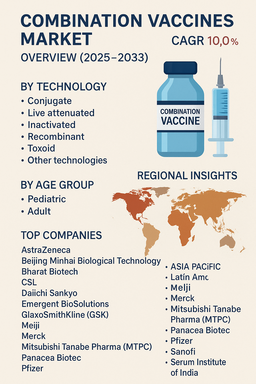
The global combination vaccines market is projected to grow at a CAGR of 10.0% from 2026 to 2034, supported by rising immunization programs, growing pediatric vaccination rates, and increasing demand for cost-effective solutions that reduce the number of injections required. Combination vaccines integrate multiple antigens into a single formulation, enhancing patient compliance and coverage while lowering healthcare delivery costs. Global health organizations, government vaccination drives, and technological innovation in recombinant and conjugate platforms are fueling adoption across both pediatric and adult populations.
Rising Demand for Immunization and Simplified Healthcare Delivery
The rising prevalence of infectious diseases, coupled with the need for streamlined vaccination schedules, is driving demand for combination vaccines worldwide. Pediatric immunization programs are expanding significantly, with combination formulations providing a critical tool for reducing the number of clinic visits and injections for children. Adult immunization, including vaccines for influenza, hepatitis, and COVID-19 booster programs, is also reinforcing market growth. Increasing collaboration between governments, NGOs, and pharmaceutical companies to ensure equitable vaccine access is further boosting demand.
Challenges: Regulatory Complexities and Cold Chain Requirements
Despite the growth trajectory, the combination vaccines market faces challenges such as complex regulatory approval processes, which can delay the introduction of new products. Cold chain requirements and supply chain limitations in low- and middle-income countries hinder accessibility and distribution. Additionally, concerns around vaccine hesitancy and adverse events can impact uptake in certain populations. However, ongoing investments in next-generation platforms, improved cold chain solutions, and widespread awareness campaigns are expected to mitigate these barriers.
Market Segmentation by Technology
By technology, conjugate vaccines hold a significant share due to their proven effectiveness in pediatric immunization programs against diseases like pneumococcal and meningococcal infections. Live attenuated vaccines continue to play a major role in providing durable immunity, while inactivated vaccines are widely adopted for their safety profiles. Recombinant vaccines are gaining momentum, leveraging genetic engineering to deliver high efficacy and safety. Toxoid vaccines remain essential in preventing diseases such as diphtheria and tetanus. Other technologies are being explored for novel formulations to address emerging infectious diseases.
Market Segmentation by Age Group
By age group, pediatric vaccines dominate the market, driven by large-scale immunization programs supported by WHO, UNICEF, and national governments. Adult vaccines represent a growing segment, supported by booster programs, aging populations, and rising emphasis on preventing infectious diseases across all age groups.
Regional Insights
In 2025, North America led the global combination vaccines market, supported by robust immunization infrastructure, favorable reimbursement policies, and advanced biotechnology innovation. Europe followed closely, with strong vaccination coverage and significant investments in next-generation recombinant vaccines. Asia Pacific is the fastest-growing region, driven by large pediatric populations, government-supported immunization campaigns, and increasing domestic production by companies in India and China. Latin America is experiencing steady growth with expanded vaccine access programs, while the Middle East & Africa are gradually improving vaccine uptake with international funding and healthcare modernization.
Competitive Landscape
The 2025 combination vaccines market was dominated by multinational pharmaceutical leaders and regional vaccine manufacturers. GlaxoSmithKline (GSK), Pfizer, Sanofi, Merck, and AstraZeneca maintained strong global positions through extensive vaccine portfolios and international immunization partnerships. Serum Institute of India, Bharat Biotech, and Panacea Biotec played critical roles in affordable and large-scale vaccine production, particularly in emerging markets. Sinovac, Walvax Biotechnology, and Beijing Minhai Biological Technology strengthened Asia Pacific’s vaccine landscape. CSL, Daiichi Sankyo, Meiji, Mitsubishi Tanabe Pharma (MTPC), Takeda, and Emergent BioSolutions contributed through innovative R&D pipelines and regional supply chain capabilities. Competitive differentiation is being driven by recombinant and conjugate vaccine innovation, production scale, affordability, and strategic partnerships with global immunization programs.
Historical & Forecast Period
This study report represents analysis of each segment from 2024 to 2034 considering 2025 as the base year. Compounded Annual Growth Rate (CAGR) for each of the respective segments estimated for the forecast period of 2026 to 2034.
The current report comprises of quantitative market estimations for each micro market for every geographical region and qualitative market analysis such as micro and macro environment analysis, market trends, competitive intelligence, segment analysis, porters five force model, top winning strategies, top investment markets, emerging trends and technological analysis, case studies, strategic conclusions and recommendations and other key market insights.
Research Methodology
The complete research study was conducted in three phases, namely: secondary research, primary research, and expert panel review. key data point that enables the estimation of Combination Vaccines Market By Technology, By Age Group, By Disease, By End Use - Growth, Share, Opportunities & Competitive Analysis, 2026 - 2034 market are as follows:
Market forecast was performed through proprietary software that analyzes various qualitative and quantitative factors. Growth rate and CAGR were estimated through intensive secondary and primary research. Data triangulation across various data points provides accuracy across various analyzed market segments in the report. Application of both top down and bottom-up approach for validation of market estimation assures logical, methodical and mathematical consistency of the quantitative data.
| ATTRIBUTE | DETAILS |
|---|---|
| Research Period | 2024-2034 |
| Base Year | 2025 |
| Forecast Period | 2026-2034 |
| Historical Year | 2024 |
| Unit | USD Million |
| Segmentation | |
Technology
|
|
Age Group
|
|
Disease
|
|
End Use
|
|
|
Region Segment (2024-2034; US$ Million)
|
Key questions answered in this report


