
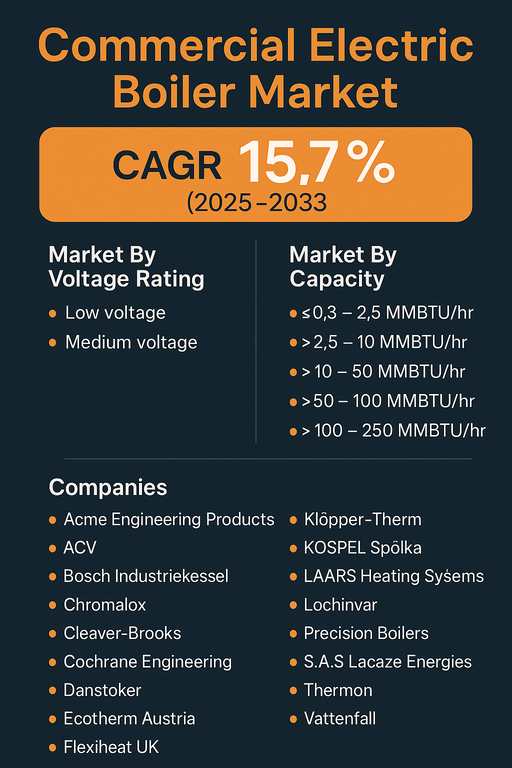
The commercial electric boiler market is projected to grow at a CAGR of 15.7% from 2026 to 2034, driven by decarbonization goals, electrification of heat, rising demand for clean energy solutions in commercial heating, and increasing adoption of zero-emission heating systems in public infrastructure, hospitality, education, and healthcare. Electric boilers offer reliable and sustainable alternatives to fossil-fueled systems, requiring minimal maintenance while ensuring precise temperature control.
Market Drivers
Global Decarbonization and Electrification Initiatives
Governments and commercial sectors are aggressively shifting from gas or oil-fired heating to electric alternatives to meet carbon neutrality targets. Electric boilers are zero-emission at the point of use and are being widely adopted in energy transition programs, particularly in Europe and North America.
Compatibility with Renewable Energy Grids
Electric boilers are increasingly integrated with renewable energy grids, enabling flexible heating solutions during off-peak hours or when excess solar or wind energy is available. This improves grid stability and supports green building certification in sectors such as hospitals, schools, and public buildings.
Rising Demand for Space- and Energy-Efficient Heating Systems
Modern electric boilers feature compact, modular designs with low noise and no flue gas emissions, making them suitable for installations in urban buildings, retrofits, and confined mechanical rooms. Their high efficiency (up to 99%) and scalability support long-term energy cost savings and operational sustainability.
Market Restraint
High Electricity Costs and Limited Heating Capacity in Certain Regions
In regions with high electricity tariffs or unstable grids, operating electric boilers can be more expensive than natural gas-based systems. Additionally, in extremely cold climates or large-scale heating needs, electric boilers may not match the heat output of high-capacity gas boilers, limiting their adoption in some sectors.
Market Segmentation by Voltage Rating
By voltage, the market is divided into Low Voltage and Medium Voltage systems. In 2025, low voltage boilers dominated the market due to their widespread use in small- to mid-size commercial buildings such as schools, clinics, and offices. Medium voltage boilers, typically used in large campuses, airports, and district heating systems, are expected to grow rapidly due to increasing infrastructure investments and the need for centralized low-emission heat supply in smart city projects.
Market Segmentation by Capacity
In 2025, the > 2.5 – 10 MMBTU/hr segment led the market, serving hospitals, mid-sized commercial complexes, and institutional campuses with balanced capacity and energy efficiency. However, the > 50 – 100 MMBTU/hr and > 100 – 250 MMBTU/hr categories are projected to witness the fastest CAGR due to growing deployment in industrial parks, district energy systems, and utility-grade heating projects.
Geographic Trends
In 2025, Europe accounted for the highest market share, driven by strong regulatory backing, carbon pricing, and government subsidies promoting electrified heating in Germany, the UK, France, and Scandinavia. From 2026 to 2034, Asia Pacific is expected to register the highest CAGR, supported by smart city developments, electrification targets in China and Japan, and expansion of renewable-powered commercial infrastructure. North America remains a robust market with widespread adoption in institutional retrofits, healthcare, and government buildings. Latin America and Middle East & Africa are emerging segments, where electrification of urban centers and investments in green public infrastructure are encouraging adoption.
Competitive Trends
In 2025, the competitive landscape was characterized by energy-efficiency innovation, modular design, and renewable integration capabilities. Bosch Industriekessel, Cleaver-Brooks, Fulton, and Precision Boilers led the U.S. and European markets with high-performance, plug-and-play electric boilers designed for centralized and zoned heating. Chromalox, Klöpper-Therm, and Thermon focused on industrial-strength electric heating with scalable output and smart grid compatibility. Lochinvar, LAARS Heating Systems, and Hi-Therm Boilers provided efficient, compact systems for commercial retrofits and building energy code compliance. European firms such as Ecotherm Austria, Thermona, Danstoker, and S.A.S Lacaze Energies developed systems with remote monitoring, modular upgrades, and integration with solar PV and thermal systems. Acme Engineering Products, KOSPEL Spólka, Vattenfall, and Flexiheat UK are investing in long-duration heat storage and hybrid-electric configurations, helping position electric boilers as part of the larger zero-carbon heating ecosystem.
Historical & Forecast Period
This study report represents analysis of each segment from 2024 to 2034 considering 2025 as the base year. Compounded Annual Growth Rate (CAGR) for each of the respective segments estimated for the forecast period of 2026 to 2034.
The current report comprises of quantitative market estimations for each micro market for every geographical region and qualitative market analysis such as micro and macro environment analysis, market trends, competitive intelligence, segment analysis, porters five force model, top winning strategies, top investment markets, emerging trends and technological analysis, case studies, strategic conclusions and recommendations and other key market insights.
Research Methodology
The complete research study was conducted in three phases, namely: secondary research, primary research, and expert panel review. key data point that enables the estimation of Commercial Electric Boiler Market By Voltage Rating, By Capacity, By Application, By Product - Growth, Share, Opportunities & Competitive Analysis, 2026 - 2034 market are as follows:
Market forecast was performed through proprietary software that analyzes various qualitative and quantitative factors. Growth rate and CAGR were estimated through intensive secondary and primary research. Data triangulation across various data points provides accuracy across various analyzed market segments in the report. Application of both top down and bottom-up approach for validation of market estimation assures logical, methodical and mathematical consistency of the quantitative data.
| ATTRIBUTE | DETAILS |
|---|---|
| Research Period | 2024-2034 |
| Base Year | 2025 |
| Forecast Period | 2026-2034 |
| Historical Year | 2024 |
| Unit | USD Million |
| Segmentation | |
Voltage Rating
|
|
Capacity
|
|
Application
|
|
Product
|
|
|
Region Segment (2024-2034; US$ Million)
|
Key questions answered in this report


