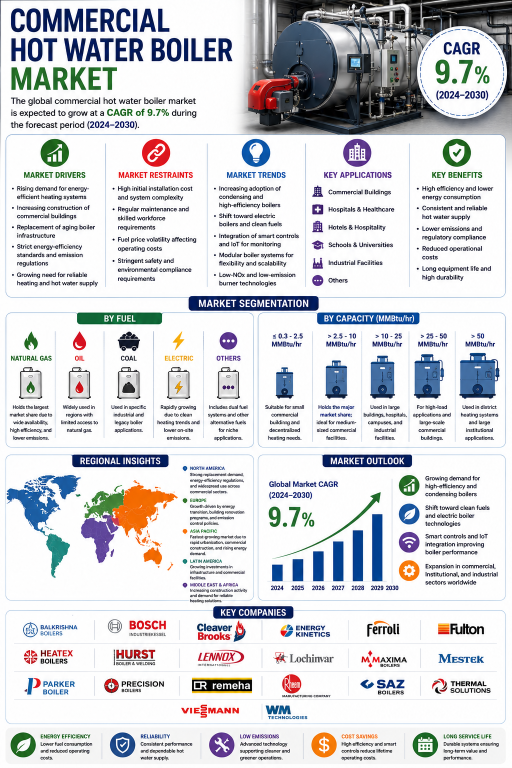
The global commercial hot water boiler market is expected to grow at a CAGR of 9.7% during the forecast period. Market growth is driven by rising demand for efficient heating systems in commercial buildings, increasing replacement of aging boiler infrastructure, growing construction of hotels, hospitals, offices, schools, and institutional facilities, and stricter energy-efficiency standards. Commercial hot water boilers are widely used for space heating, domestic hot water supply, and process heating applications, making them essential equipment across commercial and light industrial facilities.
Market Drivers
Rising Demand for Energy-Efficient Commercial Heating Systems
Building owners and facility operators are increasingly investing in high-efficiency hot water boilers to reduce fuel consumption, lower operating costs, and meet building energy codes. Growth in commercial construction, renovation activity, and institutional infrastructure is supporting demand for advanced boiler systems. Condensing boilers, low-emission burners, and smart control systems are gaining adoption as end users focus on energy savings and reliable heating performance.
Market Restraints
High Installation Cost and Maintenance Requirements
Commercial hot water boilers require significant upfront investment, including equipment cost, installation, piping, venting, controls, and compliance with safety standards. Regular maintenance is required to ensure safe operation, fuel efficiency, and longer service life. Fuel price volatility and the need for trained technicians can further increase operating expenses, especially for small and medium commercial facilities.
Commercial Hot Water Boiler Market Trends
The market is witnessing increasing adoption of condensing boiler technologies, electric boilers, low-NOx burners, and smart boiler control systems. End users are shifting toward cleaner fuels and energy-efficient heating solutions to reduce emissions and improve building performance. Demand for modular boiler systems is increasing due to installation flexibility, redundancy, and better load management. Electrification of heating, integration with building management systems, and remote monitoring are also becoming important trends across commercial facilities.
Market Segmentation
By Fuel
Based on fuel, the market is segmented into Natural Gas, Oil, Coal, Electric, and Others. Natural gas holds a significant market share due to its wide availability, lower emissions compared to coal and oil, strong heating efficiency, and broad use across commercial buildings. Electric boilers are expected to witness strong growth due to rising electrification trends, lower on-site emissions, and suitability for buildings aiming to reduce fossil fuel dependence. Oil and coal boilers continue to serve specific regional and legacy applications, while other fuel types are used in niche heating requirements.
By Capacity
Based on capacity, the market is segmented into ≤ 0.3 - 2.5 MMBtu/hr, > 2.5 - 10 MMBtu/hr, > 10 - 25 MMBtu/hr, > 25 - 50 MMBtu/hr, and > 50 MMBtu/hr. The > 2.5 - 10 MMBtu/hr segment holds a major market share due to its suitability for medium-sized commercial buildings, hotels, schools, hospitals, and office facilities. The ≤ 0.3 - 2.5 MMBtu/hr segment remains important for small commercial buildings and decentralized heating applications. Higher capacity boilers above 10 MMBtu/hr are widely used in large institutions, campuses, district heating systems, and industrial-commercial facilities.
Regional Insights
North America represents a major market for commercial hot water boilers due to strong replacement demand, strict building efficiency standards, and widespread use across offices, healthcare facilities, schools, and hospitality buildings. Europe is witnessing steady growth supported by energy-efficiency regulations, building renovation programs, and decarbonization initiatives. Asia Pacific is expected to record the fastest growth during the forecast period due to rapid commercial construction, urbanization, infrastructure expansion, and rising demand for reliable heating systems across China, India, Japan, South Korea, and Southeast Asia. Latin America and the Middle East & Africa are also experiencing growing demand as commercial infrastructure development and energy-efficient building systems gain momentum.
Competitive Landscape
The commercial hot water boiler market is competitive, with manufacturers focusing on fuel efficiency, emission reduction, product reliability, modular system design, and after-sales service. Companies are investing in condensing technology, electric boiler platforms, digital controls, and low-emission combustion systems to strengthen their market positions. Strategic partnerships with HVAC contractors, facility management companies, and building solution providers remain key growth strategies. Competitive differentiation increasingly depends on energy efficiency, lifecycle cost, safety performance, service support, and compliance with emission standards.
Key companies operating in the market include Balkrishna Boilers, Bosch Industriekessel, Cleaver-Brooks, Energy Kinetics, Ferroli, Fulton, Heatex Boilers, Hurst Boiler & Welding, Lennox International, Lochinvar, Maxima Boilers, Mestek, Parker Boiler, Precision Boilers, Remeha, Rheem Manufacturing Company, SAZ Boilers, Thermal Solutions, Viessmann, and WM Technologies.
Commercial Hot Water Boiler Industry News
The industry is witnessing increasing investment in high-efficiency boiler systems, low-NOx combustion technologies, and electric heating solutions. Manufacturers are expanding product portfolios with compact, modular, and digitally connected boilers designed for commercial buildings. Growth in building renovation, energy audits, and emission reduction programs is expected to support demand for upgraded boiler systems. The shift toward cleaner heating technologies and smart facility management is expected to remain a key industry focus during the forecast period.
Historical & Forecast Period
This study report represents analysis of each segment from 2024 to 2034 considering 2025 as the base year. Compounded Annual Growth Rate (CAGR) for each of the respective segments estimated for the forecast period of 2026 to 2034.
The current report comprises of quantitative market estimations for each micro market for every geographical region and qualitative market analysis such as micro and macro environment analysis, market trends, competitive intelligence, segment analysis, porters five force model, top winning strategies, top investment markets, emerging trends and technological analysis, case studies, strategic conclusions and recommendations and other key market insights.
Research Methodology
The complete research study was conducted in three phases, namely: secondary research, primary research, and expert panel review. key data point that enables the estimation of Commercial Hot Water Boiler market are as follows:
Market forecast was performed through proprietary software that analyzes various qualitative and quantitative factors. Growth rate and CAGR were estimated through intensive secondary and primary research. Data triangulation across various data points provides accuracy across various analyzed market segments in the report. Application of both top down and bottom-up approach for validation of market estimation assures logical, methodical and mathematical consistency of the quantitative data.
| ATTRIBUTE | DETAILS |
|---|---|
| Research Period | 2024-2034 |
| Base Year | 2025 |
| Forecast Period | 2026-2034 |
| Historical Year | 2024 |
| Unit | USD Million |
| Segmentation | |
Fuel
|
|
Capacity
|
|
Technology
|
|
Application
|
|
|
Region Segment (2024-2034; US$ Million)
|
Frequently Asked Questions
What is the expected growth rate of the commercial hot water boiler market?
The commercial hot water boiler market is expected to grow at a CAGR of 9.7% during the forecast period.
Which fuel segment holds a significant market share?
Natural gas holds a significant market share due to wide availability, strong heating efficiency, and lower emissions compared to coal and oil.
Which capacity segment dominates the market?
The > 2.5 - 10 MMBtu/hr capacity segment dominates the market due to strong use in medium-sized commercial buildings, schools, hotels, hospitals, and offices.
What are the major growth drivers?
Major growth drivers include rising demand for energy-efficient heating systems, commercial construction growth, replacement of aging boilers, and stricter building energy standards.
Who are the major companies operating in the market?
Major companies include Bosch Industriekessel, Cleaver-Brooks, Fulton, Hurst Boiler & Welding, Lochinvar, Rheem Manufacturing Company, Viessmann, Lennox International, Precision Boilers, and Thermal Solutions.