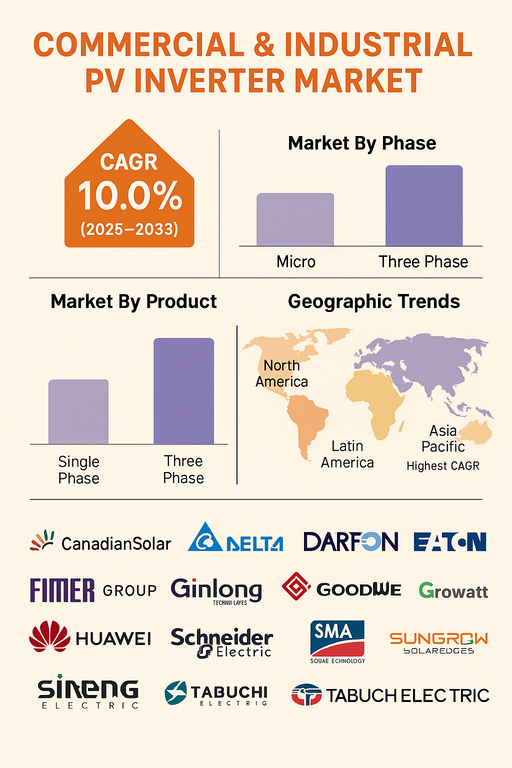
The commercial & industrial PV inverter market is projected to grow at a Compound Annual Growth Rate (CAGR) of 10.0% from 2026 to 2034, driven by increasing investments in solar infrastructure, rising demand for distributed generation, and expanding net metering and feed-in tariff schemes. C&I sectors are rapidly adopting photovoltaic (PV) systems to lower operational costs and meet corporate sustainability targets. PV inverters, which convert DC power from solar panels into grid-compatible AC power, are essential components for optimizing energy performance, ensuring grid compliance, and enabling smart energy integration.
Market Drivers
Surge in Rooftop and Distributed Solar Installations
Growing awareness of energy cost optimization and favorable policies are pushing commercial and industrial players to install rooftop and distributed solar systems. These installations demand reliable and efficient inverters that can support dynamic loads, smart monitoring, and grid interaction. The transition toward self-consumption and energy independence further enhances the adoption of advanced PV inverters.
Technological Innovation in Inverter Platforms
Advances in inverter technologies such as multi-MPPT tracking, rapid shutdown, and IoT-based energy management are improving reliability, efficiency, and control in PV systems. Three-phase string inverters, microinverters, and hybrid configurations are seeing increasing uptake in commercial and industrial settings where high uptime, remote diagnostics, and scalability are crucial.
Policy Support and Regulatory Push
Governments globally are incentivizing clean energy adoption through tax rebates, capital subsidies, and grid interconnection reforms. Regulatory mandates related to voltage management, anti-islanding, and smart grid integration are also creating demand for next-generation PV inverters with built-in grid-support features and communication interfaces.
Market Restraint
High Initial Capital Investment and Integration Complexity
Despite long-term savings, the upfront cost of PV systems especially when paired with advanced inverters and monitoring systems remains a hurdle for many SMEs. Additional complexities arise in retrofitting older infrastructures or integrating with hybrid energy systems. Variations in local regulations and grid compatibility further challenge uniform deployment across regions.
Market Segmentation by Product
In 2025, Central inverters dominated the market in terms of revenue due to their suitability for high-capacity, large-area installations typically found in industrial zones, manufacturing plants, and solar farms. Their higher power rating, scalability, and efficiency make them preferred in utility-scale commercial setups. However, Micro inverters are gaining traction, particularly in decentralized or rooftop commercial systems where module-level performance optimization, rapid shutdown compliance, and ease of maintenance offer clear benefits. Their usage is increasing in retail chains, office complexes, schools, and healthcare institutions.
Market Segmentation by Phase
Three-phase inverters captured the majority market share in 2025, particularly due to their use in industrial applications that require higher voltage handling, balanced power distribution, and integration with heavy machinery. These are commonly installed in factories, warehouses, and logistics centers. Single-phase inverters continue to serve smaller commercial premises such as retail shops, clinics, and educational buildings, especially in regions where grid connections are limited to lower voltage networks.
Geographic Trends
Asia Pacific led the commercial & industrial PV inverter market in 2025 and is expected to register the fastest CAGR through 2034, driven by aggressive solar capacity targets in China, India, Japan, and Southeast Asia. The growth is supported by low module prices, local manufacturing ecosystems, and government initiatives such as India’s "Solar Rooftop Programme" and China's solar subsidies. Europe remains a mature market, supported by strong green energy policies, particularly in Germany, the Netherlands, Italy, and Spain. North America, especially the U.S., continues to grow steadily, supported by the Inflation Reduction Act (IRA), state-level incentives, and corporate sustainability goals. Latin America and Middle East & Africa (MEA) are emerging regions with significant potential, driven by favorable irradiation levels, growing grid infrastructure, and government-backed solar procurement programs.
Competitive Trends
The C&I PV inverter market is competitive with established players offering differentiated solutions based on performance, digital features, and regional adaptation. In 2025, SMA Solar Technology, Sungrow, and Huawei Technologies remained dominant through their wide product range and robust global presence. SolarEdge Technologies, GoodWe, and Growatt New Energy expanded rapidly in mid-scale commercial markets with smart inverter solutions and integrated energy management systems. Schneider Electric and Eaton offered strength in industrial-grade three-phase inverters with grid-support capabilities and advanced diagnostics. Delta Electronics, Ginlong Technologies, and Darfon Electronics invested in R&D for IoT-enabled and hybrid-ready inverter platforms. Fimer Group, Sineng Electric, Canadian Solar, and Tabuchi Electric strengthened their foothold through regional partnerships and tailored product lines for C&I segments. Mergers, joint ventures, and innovation in cybersecurity, remote monitoring, and inverter-battery integration are expected to drive the next phase of competitiveness and consolidation in the PV inverter market.
Historical & Forecast Period
This study report represents analysis of each segment from 2024 to 2034 considering 2025 as the base year. Compounded Annual Growth Rate (CAGR) for each of the respective segments estimated for the forecast period of 2026 to 2034.
The current report comprises of quantitative market estimations for each micro market for every geographical region and qualitative market analysis such as micro and macro environment analysis, market trends, competitive intelligence, segment analysis, porters five force model, top winning strategies, top investment markets, emerging trends and technological analysis, case studies, strategic conclusions and recommendations and other key market insights.
Research Methodology
The complete research study was conducted in three phases, namely: secondary research, primary research, and expert panel review. key data point that enables the estimation of Commercial & Industrial PV Inverter market are as follows:
Market forecast was performed through proprietary software that analyzes various qualitative and quantitative factors. Growth rate and CAGR were estimated through intensive secondary and primary research. Data triangulation across various data points provides accuracy across various analyzed market segments in the report. Application of both top down and bottom-up approach for validation of market estimation assures logical, methodical and mathematical consistency of the quantitative data.
| ATTRIBUTE | DETAILS |
|---|---|
| Research Period | 2024-2034 |
| Base Year | 2025 |
| Forecast Period | 2026-2034 |
| Historical Year | 2024 |
| Unit | USD Million |
| Segmentation | |
Product
|
|
Phase
|
|
Connectivity
|
|
|
Region Segment (2024-2034; US$ Million)
|
Key questions answered in this report