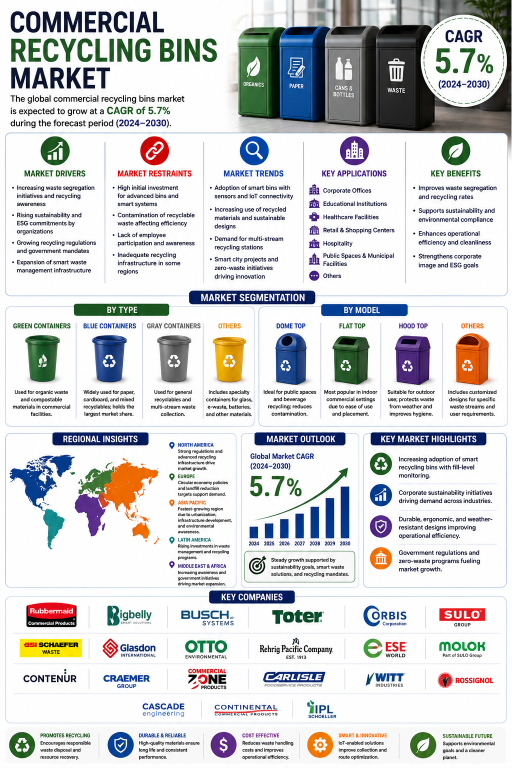
The global commercial recycling bins market is expected to grow at a CAGR of 5.7% during the forecast period. Market growth is driven by increasing waste segregation initiatives, rising sustainability commitments among businesses, growing recycling regulations, and expanding investments in smart waste management infrastructure. Commercial recycling bins play a critical role in improving waste collection efficiency, supporting circular economy objectives, and helping organizations achieve environmental compliance goals. Growing awareness regarding responsible waste disposal and recycling practices is further supporting market expansion worldwide.
Market Drivers
Increasing Focus on Waste Segregation and Sustainability Programs
Governments, municipalities, educational institutions, commercial facilities, and corporate organizations are increasingly implementing recycling and waste diversion programs to reduce landfill waste. Businesses are adopting dedicated recycling bins to improve waste sorting efficiency and support environmental, social, and governance (ESG) objectives. The growing emphasis on sustainability reporting and green building certifications is significantly driving demand for commercial recycling bins.
Market Restraints
High Initial Investment and Operational Challenges
Large-scale deployment of commercial recycling bins, especially smart and sensor-equipped systems, can require substantial upfront investment. Organizations may also face challenges related to employee participation, contamination of recyclable materials, and maintenance requirements. Inadequate recycling infrastructure in certain regions can further limit the effectiveness of recycling collection programs and impact market growth.
Commercial Recycling Bins Market Trends
The market is witnessing increasing adoption of smart recycling bins equipped with sensors, fill-level monitoring systems, and data analytics capabilities. Manufacturers are focusing on ergonomic designs, durable recycled materials, and modular waste collection solutions. Demand for aesthetically designed recycling stations that improve user engagement and waste sorting accuracy is also increasing. Smart city initiatives, zero-waste programs, and corporate sustainability commitments continue to create new growth opportunities across commercial and public-sector environments.
Market Segmentation
By Type
Based on type, the market is segmented into Green Containers, Blue Containers, Gray Containers, and Others. Blue containers account for a significant market share due to their widespread use for paper, cardboard, and mixed recyclable waste collection across offices, educational institutions, retail facilities, and public spaces. Green containers are extensively used for organic waste and environmentally focused recycling programs. Gray containers and other specialized recycling bins continue to support multi-stream waste segregation systems across commercial facilities.
By Model
Based on model, the market is segmented into Dome Top, Flat Top, Hood Top, and Others. Flat top recycling bins hold a major market share due to their versatility, ease of placement, and suitability for indoor commercial environments such as offices, schools, airports, hospitals, and shopping centers. Dome top bins remain highly popular for beverage container collection and contamination reduction. Hood top and specialized models are increasingly adopted for outdoor environments and high-traffic public spaces.
Regional Insights
North America represents a major market for commercial recycling bins due to strong recycling infrastructure, stringent waste management regulations, and widespread corporate sustainability initiatives. The United States continues to lead regional demand owing to increasing adoption of recycling programs across commercial buildings, educational institutions, and public facilities. Europe is witnessing steady growth supported by circular economy policies, landfill reduction targets, and strict environmental regulations. Asia Pacific is expected to record the fastest growth during the forecast period due to rapid urbanization, expanding commercial infrastructure, increasing environmental awareness, and government-led waste management initiatives across China, India, Japan, South Korea, and Southeast Asia. Latin America and the Middle East & Africa are also experiencing growing demand as recycling awareness and waste management investments continue to expand.
Competitive Landscape
The commercial recycling bins market is moderately competitive, with manufacturers focusing on product durability, sustainability, smart waste management technologies, and customized recycling solutions. Companies are investing in recycled materials, sensor-enabled collection systems, modular designs, and aesthetically appealing products to strengthen their market positions. Strategic partnerships with municipalities, facility management companies, educational institutions, and commercial organizations remain key growth strategies. Competitive differentiation increasingly depends on product quality, waste segregation efficiency, smart technology integration, sustainability credentials, and service support.
Key companies operating in the market include Rubbermaid Commercial Products, Bigbelly, Inc., Busch Systems International Inc., Toter LLC, Orbis Corporation, SULO Group, SSI Schaefer Waste, Glasdon International Limited, Otto Environmental Systems North America, Inc., Rehrig Pacific Company, ESE World B.V., Molok Ltd, CONTENUR, Craemer Group, Commercial Zone Products, Carlisle FoodService Products, Witt Industries, Rossignol, Cascade Engineering, Continental Commercial Products, and IPL Schoeller.
Commercial Recycling Bins Industry News
The industry is witnessing growing investments in smart waste management systems and recycling infrastructure modernization. Manufacturers are introducing sensor-enabled recycling bins capable of real-time monitoring, route optimization, and waste collection analytics. Sustainability-focused organizations are increasingly adopting multi-stream recycling stations and products manufactured from recycled materials. The expansion of smart city projects, corporate ESG initiatives, and circular economy programs is expected to remain a major driver of innovation and market growth during the forecast period.
Historical & Forecast Period
This study report represents analysis of each segment from 2024 to 2034 considering 2025 as the base year. Compounded Annual Growth Rate (CAGR) for each of the respective segments estimated for the forecast period of 2026 to 2034.
The current report comprises of quantitative market estimations for each micro market for every geographical region and qualitative market analysis such as micro and macro environment analysis, market trends, competitive intelligence, segment analysis, porters five force model, top winning strategies, top investment markets, emerging trends and technological analysis, case studies, strategic conclusions and recommendations and other key market insights.
Research Methodology
The complete research study was conducted in three phases, namely: secondary research, primary research, and expert panel review. key data point that enables the estimation of Commercial Recycling Bins market are as follows:
Market forecast was performed through proprietary software that analyzes various qualitative and quantitative factors. Growth rate and CAGR were estimated through intensive secondary and primary research. Data triangulation across various data points provides accuracy across various analyzed market segments in the report. Application of both top down and bottom-up approach for validation of market estimation assures logical, methodical and mathematical consistency of the quantitative data.
| ATTRIBUTE | DETAILS |
|---|---|
| Research Period | 2024-2034 |
| Base Year | 2025 |
| Forecast Period | 2026-2034 |
| Historical Year | 2024 |
| Unit | USD Million |
| Segmentation | |
Type
|
|
Model
|
|
Material
|
|
End Use
|
|
Distribution Channel
|
|
|
Region Segment (2024-2034; US$ Million)
|
Frequently Asked Questions
What is the expected growth rate of the commercial recycling bins market?
The commercial recycling bins market is expected to grow at a CAGR of 5.7% during the forecast period.
Which type segment holds a significant market share?
Blue containers hold a significant market share due to their extensive use for paper, cardboard, and mixed recyclable waste collection.
Which model dominates the market?
Flat top recycling bins dominate the market owing to their versatility, ease of use, and widespread adoption across commercial facilities.
What are the major growth drivers?
Major growth drivers include increasing waste segregation initiatives, expanding recycling regulations, growing corporate sustainability programs, and rising investments in smart waste management infrastructure.
Who are the major companies operating in the market?
Major companies include Rubbermaid Commercial Products, Bigbelly, Inc., Busch Systems International Inc., Toter LLC, SULO Group, SSI Schaefer Waste, Glasdon International Limited, Rehrig Pacific Company, Molok Ltd, CONTENUR, Craemer Group, and IPL Schoeller.