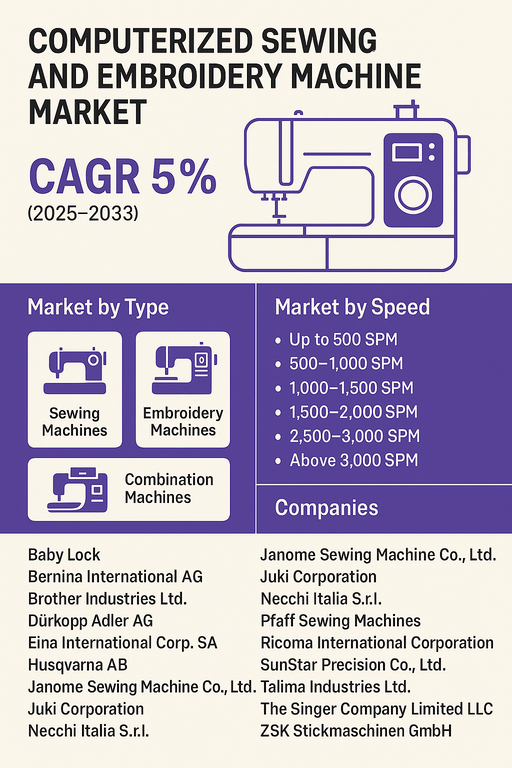
The computerized sewing and embroidery machine market is projected to grow at a CAGR of 5% from 2026 to 2034, driven by rising demand for automation in textile operations, growing interest in personalized embroidery, and increasing adoption of high-speed, precision stitching solutions in both residential and commercial sectors. These machines integrate digital interfaces, automatic pattern selection, and programmable stitching functions, enhancing productivity, accuracy, and creative flexibility.
Market Drivers
Automation and Precision in Textile Manufacturing
Computerized sewing and embroidery machines enable consistent, high-precision stitching with reduced operator input, making them ideal for mass production and intricate designs. As the textile and apparel industry transitions to smart manufacturing, these machines offer programmable control systems, real-time monitoring, and digital pattern loading streamlining production while minimizing errors and labor dependency.
Rising Popularity of DIY, Customization, and Small-Scale Craft Businesses
The global trend toward customization and handcrafted aesthetics has fueled demand for computerized embroidery and combination machines among hobbyists, small businesses, and home users. With user-friendly touchscreens, USB connectivity, and pre-loaded design libraries, these machines empower users to create intricate designs at home or in boutique workshops.
Integration of Advanced Software and Design Capabilities
Modern machines now support wireless design uploads, cloud storage access, and compatibility with digitizing software, allowing for enhanced personalization and design complexity. This has increased their appeal across design studios, craft brands, and manufacturers looking to diversify product offerings with intricate embroidery patterns and detailed logos.
Market Restraint
High Initial Investment and Learning Curve
Despite benefits, computerized machines come at a premium cost due to embedded software, motorized components, and custom firmware. For budget-conscious users and SMEs, the capital requirement may limit adoption. Additionally, the technical complexity and learning curve associated with software-based operation and pattern digitization may discourage traditional operators or less tech-savvy users.
Market Segmentation by Type
The market is segmented into Sewing Machines, Embroidery Machines, and Combination Machines. In 2025, sewing machines accounted for the largest market share due to their broad utility in apparel and home textile manufacturing. Embroidery machines followed, driven by demand in fashion decoration, branding, and monogramming. However, combination machines, which offer both sewing and embroidery functionalities, are expected to witness the fastest growth from 2026 to 2034. These multi-functional systems are gaining popularity in both home-based and semi-commercial applications due to space and cost efficiency.
Market Segmentation by Speed
In 2025, machines operating in the 1,000-1,500 SPM segment held the largest market share due to their optimal balance between speed, precision, and affordability suitable for both high-end home users and commercial settings. The Above 3,000 SPM segment is projected to witness the highest CAGR, as industrial textile manufacturers prioritize high-output models to meet increasing demand in garment production and mass embroidery applications.
Geographic Trends
In 2025, Asia Pacific dominated the market due to its strong textile manufacturing base in China, India, Bangladesh, and Vietnam. The region is expected to maintain its lead through 2034, supported by industrial automation trends, cost-competitive production, and expanding textile exports. North America and Europe represent mature but growing markets, with increasing consumer interest in home décor, crafting, and DIY embroidery. The U.S., Germany, and France show high adoption in both residential and small business categories. Latin America and Middle East & Africa are emerging markets with growing penetration of computerized machines via e-commerce and local distributors, supported by regional growth in apparel manufacturing and design-focused small businesses.
Competitive Trends
In 2025, the competitive landscape featured a mix of global industrial equipment manufacturers and consumer sewing brands. Brother Industries Ltd., Janome Sewing Machine Co., Ltd., and The Singer Company Limited LLC held strong global shares with broad product portfolios targeting both home and commercial users. Juki Corporation, Durkopp Adler AG, and SunStar Precision Co., Ltd. focused on high-performance industrial-grade machines tailored for garment factories and upholstery manufacturers. Bernina International AG, Elna International Corp. SA, Husqvarna AB, and Pfaff Sewing Machines led in the premium hobbyist segment, emphasizing European craftsmanship and precision. Tajima Industries Ltd., ZSK Stickmaschinen GmbH, and Ricoma International Corporation remained key players in commercial embroidery equipment, providing multi-head systems, digitization software, and enterprise-level service. Strategic innovation areas include wireless connectivity, AI-assisted design automation, and integration with cloud-based stitching libraries to cater to next-generation textile production and creative use cases.
Historical & Forecast Period
This study report represents analysis of each segment from 2024 to 2034 considering 2025 as the base year. Compounded Annual Growth Rate (CAGR) for each of the respective segments estimated for the forecast period of 2026 to 2034.
The current report comprises of quantitative market estimations for each micro market for every geographical region and qualitative market analysis such as micro and macro environment analysis, market trends, competitive intelligence, segment analysis, porters five force model, top winning strategies, top investment markets, emerging trends and technological analysis, case studies, strategic conclusions and recommendations and other key market insights.
Research Methodology
The complete research study was conducted in three phases, namely: secondary research, primary research, and expert panel review. key data point that enables the estimation of Computerized Sewing and Embroidery Machine market are as follows:
Market forecast was performed through proprietary software that analyzes various qualitative and quantitative factors. Growth rate and CAGR were estimated through intensive secondary and primary research. Data triangulation across various data points provides accuracy across various analyzed market segments in the report. Application of both top down and bottom-up approach for validation of market estimation assures logical, methodical and mathematical consistency of the quantitative data.
| ATTRIBUTE | DETAILS |
|---|---|
| Research Period | 2024-2034 |
| Base Year | 2025 |
| Forecast Period | 2026-2034 |
| Historical Year | 2024 |
| Unit | USD Million |
| Segmentation | |
Type
|
|
Speed
|
|
Category
|
|
Application
|
|
Distribution Channel
|
|
|
Region Segment (2024-2034; US$ Million)
|
Key questions answered in this report