
The global continuous thermal monitoring market is projected to grow at a CAGR of 2.8% from 2026 to 2034, driven by the growing emphasis on ensuring electrical safety, enhancing asset reliability, and minimizing unplanned outages in power distribution and industrial environments. Continuous thermal monitoring solutions play a crucial role in detecting abnormal temperature fluctuations, identifying hotspots, and providing real-time diagnostics for critical equipment such as switchgear, transformers, and bus ducts. These systems are gaining traction as industries shift toward condition-based and predictive maintenance frameworks to reduce downtime, lower operational costs, and enhance system performance. Growing industrial automation, data center expansion, and increased focus on energy efficiency are further boosting the adoption of advanced thermal monitoring systems across multiple end-use sectors.
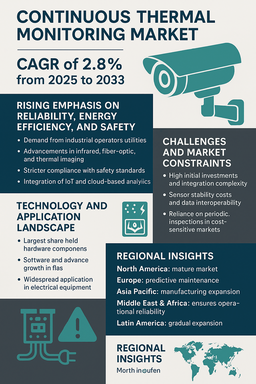
Rising Emphasis on Reliability, Energy Efficiency, and Safety
The market is witnessing rising demand from industrial operators and utilities that seek to improve equipment uptime and prevent thermal-related failures. Continuous monitoring systems are increasingly integrated into digital substations, industrial control panels, and renewable energy plants to provide real-time insights into thermal performance. Advancements in infrared sensing, fiber-optic temperature monitoring, and thermal imaging have made these systems more accurate, compact, and durable, enabling continuous operation in harsh industrial conditions. The growing digitalization of power networks, combined with stricter compliance with international safety standards such as IEEE and NFPA, is encouraging companies to deploy continuous thermal monitoring solutions as part of their preventive maintenance programs. Additionally, the integration of IoT and cloud-based data analytics is enabling real-time alerts and advanced thermal trend visualization, helping maintenance teams identify potential failures before they lead to costly shutdowns.
Challenges and Market Constraints
Despite the growing adoption of continuous thermal monitoring, the market faces several challenges related to cost and integration. The high initial investment associated with installing infrared or fiber-optic sensors, combined with the complexity of integrating these systems into legacy electrical infrastructure, continues to limit penetration, particularly among small and medium-scale operators. In addition, achieving long-term sensor stability in high-voltage and high-temperature environments requires rigorous calibration and maintenance, which adds to operational expenses. Data interoperability and standardization also remain ongoing issues, as end users often face difficulties integrating equipment from multiple vendors into a unified monitoring system. Furthermore, in cost-sensitive markets, organizations tend to rely on periodic inspections rather than real-time monitoring, limiting the pace of technology deployment. Nevertheless, as awareness of predictive maintenance benefits grows, many industries are beginning to recognize the long-term value of continuous monitoring in extending asset lifecycles and preventing catastrophic failures.
Technology and Application Landscape
From a technological standpoint, hardware components such as infrared cameras, thermal sensors, and fiber-optic probes account for the largest share of the market, as they form the backbone of data acquisition and measurement. However, software and analytics platforms are emerging as the fastest-growing segment, supported by advances in machine learning and AI algorithms capable of predictive fault detection. These platforms are transforming traditional temperature readings into actionable insights that improve operational reliability and efficiency. Continuous thermal monitoring finds widespread application across switchgear assemblies, motor control centers, dry transformers, and low-voltage transformers. Industries such as power generation, manufacturing, and oil & gas are leading adopters, utilizing thermal monitoring to maintain system stability and optimize performance. Data centers, in particular, represent a growing application segment as they require constant monitoring to ensure cooling efficiency and prevent overheating in high-density environments.
Regional Insights
Geographically, North America remains one of the most mature markets, driven by strong industrial digitalization, modernization of aging power infrastructure, and strict adherence to safety standards. Europe continues to prioritize predictive maintenance technologies as part of its sustainability and energy efficiency initiatives, while Asia Pacific is witnessing steady growth fueled by rapid industrialization, manufacturing expansion, and rising investments in smart grid infrastructure across China, India, and Southeast Asia. The Middle East and Africa are adopting continuous thermal monitoring systems primarily within utility, oil & gas, and energy-intensive industries to ensure operational safety and reliability under extreme environmental conditions. Meanwhile, Latin America is gradually expanding adoption through refinery modernization projects and electrical network upgrades. These regional dynamics reflect a growing global emphasis on digital asset management and thermal risk mitigation across both developed and emerging economies.
Competitive Landscape
The continuous thermal monitoring market is moderately fragmented, with several global and regional players offering a mix of hardware, software, and integrated services. Leading companies such as ABB, Advanced Energy, Calex Electronics, Drägerwerk AG & Co. KGaA, Doble Engineering Company, Dynamic Ratings, Ellab, Exertherm, GE Vernova, Honeywell International, Microchip Technologies, OMRON Corporation, Optris, Powell Industries, Schneider Electric, Siemens, Teledyne FLIR, Vaisala, Vertiv Group, and WIKA Alexander Wiegand are actively competing through product innovation, system integration, and service reliability. These players are focusing on developing high-precision, ruggedized sensors capable of operating in extreme environments, while simultaneously investing in digital platforms that combine real-time data acquisition with AI-driven analytics. Partnerships with utilities, industrial automation companies, and OEMs are expanding product reach and enabling end-to-end monitoring ecosystems. The long-term outlook for the market remains positive, as industries continue to prioritize asset health management and sustainability through enhanced monitoring and diagnostics capabilities.
Historical & Forecast Period
This study report represents analysis of each segment from 2024 to 2034 considering 2025 as the base year. Compounded Annual Growth Rate (CAGR) for each of the respective segments estimated for the forecast period of 2026 to 2034.
The current report comprises of quantitative market estimations for each micro market for every geographical region and qualitative market analysis such as micro and macro environment analysis, market trends, competitive intelligence, segment analysis, porters five force model, top winning strategies, top investment markets, emerging trends and technological analysis, case studies, strategic conclusions and recommendations and other key market insights.
Research Methodology
The complete research study was conducted in three phases, namely: secondary research, primary research, and expert panel review. key data point that enables the estimation of Continuous Thermal Monitoring Market By Offering, By Application, By End Use - Growth, Share, Opportunities & Competitive Analysis, 2026 - 2034 market are as follows:
Market forecast was performed through proprietary software that analyzes various qualitative and quantitative factors. Growth rate and CAGR were estimated through intensive secondary and primary research. Data triangulation across various data points provides accuracy across various analyzed market segments in the report. Application of both top down and bottom-up approach for validation of market estimation assures logical, methodical and mathematical consistency of the quantitative data.
| ATTRIBUTE | DETAILS |
|---|---|
| Research Period | 2024-2034 |
| Base Year | 2025 |
| Forecast Period | 2026-2034 |
| Historical Year | 2024 |
| Unit | USD Million |
| Segmentation | |
Offering
|
|
Application
|
|
End Use
|
|
|
Region Segment (2024-2034; US$ Million)
|
Key questions answered in this report


