
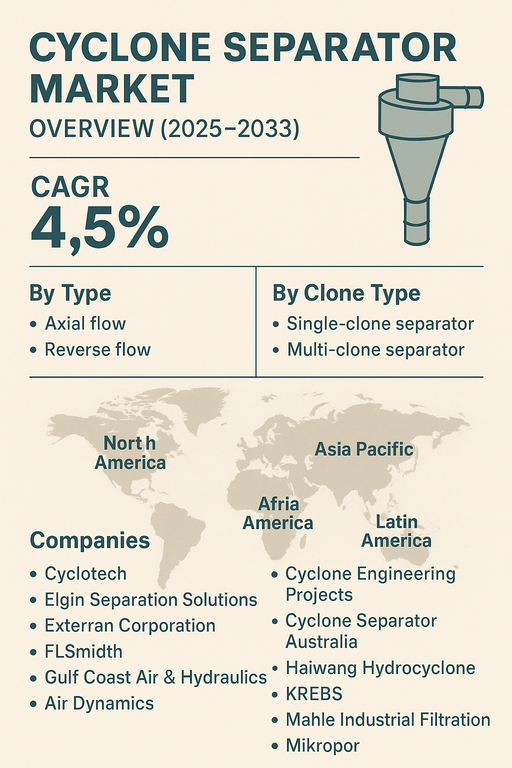
The global cyclone separator market is projected to grow at a CAGR of 4.5% from 2026 to 2034. Market expansion is supported by rising demand for efficient air pollution control, dust collection, and solid-liquid separation across industries such as mining, oil & gas, chemical processing, and power generation. Cyclone separators are widely used due to their low cost, simple design, and high efficiency in removing particulates without filters. Increasing environmental regulations and industrialization in emerging economies are further driving adoption of cyclone separators globally.
Rising Demand for Industrial Efficiency and Air Quality Control
Growing industrial activities and stricter environmental compliance norms are fueling adoption of cyclone separators as a cost-effective solution for dust collection and pollution control. The mining and mineral processing industries are major consumers, using cyclone separators for classifying solids and liquid-solid separation. In oil & gas and chemical processing, cyclone separators play a critical role in protecting downstream equipment from erosion and contamination. Additionally, their application in HVAC systems, cement plants, and food processing is expanding due to their ability to handle large volumes with minimal maintenance.
Challenges: Pressure Drop and Limited Fine Particle Capture
Despite strong demand, cyclone separators face challenges such as limited efficiency in capturing fine particles (<10 microns), often requiring integration with bag filters or scrubbers for compliance with stringent air quality standards. Pressure drop across cyclone systems can increase operational costs by raising energy consumption. Furthermore, technological alternatives like electrostatic precipitators and advanced filtration systems compete directly with cyclone separators in high-performance applications. However, advancements in multi-clone separator designs and computational fluid dynamics (CFD)-based optimization are improving efficiency and extending market potential.
Market Segmentation by Type
By type, the market is segmented into axial flow and reverse flow cyclone separators. In 2025, reverse flow separators held the largest share, widely adopted in dust collection and industrial emission control due to their higher separation efficiency. Axial flow separators, while less common, are increasingly used in specialized applications where compact design and lower pressure drop are required.
Market Segmentation by Clone Type
By clone type, the market is divided into single-clone and multi-clone separators. Single-clone separators dominate, particularly in smaller-scale industrial and HVAC applications where cost-effectiveness is critical. Multi-clone separators are gaining traction in heavy industries such as power plants, cement manufacturing, and mining, where handling high dust loads and improving separation efficiency are essential.
Regional Insights
In 2025, Asia Pacific led the cyclone separator market, supported by rapid industrialization, mining activity, and stringent air quality regulations in China and India. North America remains a key market, with demand driven by environmental compliance and advanced applications in oil & gas and chemicals. Europe demonstrates steady adoption, supported by environmental directives and industrial modernization in Germany, the UK, and France. Latin America and the Middle East & Africa (MEA) represent emerging markets, where rising investment in mining, energy, and cement industries is creating new opportunities.
Competitive Landscape
The 2025 cyclone separator market featured competition among global industrial solution providers and regional specialists. FLSmidth, The Weir Group, and Sulzer are leading players with strong positions in mining, mineral processing, and power generation. KREBS (a FLSmidth brand) and Multotec specialize in hydrocyclones and multi-clone systems for heavy-duty applications. Cyclotech and Exterran Corporation have a strong presence in oil & gas separation technologies. Elgin Separation Solutions and Gulf Coast Air & Hydraulics cater to the North American industrial sector. Haiwang Hydrocyclone and Cyclone Separator Australia are expanding in the Asia Pacific market. Mahle Industrial Filtration, Mikropor, Air Dynamics, and Cyclone Engineering Projects are notable players focusing on filtration, dust control, and niche applications. Competitive strategies are increasingly focused on improving separation efficiency, energy optimization, and offering turnkey industrial solutions.
Historical & Forecast Period
This study report represents analysis of each segment from 2024 to 2034 considering 2025 as the base year. Compounded Annual Growth Rate (CAGR) for each of the respective segments estimated for the forecast period of 2026 to 2034.
The current report comprises of quantitative market estimations for each micro market for every geographical region and qualitative market analysis such as micro and macro environment analysis, market trends, competitive intelligence, segment analysis, porters five force model, top winning strategies, top investment markets, emerging trends and technological analysis, case studies, strategic conclusions and recommendations and other key market insights.
Research Methodology
The complete research study was conducted in three phases, namely: secondary research, primary research, and expert panel review. key data point that enables the estimation of Cyclone Separator Market By Type, By Clone Type, By Capacity, By Application, By End Use Industry, By Distribution Channel - Growth, Share, Opportunities & Competitive Analysis, 2026 - 2034 market are as follows:
Market forecast was performed through proprietary software that analyzes various qualitative and quantitative factors. Growth rate and CAGR were estimated through intensive secondary and primary research. Data triangulation across various data points provides accuracy across various analyzed market segments in the report. Application of both top down and bottom-up approach for validation of market estimation assures logical, methodical and mathematical consistency of the quantitative data.
| ATTRIBUTE | DETAILS |
|---|---|
| Research Period | 2024-2034 |
| Base Year | 2025 |
| Forecast Period | 2026-2034 |
| Historical Year | 2024 |
| Unit | USD Million |
| Segmentation | |
Type
|
|
Clone Type
|
|
Capacity
|
|
Application
|
|
End Use Industry
|
|
Distribution Channel
|
|
|
Region Segment (2024-2034; US$ Million)
|
Key questions answered in this report


