
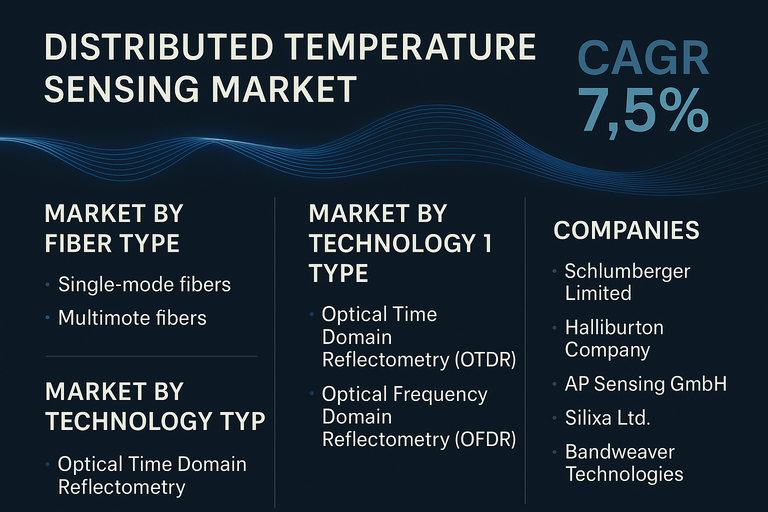
The distributed temperature sensing market is projected to grow at a CAGR of 7.5% from 2026 to 2034, driven by rising demand for real-time thermal monitoring in critical infrastructure sectors such as oil & gas, power transmission, pipeline management, fire detection, and environmental monitoring. DTS systems utilize fiber optic cables as linear sensors to measure temperature variations over long distances with high spatial resolution, offering a superior alternative to conventional point-based temperature sensors. Increased emphasis on predictive maintenance, safety assurance, and asset optimization is accelerating the adoption of fiber-based sensing technologies.
Market Drivers
Growing Demand in Oil & Gas Pipeline Monitoring
DTS systems are increasingly used in upstream, midstream, and downstream segments to detect thermal anomalies, prevent leaks, and ensure pipeline integrity. In applications such as downhole monitoring and hydraulic fracturing, DTS offers real-time insights into temperature gradients and flow profiles, helping operators improve reservoir management and safety outcomes.
Grid Modernization and Fire Prevention in Power Infrastructure
As utility providers invest in smart grid upgrades, DTS is gaining traction in monitoring high-voltage cable conditions, transformer health, and switchgear temperature. In tunnel systems, data centers, and industrial facilities, DTS also supports early fire detection by identifying hot spots over kilometers of cable installations, enhancing facility safety and response times.
Rising Integration in Structural Health and Environmental Monitoring
DTS is being deployed for temperature profiling in dams, tunnels, railways, and geotechnical infrastructure to detect movements, seepage, and other structural anomalies. Similarly, in environmental studies, DTS helps monitor temperature changes in water bodies, permafrost, and underground thermal energy storage, offering valuable data for climate impact assessments and civil engineering applications.
Market Restraint
High System Costs and Complexity of Deployment
Despite its performance advantages, DTS systems involve high capital investment, especially for long-range coverage, dense spatial resolution, and ruggedized installations. Moreover, system integration requires specialized hardware (interrogators), advanced calibration, and fiber optic installation expertise. These cost and complexity factors pose adoption barriers, particularly among smaller utilities and industrial operators in cost-sensitive markets.
Market Segmentation by Fiber Type
By fiber type, the market is segmented into Single-mode fibers and Multimode fibers. In 2025, Single-mode fibers accounted for the largest revenue share due to their suitability for long-distance measurements exceeding 30 km with minimal signal loss. They are widely used in oil wells, transmission lines, and geological monitoring. Multimode fibers, while offering a higher light-gathering capacity, are more suitable for short-range applications such as fire detection in tunnels or facilities, with growth anticipated in specialized industrial and urban infrastructure environments.
Market Segmentation by Technology Type
By technology, the market is categorized into Optical Time Domain Reflectometry (OTDR) and Optical Frequency Domain Reflectometry (OFDR). OTDR-based DTS systems dominated the market in 2025 due to their reliability in long-range applications, field ruggedness, and deployment in harsh conditions such as deep wells and high-voltage installations. OFDR technology, while more limited in range, offers finer spatial resolution and faster response, making it ideal for short-range, high-precision applications like lab setups, manufacturing lines, and compact industrial environments. OFDR is expected to see increased adoption as demand for localized diagnostics and fine-grained thermal profiling rises.
Geographic Trends
In 2025, North America led the DTS market due to high investments in oil & gas infrastructure, power grid modernization, and environmental monitoring programs across the U.S. and Canada. The region also benefits from established vendors and a strong base of oilfield service providers. Europe followed, driven by underground cable monitoring, smart city projects, and early fire detection requirements in Germany, the UK, and Nordic countries. Asia Pacific is expected to witness the highest CAGR from 2026 to 2034, supported by infrastructure expansion, urban tunnel projects, and oil & gas exploration in China, India, and Southeast Asia. Middle East & Africa are key growth zones due to increasing adoption in desert pipeline monitoring and oilfield installations, while Latin America is emerging in pipeline and mining safety applications.
Competitive Trends
The DTS market is moderately consolidated, with technology-centric players offering specialized solutions across energy, safety, and industrial verticals. In 2025, Schlumberger and Halliburton led the oilfield service segment with integrated fiber-optic sensing solutions for reservoir diagnostics and downhole monitoring. AP Sensing GmbH and Bandweaver Technologies expanded their presence across infrastructure safety and utility monitoring through scalable OTDR-based systems with AI-powered data analytics. Silixa Ltd. advanced its position through OFDR-based DTS solutions offering sub-meter resolution for mining, research labs, and environmental applications. Strategic partnerships with EPC firms, deployment service providers, and cloud analytics vendors are expected to shape the future landscape as DTS becomes central to industrial digitalization and predictive maintenance frameworks.
Historical & Forecast Period
This study report represents analysis of each segment from 2024 to 2034 considering 2025 as the base year. Compounded Annual Growth Rate (CAGR) for each of the respective segments estimated for the forecast period of 2026 to 2034.
The current report comprises of quantitative market estimations for each micro market for every geographical region and qualitative market analysis such as micro and macro environment analysis, market trends, competitive intelligence, segment analysis, porters five force model, top winning strategies, top investment markets, emerging trends and technological analysis, case studies, strategic conclusions and recommendations and other key market insights.
Research Methodology
The complete research study was conducted in three phases, namely: secondary research, primary research, and expert panel review. key data point that enables the estimation of Distributed Temperature Sensing Market By Fiber Type, By Technology Type, By Operating Principle, By Application - Growth, Share, Opportunities & Competitive Analysis, 2026 - 2034 market are as follows:
Market forecast was performed through proprietary software that analyzes various qualitative and quantitative factors. Growth rate and CAGR were estimated through intensive secondary and primary research. Data triangulation across various data points provides accuracy across various analyzed market segments in the report. Application of both top down and bottom-up approach for validation of market estimation assures logical, methodical and mathematical consistency of the quantitative data.
| ATTRIBUTE | DETAILS |
|---|---|
| Research Period | 2024-2034 |
| Base Year | 2025 |
| Forecast Period | 2026-2034 |
| Historical Year | 2024 |
| Unit | USD Million |
| Segmentation | |
Fiber Type
|
|
Technology Type
|
|
Operating Principle
|
|
Application
|
|
|
Region Segment (2024-2034; US$ Million)
|
Key questions answered in this report


