
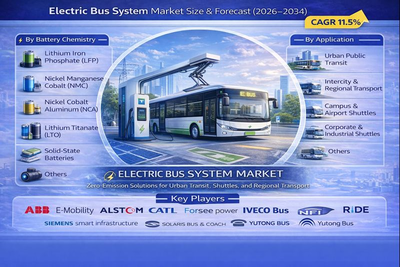
The electric bus system market is expected to grow at a CAGR of 11.5% during 2026–2034, driven by public transport decarbonization targets, tightening city-level emissions rules, and improving total cost of ownership versus diesel in high-utilization routes. Electric bus systems combine vehicles, batteries, charging infrastructure, software, and depot/route operations planning to deliver reliable zero-emission mobility. Growth is also supported by government subsidies and tenders, expansion of charging networks, better battery durability, and increasing use of fleet analytics for energy optimization, uptime, and maintenance planning.
Market Drivers
Market growth is driven by large-scale public procurement programs for urban fleet electrification, supported by national and municipal funding to reduce local air pollution and CO₂ emissions. Battery cost improvements and higher energy density are enabling longer range and better route coverage, while charging ecosystem maturity is improving fleet availability. Utilities and city operators are adopting smart charging and energy management to reduce peak demand charges and stabilize depot operations. Demand is also rising for electrified shuttles in campuses, airports, and industrial sites due to controlled routes and predictable duty cycles, which improves project feasibility. OEMs and system integrators are expanding service and maintenance models, warranties, and financing options, supporting wider adoption among operators.
Market Restraints
The market faces restraints related to high upfront capex for vehicles and charging infrastructure, depot power upgrades, and longer procurement and permitting cycles. Grid constraints, transformer availability, and interconnection delays can limit large depot deployments, while electricity price volatility can impact operating cost assumptions. Battery performance degradation under extreme temperatures and high-duty cycles increases the need for careful route planning and thermal management, which can raise system complexity. Limited availability of trained technicians, spare parts planning, and charging downtime risk can impact service reliability if not managed well. Safety and compliance requirements, including battery safety standards and charging interoperability, can also increase deployment time for new operators.
Market Segmentation
By Battery Chemistry
By battery chemistry, the market is segmented into Lithium Iron Phosphate (LFP), Nickel Manganese Cobalt (NMC), Nickel Cobalt Aluminum (NCA), Lithium Titanate (LTO), solid-state batteries, and others. LFP holds a major share due to strong thermal stability, long cycle life, and cost advantages that suit high-uptime public transit fleets. NMC is widely used where higher energy density and longer range are needed, supporting deployments in mixed duty cycles and regional routes. NCA remains more selective in buses due to safety and thermal management needs, but it is used where high energy density is prioritized. LTO supports niche but important use cases requiring very fast charging and high cycle life, especially in opportunity-charging models with frequent charging stops. Solid-state batteries are an emerging segment with long-term potential for improved safety and energy density, but near-term adoption remains limited by cost and scaling readiness. Others include alternative lithium variants and hybridized pack strategies adopted for specific performance and cost targets.
By Application
By application, the market is segmented into urban public transit, intercity & regional transport, campus & airport shuttles, corporate & industrial shuttles, and others. Urban public transit holds a major share due to high route utilization, strong policy push in cities, and tender-based fleet replacement programs. Intercity and regional transport is growing strongly as battery range improves and charging corridors expand, although route length and seasonal temperature variation require careful planning. Campus and airport shuttles are seeing steady adoption due to predictable routes, centralized depots, and easier charging logistics, which reduces operational risk. Corporate and industrial shuttles are expanding as large employers and industrial parks adopt decarbonization programs and prefer low-noise, low-maintenance fleets. Others include municipal service routes and special-purpose fleets where electrification is driven by regulatory compliance and operating cost reduction.
Regional Insights
Asia Pacific leads electric bus deployments due to large-scale fleet electrification programs, strong domestic supply chains, and high-volume procurement models that accelerate adoption. Europe shows strong growth supported by emissions regulation, city clean-air zones, and structured public procurement with increasing preference for zero-emission buses and standardized charging. North America is expanding steadily as federal and state funding programs grow and transit agencies increase fleet electrification pilots into multi-year rollouts, with a strong focus on depot charging and reliability. Latin America is emerging with growing adoption in large cities where concession models and international financing support fleet upgrades. The Middle East & Africa is at an earlier stage but shows increasing activity in large urban projects, airport mobility, and high-visibility sustainability programs, particularly where electricity pricing and grid readiness support electric bus economics.
Competitive Landscape
The market is competitive, with OEMs, battery suppliers, and charging and grid-integration players focusing on improving range, uptime, charging speed, and lifecycle cost. Key strategies include expanding LFP-based offerings for cost and safety, offering end-to-end systems including chargers and energy management software, and providing long-term service contracts with performance guarantees. Differentiation is driven by battery durability and warranty terms, charging interoperability, fleet management software capability, and proven deployment experience at scale. Vendors are also investing in smart depot solutions, predictive maintenance, and stronger partnerships with utilities and infrastructure providers to reduce deployment delays and improve grid integration. Key companies operating in the market include ABB E-Mobility, Alstom, CATL, Forsee Power, IVECO Bus, NFI, RIDE, Siemens Smart Infrastructure, Solaris Bus & Coach, and Yutong Bus.
Historical & Forecast Period
This study report represents analysis of each segment from 2024 to 2034 considering 2025 as the base year. Compounded Annual Growth Rate (CAGR) for each of the respective segments estimated for the forecast period of 2026 to 2034.
The current report comprises of quantitative market estimations for each micro market for every geographical region and qualitative market analysis such as micro and macro environment analysis, market trends, competitive intelligence, segment analysis, porters five force model, top winning strategies, top investment markets, emerging trends and technological analysis, case studies, strategic conclusions and recommendations and other key market insights.
Research Methodology
The complete research study was conducted in three phases, namely: secondary research, primary research, and expert panel review. key data point that enables the estimation of Electric Bus System Market By Component, By Battery Chemistry, By Application - Growth, Share, Opportunities & Competitive Analysis, 2026 - 2034 market are as follows:
Market forecast was performed through proprietary software that analyzes various qualitative and quantitative factors. Growth rate and CAGR were estimated through intensive secondary and primary research. Data triangulation across various data points provides accuracy across various analyzed market segments in the report. Application of both top down and bottom-up approach for validation of market estimation assures logical, methodical and mathematical consistency of the quantitative data.
| ATTRIBUTE | DETAILS |
|---|---|
| Research Period | 2024-2034 |
| Base Year | 2025 |
| Forecast Period | 2026-2034 |
| Historical Year | 2024 |
| Unit | USD Million |
| Segmentation | |
Component
|
|
Battery Chemistry
|
|
Application
|
|
|
Region Segment (2024-2034; US$ Million)
|
Frequently Asked Questions
What is the growth outlook for the electric bus system market?
The market is expected to grow at a CAGR of 11.5% during 2026–2034, supported by public transport decarbonization policies and improving electric bus system economics.
Which battery chemistry segment is most used today?
LFP holds a major share due to safety, cycle life, and cost advantages for high-utilization transit fleets, while NMC is important where higher energy density is needed.
Which application segment dominates the market?
Urban public transit dominates due to large tenders, high route utilization, and strong city-level emissions goals.
Which regions are key demand centers?
Asia Pacific leads deployments, followed by Europe and North America, while Latin America and Middle East & Africa are emerging.
What are the key challenges in this market?
High upfront infrastructure cost, grid upgrade timelines, charging interoperability, battery degradation in harsh conditions, and operational readiness (skills and maintenance) are major challenges.


