
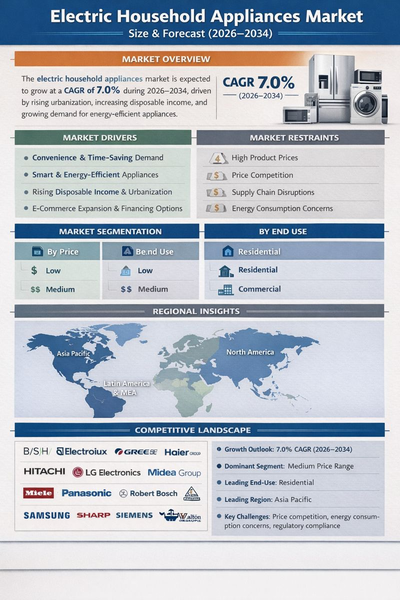
The electric household appliances market is expected to grow at a CAGR of 7.0% during 2026–2034, driven by rising urbanization, increasing disposable income, and growing demand for energy-efficient appliances. Expansion of smart home ecosystems and lifestyle modernization is accelerating replacement of traditional appliances with connected and automated models. Rapid growth in residential housing, hospitality, and commercial infrastructure further supports market expansion. Manufacturers are focusing on digital control, IoT integration, and sustainable product design to strengthen market competitiveness.
Market Drivers
Market growth is driven by rising demand for convenience, time-saving appliances, and improved living standards. Increasing penetration of smart appliances with mobile connectivity and automation features is boosting consumer adoption. Government energy-efficiency standards and labeling programs are encouraging replacement of old appliances with efficient models. Growth in nuclear families and urban housing projects is supporting steady demand. Expansion of e-commerce platforms and financing options is also improving product accessibility across income groups.
Market Restraints
The market faces restraints from high product prices in premium segments, intense price competition, and short product replacement cycles. Supply chain disruptions and raw material price volatility impact manufacturing costs. Energy consumption concerns in developing regions limit adoption of high-capacity appliances. In addition, repairability challenges and electronic waste regulations add compliance cost for manufacturers.
Market Segmentation
By Price
By price, the market is segmented into low, medium, and high. The medium-price segment holds the largest market share due to balanced affordability and feature offerings. The low-price segment remains strong in emerging economies where price sensitivity is high. The high-price segment is growing steadily due to rising demand for premium, smart, and energy-efficient appliances in urban households.
By End Use
Based on end use, the market is segmented into residential and commercial. Residential applications dominate the market due to continuous household replacement demand and smart home adoption. Commercial applications are expanding in hotels, restaurants, offices, and retail spaces, driven by infrastructure growth and appliance modernization.
Regional Insights
Asia Pacific leads the electric household appliances market due to high population density, rising income levels, and strong manufacturing presence in China, India, Japan, and South Korea. Europe follows with strong energy-efficiency regulations and demand for premium appliances. North America shows stable growth supported by smart appliance adoption and replacement demand. Latin America and the Middle East & Africa represent emerging growth markets driven by urban development and retail expansion.
Competitive Landscape
The market is highly competitive, with companies focusing on product innovation, energy efficiency, smart connectivity, and after-sales service. Brand positioning, distribution reach, and pricing strategy play key roles in competition. Manufacturers are investing in AI-enabled appliances, voice control integration, and sustainability-focused product portfolios.
Key companies operating in the market include BSH Hausgeräte, Electrolux, Gree Electric Appliances, Haier Group, Hitachi, LG Electronics, Midea Group, Miele, Panasonic, Robert Bosch, Samsung Electronics, Sharp, Siemens, Walton Group, and Whirlpool.
Historical & Forecast Period
This study report represents analysis of each segment from 2024 to 2034 considering 2025 as the base year. Compounded Annual Growth Rate (CAGR) for each of the respective segments estimated for the forecast period of 2026 to 2034.
The current report comprises of quantitative market estimations for each micro market for every geographical region and qualitative market analysis such as micro and macro environment analysis, market trends, competitive intelligence, segment analysis, porters five force model, top winning strategies, top investment markets, emerging trends and technological analysis, case studies, strategic conclusions and recommendations and other key market insights.
Research Methodology
The complete research study was conducted in three phases, namely: secondary research, primary research, and expert panel review. key data point that enables the estimation of Electric Household Appliances Market By Product Type, By Price, By End Use, By Distribution Channel - Growth, Share, Opportunities & Competitive Analysis, 2026 - 2034 market are as follows:
Market forecast was performed through proprietary software that analyzes various qualitative and quantitative factors. Growth rate and CAGR were estimated through intensive secondary and primary research. Data triangulation across various data points provides accuracy across various analyzed market segments in the report. Application of both top down and bottom-up approach for validation of market estimation assures logical, methodical and mathematical consistency of the quantitative data.
| ATTRIBUTE | DETAILS |
|---|---|
| Research Period | 2024-2034 |
| Base Year | 2025 |
| Forecast Period | 2026-2034 |
| Historical Year | 2024 |
| Unit | USD Million |
| Segmentation | |
Product Type
|
|
Price
|
|
End Use
|
|
Distribution Channel
|
|
|
Region Segment (2024-2034; US$ Million)
|
Frequently Asked Questions
What is the growth outlook for the electric household appliances market?
The market is expected to grow at a CAGR of 7.0% during 2026–2034, supported by urbanization and smart appliance adoption.
Which price segment dominates the market?
The medium-price segment dominates due to balanced cost and features.
Which end-use segment leads the market?
Residential end use leads due to continuous household demand.
Which region leads the market?
Asia Pacific leads the market, followed by Europe and North America.
What are the key challenges in this market?
Price competition, energy consumption concerns, and regulatory compliance are major challenges.


