
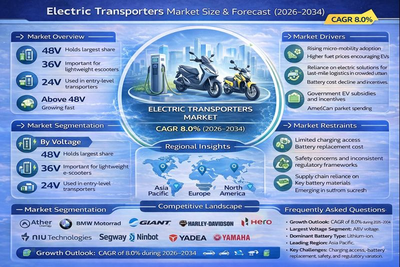
The electric transporters market is expected to grow at a CAGR of 8.0% during 2026–2034, driven by rising urban congestion, increasing demand for low-cost mobility, and government support for clean transportation. Electric transporters, including e-scooters, e-mopeds, and light electric two-wheelers, are gaining traction due to lower operating cost, reduced emissions, and improving charging access. Growth is also supported by better battery performance, higher energy density, and expanding shared mobility and last-mile delivery use cases. Continuous improvement in motor efficiency and vehicle electronics is increasing range and usability across city and suburban environments.
Market Drivers
Market growth is driven by expanding adoption of micro-mobility in urban areas, rising fuel prices, and stronger emission norms pushing consumers toward electric alternatives. Growth in gig economy delivery services and last-mile logistics is increasing demand for reliable electric transporters with stable range and payload handling. Battery cost decline and wider availability of lithium-ion packs are improving affordability and performance. Supportive policies such as EV subsidies, registration benefits, and charging infrastructure investments are accelerating market uptake. Increasing consumer preference for smart connectivity features such as app-based tracking, navigation, and theft prevention is also supporting demand.
Market Restraints
The market faces restraints related to limited charging access in dense urban housing, battery replacement cost, and range anxiety in regions with weak charging networks. Safety concerns, inconsistent regulatory frameworks for micro-mobility, and restrictions on where e-transporters can operate can limit adoption. Supply chain dependence on battery materials can create pricing volatility. In addition, performance challenges in extreme climates and durability concerns under heavy daily use can affect fleet economics and consumer confidence.
Market Segmentation
By Voltage
By voltage, the market is segmented into 24V, 36V, 48V, and above 48V. 48V holds a major share due to balanced torque delivery, efficiency, and compatibility with mainstream urban electric scooters and mopeds. 36V remains important for lightweight personal mobility devices where cost and compact design are priorities. 24V is used mainly in entry-level and low-speed devices where short-range commuting is the focus. Above 48V is witnessing strong growth as higher-performance electric two-wheelers and premium transporters demand higher power output, better acceleration, and improved load handling.
By Battery
By battery, the market is segmented into lithium-ion, lead-acid, nickel-metal hydride, and solid state. Lithium-ion dominates due to higher energy density, lighter weight, faster charging, and longer lifecycle, making it the preferred choice across consumer and fleet segments. Lead-acid remains in price-sensitive markets due to lower upfront cost but faces decline due to weight and shorter lifespan. Nickel-metal hydride has limited adoption and is mostly relevant in niche designs where safety and temperature stability are valued. Solid state batteries represent an emerging segment, expected to gain traction over time as commercialization improves due to potential benefits in safety, energy density, and charging performance.
Regional Insights
Asia Pacific leads the electric transporters market due to high two-wheeler penetration, strong demand for affordable commuting, and rapid scale-up of EV manufacturing ecosystems. Europe shows steady growth driven by micro-mobility adoption, urban emission policies, and shared mobility networks. North America follows with demand concentrated in premium electric motorcycles, urban micro-mobility, and campus or commercial use cases. Latin America and the Middle East & Africa represent emerging markets supported by rising urbanization, delivery services expansion, and gradual charging ecosystem development.
Competitive Landscape
The market is moderately competitive, with players focusing on range improvement, battery swapping models, connected features, and product portfolio expansion across commuter and performance categories. Cost optimization, local assembly, and supply chain partnerships for battery packs and power electronics are key strategies. Companies are also investing in fast charging, safety systems, and durable designs for fleet operators. Branding, dealer networks, and after-sales service capability remain critical for long-term market positioning. Key companies operating in the market include Ather Energy, BMW Motorrad, Giant, Harley-Davidson, Hero MotoCorp, Niu Technologies, Segway Ninebot, Yadea Technology, Yamaha Motor, and Zero Motorcycles.
Historical & Forecast Period
This study report represents analysis of each segment from 2024 to 2034 considering 2025 as the base year. Compounded Annual Growth Rate (CAGR) for each of the respective segments estimated for the forecast period of 2026 to 2034.
The current report comprises of quantitative market estimations for each micro market for every geographical region and qualitative market analysis such as micro and macro environment analysis, market trends, competitive intelligence, segment analysis, porters five force model, top winning strategies, top investment markets, emerging trends and technological analysis, case studies, strategic conclusions and recommendations and other key market insights.
Research Methodology
The complete research study was conducted in three phases, namely: secondary research, primary research, and expert panel review. key data point that enables the estimation of Electric Transporters Market By Electric Vehicle, By Voltage, By Range, By Battery, By Application, By End Use - Growth, Share, Opportunities & Competitive Analysis, 2026 - 2034 market are as follows:
Market forecast was performed through proprietary software that analyzes various qualitative and quantitative factors. Growth rate and CAGR were estimated through intensive secondary and primary research. Data triangulation across various data points provides accuracy across various analyzed market segments in the report. Application of both top down and bottom-up approach for validation of market estimation assures logical, methodical and mathematical consistency of the quantitative data.
| ATTRIBUTE | DETAILS |
|---|---|
| Research Period | 2024-2034 |
| Base Year | 2025 |
| Forecast Period | 2026-2034 |
| Historical Year | 2024 |
| Unit | USD Million |
| Segmentation | |
Electric Vehicle
|
|
Voltage
|
|
Battery
|
|
Range
|
|
Application
|
|
End Use
|
|
|
Region Segment (2024-2034; US$ Million)
|
Frequently Asked Questions
What is the growth outlook for the electric transporters market?
The market is expected to grow at a CAGR of 8.0% during 2026–2034, supported by urban mobility demand and electrification policies.
Which voltage segment holds the largest share?
48V holds the largest share due to balanced performance, efficiency, and wide product compatibility.
Which battery type dominates the market?
Lithium-ion dominates due to higher energy density, faster charging, and longer lifecycle.
Which region leads the market?
Asia Pacific leads the market, followed by Europe and North America.
What are the key challenges in this market?
Charging access limitations, battery replacement cost, safety concerns, and regulatory variation are major challenges.


