
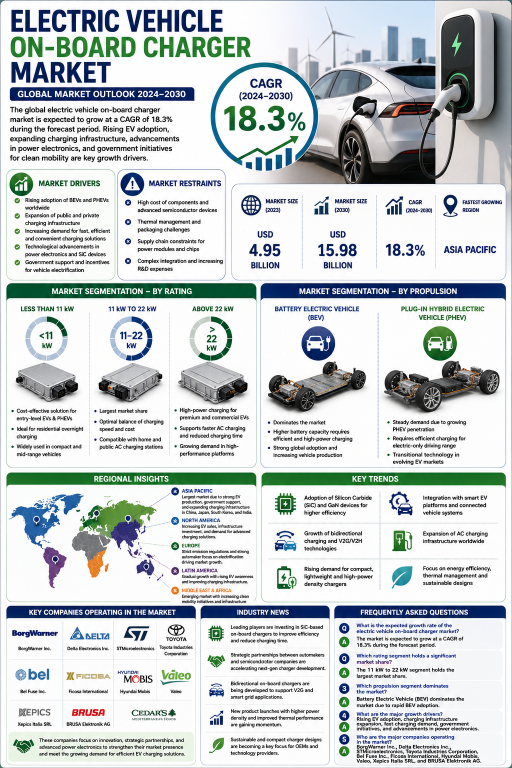
The global electric vehicle on-board charger market is expected to grow at a CAGR of 18.3% during the forecast period. Market growth is driven by rising electric vehicle adoption, expanding charging infrastructure, growing demand for fast and efficient charging systems, and increasing government support for vehicle electrification. On-board chargers are critical components in electric vehicles as they convert AC power from charging stations or household outlets into DC power for battery charging. The rising focus on battery performance, charging convenience, energy efficiency, and compact power electronics is further supporting market expansion worldwide.
Market Drivers
Rising Electric Vehicle Adoption and Charging Infrastructure Expansion
The rapid growth of battery electric vehicles and plug-in hybrid electric vehicles is creating strong demand for advanced on-board charging systems. Governments and automakers are investing heavily in EV production, charging networks, battery technologies, and clean mobility programs. Consumers are increasingly seeking faster charging, improved vehicle range, and convenient home and public charging options. This is significantly driving demand for high-efficiency on-board chargers across passenger and commercial electric vehicles.
Market Restraints
High Component Cost and Thermal Management Challenges
Advanced on-board chargers require high-quality power electronics, semiconductors, control units, and thermal management systems, which can increase vehicle manufacturing costs. Higher charging power ratings also create heat dissipation and packaging challenges, especially in compact vehicle platforms. Supply chain constraints for semiconductors and power modules may further impact production timelines and market growth.
Electric Vehicle On-Board Charger Market Trends
The market is witnessing growing adoption of bidirectional charging, vehicle-to-grid technology, silicon carbide power devices, and compact high-efficiency charger designs. Manufacturers are focusing on lightweight modules, faster AC charging capability, improved thermal performance, and integrated power electronics. The shift toward 11 kW to 22 kW chargers is increasing as automakers improve charging speed and user convenience. Growing investment in smart charging, connected EV platforms, and renewable energy integration is also creating new opportunities for on-board charger manufacturers.
Market Segmentation
By Rating
Based on rating, the market is segmented into Less than 11 kW, 11 kW to 22 kW, and Above 22 kW. The 11 kW to 22 kW segment accounts for a significant market share due to its strong balance between charging speed, cost efficiency, and compatibility with residential and public AC charging infrastructure. Less than 11 kW chargers remain widely used in entry-level EVs and plug-in hybrid vehicles due to lower cost and adequate overnight charging capability. Above 22 kW chargers are expected to witness growing demand in premium electric vehicles and commercial EV platforms requiring faster AC charging performance.
By Propulsion
Based on propulsion, the market is segmented into Battery Electric Vehicle (BEV) and Plug-in Hybrid Electric Vehicle (PHEV). Battery electric vehicles hold a major market share owing to rapid global BEV adoption, increasing battery capacity, and strong demand for efficient charging systems. BEVs require higher charging efficiency and power capacity, supporting demand for advanced on-board charger technologies. Plug-in hybrid electric vehicles continue to generate steady demand due to their charging requirements and transitional role in markets where full EV infrastructure is still developing.
Regional Insights
Asia Pacific represents a major market for electric vehicle on-board chargers due to strong electric vehicle production, large-scale battery manufacturing, government incentives, and rapid charging infrastructure development across China, Japan, South Korea, and India. China continues to lead regional demand owing to its large EV market and strong domestic component supply chain. Europe is witnessing steady growth supported by strict emission regulations, expanding EV adoption, and strong automaker investment in electrification. North America continues to grow due to increasing electric vehicle sales, charging infrastructure investments, and rising demand for high-performance EV platforms. Latin America and the Middle East & Africa are also expected to experience gradual growth as EV awareness, charging infrastructure, and clean mobility policies continue to develop.
Competitive Landscape
The electric vehicle on-board charger market is highly competitive, with companies focusing on power density, efficiency, cost optimization, thermal performance, and integration with vehicle power electronics. Manufacturers are investing in silicon carbide semiconductors, bidirectional charging systems, modular charger platforms, and lightweight designs to strengthen their market positions. Strategic partnerships with automakers, battery manufacturers, semiconductor suppliers, and charging infrastructure companies remain important growth strategies. Competitive differentiation increasingly depends on charging efficiency, reliability, compact design, safety performance, and compatibility with next-generation EV platforms.
Key Companies Operating in the Market Include
Key companies operating in the electric vehicle on-board charger market include BorgWarner Inc., Delta Electronics Inc., STMicroelectronics, Toyota Industries Corporation, Bel Fuse Inc., Ficosa International, Hyundai Mobis, Valeo, Xepics Italia SRL, and BRUSA Elektronik AG. These companies are focusing on high-efficiency charging modules, compact power electronics, bidirectional charging capability, silicon carbide-based solutions, and integrated EV power management systems to strengthen their market positions. Continuous investments in research and development, automaker partnerships, and advanced semiconductor technologies are helping these companies address rising demand for faster, safer, and more efficient EV charging solutions.
Electric Vehicle On-Board Charger Industry News
The industry is witnessing increasing investments in high-power on-board charging systems, bidirectional charging technologies, and silicon carbide-based power electronics. Automakers and suppliers are developing compact and lightweight charger modules to improve vehicle efficiency and reduce charging time. Vehicle-to-grid and vehicle-to-home applications are gaining attention as EVs become part of smart energy ecosystems. The expansion of electric vehicle production, charging infrastructure, and renewable energy integration is expected to remain a major driver of innovation and market growth during the forecast period.
Historical & Forecast Period
This study report represents analysis of each segment from 2024 to 2034 considering 2025 as the base year. Compounded Annual Growth Rate (CAGR) for each of the respective segments estimated for the forecast period of 2026 to 2034.
The current report comprises of quantitative market estimations for each micro market for every geographical region and qualitative market analysis such as micro and macro environment analysis, market trends, competitive intelligence, segment analysis, porters five force model, top winning strategies, top investment markets, emerging trends and technological analysis, case studies, strategic conclusions and recommendations and other key market insights.
Research Methodology
The complete research study was conducted in three phases, namely: secondary research, primary research, and expert panel review. key data point that enables the estimation of Electric Vehicle On-Board Charger Market - Growth, Share, Opportunities & Competitive Analysis, 2026 - 2034 market are as follows:
Market forecast was performed through proprietary software that analyzes various qualitative and quantitative factors. Growth rate and CAGR were estimated through intensive secondary and primary research. Data triangulation across various data points provides accuracy across various analyzed market segments in the report. Application of both top down and bottom-up approach for validation of market estimation assures logical, methodical and mathematical consistency of the quantitative data.
| ATTRIBUTE | DETAILS |
|---|---|
| Research Period | 2024-2034 |
| Base Year | 2025 |
| Forecast Period | 2026-2034 |
| Historical Year | 2024 |
| Unit | USD Million |
| Segmentation | |
Propulsion
|
|
Rating
|
|
|
Region Segment (2024-2034; US$ Million)
|
Frequently Asked Questions
What is the expected growth rate of the electric vehicle on-board charger market?
The electric vehicle on-board charger market is expected to grow at a CAGR of 18.3% during the forecast period.
Which rating segment holds a significant market share?
The 11 kW to 22 kW segment holds a significant market share due to its balance between charging speed, cost efficiency, and compatibility with common AC charging infrastructure.
Which propulsion segment dominates the market?
Battery Electric Vehicle (BEV) dominates the market owing to rapid BEV adoption, larger battery capacities, and strong demand for efficient charging systems.
What are the major growth drivers?
Major growth drivers include rising electric vehicle adoption, expanding charging infrastructure, increasing demand for fast charging, government support for vehicle electrification, and advancements in power electronics.
Who are the major companies operating in the market?
Major companies include BorgWarner Inc., Delta Electronics Inc., STMicroelectronics, Toyota Industries Corporation, Bel Fuse Inc., Ficosa International, Hyundai Mobis, Valeo, Xepics Italia SRL, and BRUSA Elektronik AG.


