
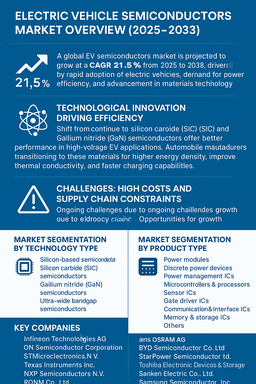
The global electric vehicle (EV) semiconductors market is projected to grow at a CAGR of 21.5% from 2026 to 2034, driven by the accelerating adoption of electric vehicles, advancements in power electronics, and the global shift toward sustainable mobility. Semiconductors are integral to EV performance, supporting functions such as battery management, motor control, onboard charging, and energy conversion. Increasing investments in EV infrastructure, battery innovation, and government incentives for zero-emission vehicles are fueling strong market growth.
Technological Innovation Driving Efficiency
The growing demand for higher power efficiency, compact form factors, and faster switching capabilities is transforming the EV semiconductor landscape. Manufacturers are increasingly integrating wide bandgap materials such as silicon carbide (SiC) and gallium nitride (GaN) to achieve superior performance in high-voltage systems. These materials enable higher energy density and improved thermal conductivity, which enhance the efficiency and range of electric vehicles. The shift from traditional silicon-based technologies to next-generation materials is being accelerated by major automakers and Tier-1 suppliers focused on optimizing EV drivetrain efficiency, reducing charging times, and lowering power losses.
Challenges: High Cost and Supply Chain Constraints
Despite rapid progress, the market faces challenges such as high manufacturing costs of wide bandgap semiconductors and complex fabrication processes. Limited wafer supply and long lead times for SiC and GaN components continue to affect production scalability. Furthermore, fluctuating raw material costs and dependency on global semiconductor foundries present supply chain vulnerabilities. However, increasing investments in localized semiconductor manufacturing and the emergence of new foundry partnerships are expected to mitigate these issues over the coming years.
Market Segmentation by Technology Type
By technology type, the market is segmented into silicon-based semiconductors, silicon carbide (SiC) semiconductors, gallium nitride (GaN) semiconductors, and ultra-wide bandgap semiconductors.In 2025, silicon-based semiconductors accounted for the largest share, driven by their cost-effectiveness and widespread adoption in control and sensor systems. However, SiC semiconductors are expected to record the highest CAGR, driven by their increasing use in EV traction inverters, DC-DC converters, and onboard chargers. GaN semiconductors are gaining traction in high-frequency, low-loss switching applications, while ultra-wide bandgap semiconductors represent an emerging segment with potential for ultra-high efficiency in next-generation EV architectures.
Market Segmentation by Product Type
By product type, the market is categorized into power modules, discrete power devices, power management ICs, microcontrollers & processors, sensor ICs, gate driver ICs, communication & interface ICs, memory & storage ICs, and others. In 2025, power modules dominated the market due to their critical role in managing high-power operations within EV drivetrains. Microcontrollers and processors form the backbone of EV control systems, enabling intelligent power distribution and efficient performance monitoring. Power management ICs and sensor ICs are expected to witness significant growth, driven by the expanding integration of ADAS and battery monitoring systems. Gate driver ICs and communication interface ICs are also essential for enabling reliable and high-speed connectivity across EV electronic subsystems.
Regional Insights
In 2025, Asia Pacific held the largest share of the EV semiconductors market, led by strong production bases in China, Japan, South Korea, and Taiwan. The region’s dominance is supported by government incentives for EV adoption, advanced manufacturing capabilities, and investments in semiconductor fabrication facilities. Europe follows closely, driven by electrification targets under EU Green Deal policies and the presence of major EV OEMs in Germany, France, and the Netherlands. North America is experiencing robust growth due to the expansion of EV manufacturing in the U.S. and increased investment in domestic semiconductor production. Emerging markets in Latin America and Middle East & Africa are expected to adopt EV semiconductor technologies gradually as charging infrastructure improves.
Competitive Landscape
The electric vehicle semiconductors market is highly competitive, with leading companies focusing on innovation in wide bandgap technologies, miniaturization, and integration. Infineon Technologies AG, ON Semiconductor Corporation, and STMicroelectronics N.V. are among the top players with strong portfolios in SiC and GaN power devices. Texas Instruments Inc., NXP Semiconductors N.V., ROHM Co., Ltd., and Wolfspeed, Inc. are advancing next-generation power electronics and control ICs. Analog Devices, Inc., Microchip Technology Inc., Renesas Electronics Corporation, and Allegro MicroSystems, Inc. specialize in power management, sensor integration, and system-on-chip solutions for EV platforms. Emerging players like BYD Semiconductor Co., Ltd., StarPower Semiconductor Ltd., and Sanken Electric Co., Ltd. are enhancing competitiveness through in-house manufacturing and vertical integration.
Historical & Forecast Period
This study report represents analysis of each segment from 2024 to 2034 considering 2025 as the base year. Compounded Annual Growth Rate (CAGR) for each of the respective segments estimated for the forecast period of 2026 to 2034.
The current report comprises of quantitative market estimations for each micro market for every geographical region and qualitative market analysis such as micro and macro environment analysis, market trends, competitive intelligence, segment analysis, porters five force model, top winning strategies, top investment markets, emerging trends and technological analysis, case studies, strategic conclusions and recommendations and other key market insights.
Research Methodology
The complete research study was conducted in three phases, namely: secondary research, primary research, and expert panel review. key data point that enables the estimation of Electric Vehicle Semiconductors Market By Technology Type, By Product Type, By Application, By End Use - Growth, Share, Opportunities & Competitive Analysis, 2026 - 2034 market are as follows:
Market forecast was performed through proprietary software that analyzes various qualitative and quantitative factors. Growth rate and CAGR were estimated through intensive secondary and primary research. Data triangulation across various data points provides accuracy across various analyzed market segments in the report. Application of both top down and bottom-up approach for validation of market estimation assures logical, methodical and mathematical consistency of the quantitative data.
| ATTRIBUTE | DETAILS |
|---|---|
| Research Period | 2024-2034 |
| Base Year | 2025 |
| Forecast Period | 2026-2034 |
| Historical Year | 2024 |
| Unit | USD Million |
| Segmentation | |
Technology Type
|
|
Product Type
|
|
Application
|
|
End Use
|
|
|
Region Segment (2024-2034; US$ Million)
|
Key questions answered in this report


