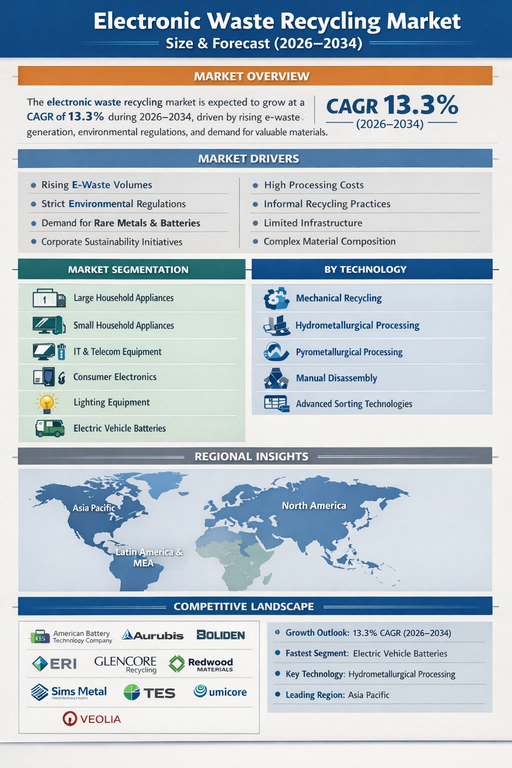
The electronic waste recycling market is expected to grow at a CAGR of 13.3% during 2026–2034, driven by rising consumption of electronic devices, shorter product life cycles, and strict environmental regulations. Electronic waste contains valuable metals such as copper, gold, silver, lithium, and cobalt, making recycling economically important. Governments and manufacturers are focusing on circular economy models to reduce landfill disposal and recover critical raw materials. Growth of electric vehicles and renewable energy systems is further increasing demand for battery and electronics recycling.
Market Drivers
Market growth is supported by increasing global e-waste generation from smartphones, laptops, appliances, and industrial electronics. Government regulations on hazardous waste disposal and extended producer responsibility policies are encouraging recycling investments. Rising demand for rare earth and battery materials is improving the business case for recycling. Corporate sustainability commitments and ESG reporting requirements are also accelerating adoption. Technological improvements in sorting, metal recovery, and automation are improving recycling efficiency and profitability.
Market Restraints
The market faces challenges related to high processing cost, complex material composition, and limited recycling infrastructure in developing regions. Informal recycling practices reduce material recovery efficiency and create environmental risks. Lack of standardized collection systems and low consumer awareness also impact recycling volumes. In addition, high capital investment requirements for advanced processing plants can restrict entry of small players.
Market Segmentation
By Product Type
By product type, the market is segmented into large household appliances, small household appliances, IT & telecommunications equipment, consumer electronics, lighting equipment, and electric vehicle batteries. IT & telecommunications equipment represents a major share due to high replacement rates of computers and networking devices. Consumer electronics also contribute significantly due to smartphones, tablets, and wearables. Electric vehicle batteries are expected to register the highest growth rate due to rapid EV adoption and critical material recovery needs.
By Technology
By technology, the market is segmented into mechanical recycling, hydrometallurgical processing, pyrometallurgical processing, manual disassembly, and advanced sorting technologies. Mechanical recycling remains widely used for initial material separation. Hydrometallurgical processing is gaining traction due to higher metal recovery efficiency and lower emissions. Pyrometallurgical processing is used for large-scale metal extraction. Manual disassembly remains important for component recovery, while advanced sorting technologies such as AI-based optical sorting are improving processing accuracy.
Regional Insights
Asia Pacific leads the electronic waste recycling market due to high electronics consumption, large population base, and expanding recycling infrastructure in China, Japan, South Korea, and India. Europe follows with strong regulatory enforcement, circular economy policies, and advanced recycling facilities. North America shows steady growth supported by corporate sustainability programs and battery recycling investments. Latin America and the Middle East & Africa represent emerging markets with improving regulatory frameworks and growing awareness.
Competitive Landscape
The market is moderately consolidated, with companies focusing on battery recycling, metal recovery efficiency, automation, and regulatory compliance. Strategic partnerships with electronics manufacturers, EV companies, and governments are key growth strategies. Expansion of lithium-ion battery recycling capacity and investment in hydrometallurgical technologies are major competitive priorities.
Key companies operating in the market include American Battery Technology Company, Aurubis, Boliden, Electronic Recyclers International, Glencore Recycling, Redwood Materials, Retriev Technologies, Sims Metal Management, Stena Metall, TES (Technology, Environment & Services), Umicore, and Veolia.
Historical & Forecast Period
This study report represents analysis of each segment from 2024 to 2034 considering 2025 as the base year. Compounded Annual Growth Rate (CAGR) for each of the respective segments estimated for the forecast period of 2026 to 2034.
The current report comprises of quantitative market estimations for each micro market for every geographical region and qualitative market analysis such as micro and macro environment analysis, market trends, competitive intelligence, segment analysis, porters five force model, top winning strategies, top investment markets, emerging trends and technological analysis, case studies, strategic conclusions and recommendations and other key market insights.
Research Methodology
The complete research study was conducted in three phases, namely: secondary research, primary research, and expert panel review. key data point that enables the estimation of Electronic Waste Recycling market are as follows:
Market forecast was performed through proprietary software that analyzes various qualitative and quantitative factors. Growth rate and CAGR were estimated through intensive secondary and primary research. Data triangulation across various data points provides accuracy across various analyzed market segments in the report. Application of both top down and bottom-up approach for validation of market estimation assures logical, methodical and mathematical consistency of the quantitative data.
| ATTRIBUTE | DETAILS |
|---|---|
| Research Period | 2024-2034 |
| Base Year | 2025 |
| Forecast Period | 2026-2034 |
| Historical Year | 2024 |
| Unit | USD Million |
| Segmentation | |
Product Type
|
|
Technology
|
|
Application
|
|
End Use Industry
|
|
|
Region Segment (2024-2034; US$ Million)
|
Frequently Asked Questions
What is the growth outlook for the electronic waste recycling market?
The market is expected to grow at a CAGR of 13.3% during 2026–2034, driven by rising e-waste generation and regulatory pressure.
Which product segment is growing fastest?
Electric vehicle batteries are growing fastest due to EV adoption and critical material recovery needs.
Which technology is gaining importance?
Hydrometallurgical processing is gaining importance due to higher recovery rates and lower environmental impact.
Which region leads the market?
Asia Pacific leads the market, followed by Europe and North America.
What are the key challenges in this market?
High processing cost, informal recycling, infrastructure gaps, and complex material composition are major challenges.