
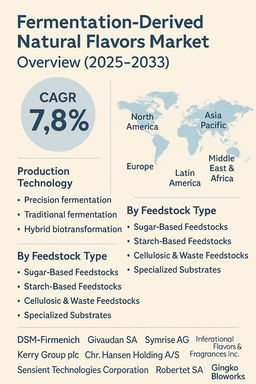
The global fermentation-derived natural flavors market is projected to grow at a CAGR of 7.8% from 2026 to 2034, driven by rising consumer demand for clean-label, sustainable, and plant-based food products. Fermentation technology enables the production of natural flavors without reliance on agricultural seasonality, providing consistent quality, scalability, and reduced environmental impact. Advances in biotechnology, precision fermentation, and biotransformation are enabling the development of unique flavor molecules that mimic traditional sources while meeting regulatory and consumer preferences for natural origin. Food and beverage manufacturers are increasingly adopting fermentation-derived solutions to replace synthetic additives and expand portfolios in dairy alternatives, meat substitutes, and functional foods.
Rising Demand for Sustainable and Clean-Label Flavors
Growing awareness of health, sustainability, and ethical sourcing is fueling demand for fermentation-derived natural flavors. Consumers are shifting toward products free from artificial additives, while food companies are under pressure to reformulate with natural and traceable ingredients. Fermentation offers a sustainable production method with lower land and water use compared to traditional farming. The technology also supports scalability, ensuring stable supply despite agricultural volatility. Hybrid approaches combining traditional fermentation and biotransformation are gaining attention for delivering novel and authentic taste profiles. This aligns with the increasing adoption of plant-based proteins, ready-to-eat foods, and beverages enriched with functional natural flavors.
Challenges: Cost Barriers and Scale-Up Limitations
Despite strong momentum, the market faces challenges related to high production costs, scale-up complexities, and regulatory approval hurdles. Precision fermentation, while highly promising, remains capital-intensive and requires sophisticated infrastructure for commercial-scale output. Consumer price sensitivity in certain regions limits penetration of premium products using fermentation-derived flavors. Regulatory frameworks vary widely across geographies, slowing approvals and creating uncertainties for global commercialization. However, ongoing investments in fermentation capacity, advances in feedstock optimization, and growing collaborations between biotech firms and flavor houses are expected to reduce costs and accelerate broader adoption.
Market Segmentation by Production Technology
By production technology, precision fermentation is emerging as the leading segment due to its ability to design and produce targeted flavor compounds with high purity and consistency. Traditional fermentation retains importance, particularly for yeast- and bacteria-based processes widely used in natural flavor production for beverages and dairy applications. Hybrid biotransformation, which combines microbial pathways with enzymatic processes, is gaining ground as a flexible approach to produce novel flavor profiles that replicate natural taste complexity.
Market Segmentation by Feedstock Type
By feedstock, sugar-based substrates represent the largest segment, owing to their availability, cost-effectiveness, and established use in fermentation. Starch-based feedstocks are expanding in adoption as companies explore diversified raw material sources to reduce dependency on sugar. Cellulosic and waste feedstocks are emerging as sustainable alternatives, aligning with the circular economy model and reducing reliance on conventional agricultural inputs. Specialized substrates, such as tailored nutrient blends and engineered feedstocks, are increasingly used in high-value applications where specific flavor precursors are required.
Regional Insights
In 2025, Europe led the fermentation-derived natural flavors market, supported by strong regulatory support for clean-label ingredients, high consumer awareness, and innovation by leading flavor houses in Switzerland, Germany, and France. North America followed, with the U.S. driving adoption through advanced biotechnology ecosystems and collaborations between startups and established food manufacturers. Asia Pacific is the fastest-growing region, driven by rising consumer demand for sustainable and natural products in China, India, and Japan, alongside significant investments in fermentation capacity. Latin America and the Middle East & Africa remain emerging markets, where increasing urbanization, growing processed food demand, and gradual shifts toward clean-label products are creating opportunities for expansion.
Competitive Landscape
The fermentation-derived natural flavors market in 2025 was dominated by global leaders in flavor and fragrance innovation. DSM-Firmenich, Givaudan SA, Symrise AG, International Flavors & Fragrances Inc., and Kerry Group plc maintained strong positions through extensive portfolios, global reach, and R&D capabilities. Chr. Hansen Holding A/S and Sensient Technologies Corporation are advancing microbial strain development and fermentation applications to diversify product offerings. Takasago International Corporation and Robertet SA continue to expand their presence with a focus on regional flavor innovation and sustainability initiatives. Ginkgo Bioworks Holdings Inc. stands out as a biotech innovator, leveraging synthetic biology platforms to design next-generation flavor molecules through precision fermentation. Competitive differentiation is increasingly defined by sustainability strategies, scalability of fermentation processes, cost reduction initiatives, and partnerships between biotech firms and food & beverage multinationals.
Historical & Forecast Period
This study report represents analysis of each segment from 2024 to 2034 considering 2025 as the base year. Compounded Annual Growth Rate (CAGR) for each of the respective segments estimated for the forecast period of 2026 to 2034.
The current report comprises of quantitative market estimations for each micro market for every geographical region and qualitative market analysis such as micro and macro environment analysis, market trends, competitive intelligence, segment analysis, porters five force model, top winning strategies, top investment markets, emerging trends and technological analysis, case studies, strategic conclusions and recommendations and other key market insights.
Research Methodology
The complete research study was conducted in three phases, namely: secondary research, primary research, and expert panel review. key data point that enables the estimation of Fermentation-Derived Natural Flavors Market By Production Technology, By Feedstock Type, By Application - Growth, Share, Opportunities & Competitive Analysis, 2026 - 2034 market are as follows:
Market forecast was performed through proprietary software that analyzes various qualitative and quantitative factors. Growth rate and CAGR were estimated through intensive secondary and primary research. Data triangulation across various data points provides accuracy across various analyzed market segments in the report. Application of both top down and bottom-up approach for validation of market estimation assures logical, methodical and mathematical consistency of the quantitative data.
| ATTRIBUTE | DETAILS |
|---|---|
| Research Period | 2024-2034 |
| Base Year | 2025 |
| Forecast Period | 2026-2034 |
| Historical Year | 2024 |
| Unit | USD Million |
| Segmentation | |
Production Technology
|
|
Feedstock Type
|
|
Application
|
|
|
Region Segment (2024-2034; US$ Million)
|
Key questions answered in this report


