
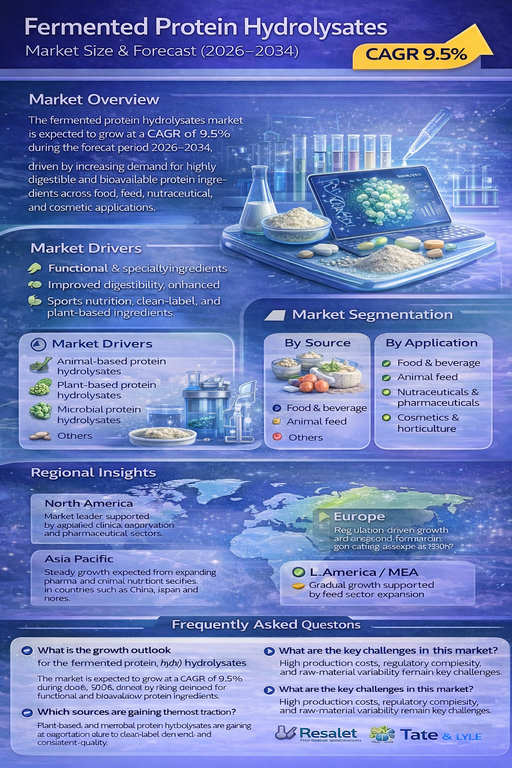
The fermented protein hydrolysates market is expected to grow at a CAGR of 9.5% during the forecast period 2026–2034, driven by rising demand for functional ingredients with improved digestibility, bioavailability, and nutritional value. Fermented protein hydrolysates are produced through controlled fermentation processes that break proteins into peptides and amino acids, enhancing their functional and health benefits. Market growth is supported by increasing use across food and beverage products, animal nutrition, nutraceuticals, and cosmetic formulations. Growing preference for clean-label, natural, and plant-based ingredients is further supporting market expansion, particularly in developed economies.
Market Drivers
Market growth is mainly driven by increasing demand for high-quality functional ingredients in food, nutraceutical, and feed applications. Fermented protein hydrolysates offer improved absorption, better flavor profiles, and enhanced bioactivity compared to conventional protein ingredients. Rising consumption of sports nutrition, clinical nutrition, and functional foods is supporting adoption in human nutrition applications. In animal feed, demand is driven by the need for efficient protein sources that improve gut health and feed conversion ratios. Continuous advancements in fermentation technology and enzyme optimization are also improving yield and cost efficiency, supporting broader commercial adoption.
Market Restraints
Despite positive growth outlook, the market faces challenges related to higher production costs associated with fermentation and downstream processing. Limited availability of standardized raw materials and variability in protein sources can impact product consistency. Regulatory requirements for food, nutraceutical, and pharmaceutical applications can increase approval timelines and compliance costs. In addition, limited awareness in some emerging markets and competition from conventional protein ingredients may restrain adoption in price-sensitive regions.
Market Segmentation
By Source
By source, the market is segmented into animal-based protein hydrolysates, plant-based protein hydrolysates, microbial protein hydrolysates, insect protein hydrolysates, and others. Plant-based protein hydrolysates account for a significant share due to growing demand for vegan and clean-label products. Animal-based protein hydrolysates continue to hold strong demand in nutrition and feed applications due to established supply chains. Microbial protein hydrolysates are gaining traction due to consistent quality and scalability, while insect protein hydrolysates remain an emerging segment supported by sustainability-driven innovation.
By Application
Based on application, the market includes food and beverage applications, animal feed applications, nutraceuticals and pharmaceuticals, cosmetics and personal care, agriculture and horticulture, and others. Food and beverage applications represent a major share, driven by functional foods, beverages, and flavor enhancement uses. Animal feed applications form a key segment due to benefits in animal growth performance and health. Nutraceuticals and pharmaceuticals are expected to witness strong growth due to rising focus on preventive healthcare. Cosmetics and personal care applications are expanding with increasing use of bioactive peptides in skin and hair care formulations.
Regional Insights
North America holds a significant share of the fermented protein hydrolysates market, supported by strong demand for functional foods, dietary supplements, and advanced animal nutrition solutions. Europe follows closely, driven by clean-label trends, regulatory support for sustainable ingredients, and strong fermentation expertise. Asia Pacific is expected to register the fastest growth during the forecast period, led by expanding food processing industries, rising health awareness, and increasing fermentation capacity in countries such as China, Japan, and South Korea. Latin America and the Middle East & Africa show gradual growth supported by expanding feed and agriculture sectors.
Competitive Landscape
The competitive landscape includes global ingredient manufacturers and specialized fermentation technology providers. Companies focus on product innovation, source diversification, and application-specific formulations to strengthen market presence. Strategic collaborations with food, feed, and pharmaceutical companies are common to expand application reach. Investments in advanced fermentation platforms, enzyme technologies, and sustainable raw materials remain key competitive strategies across the market.
Key companies operating in the market include Kerry Group, Angel Yeast, Arla Foods Ingredients Group, Novozymes, DSM-firmenich, Fonterra, Lesaffre Group, Hebei Shuntian Biotechnology, Sensient Technologies Corporation, and Tate & Lyle.
Historical & Forecast Period
This study report represents analysis of each segment from 2024 to 2034 considering 2025 as the base year. Compounded Annual Growth Rate (CAGR) for each of the respective segments estimated for the forecast period of 2026 to 2034.
The current report comprises of quantitative market estimations for each micro market for every geographical region and qualitative market analysis such as micro and macro environment analysis, market trends, competitive intelligence, segment analysis, porters five force model, top winning strategies, top investment markets, emerging trends and technological analysis, case studies, strategic conclusions and recommendations and other key market insights.
Research Methodology
The complete research study was conducted in three phases, namely: secondary research, primary research, and expert panel review. key data point that enables the estimation of Fermented Protein Hydrolysates Market By Source, By Application, By Form - Growth, Share, Opportunities & Competitive Analysis, 2026 - 2034 market are as follows:
Market forecast was performed through proprietary software that analyzes various qualitative and quantitative factors. Growth rate and CAGR were estimated through intensive secondary and primary research. Data triangulation across various data points provides accuracy across various analyzed market segments in the report. Application of both top down and bottom-up approach for validation of market estimation assures logical, methodical and mathematical consistency of the quantitative data.
| ATTRIBUTE | DETAILS |
|---|---|
| Research Period | 2024-2034 |
| Base Year | 2025 |
| Forecast Period | 2026-2034 |
| Historical Year | 2024 |
| Unit | USD Million |
| Segmentation | |
Source
|
|
Application
|
|
Form
|
|
|
Region Segment (2024-2034; US$ Million)
|
Key questions answered in this report


