
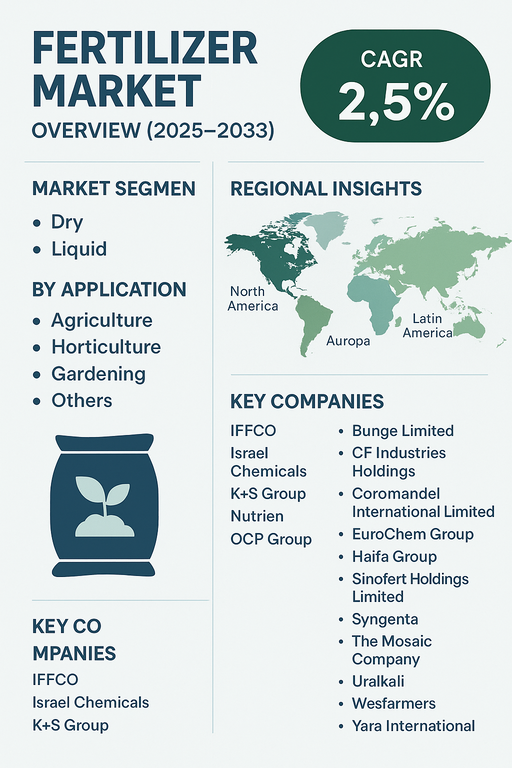
The global fertilizer market is projected to grow at a CAGR of 2.5% from 2026 to 2034. Growth is primarily driven by rising global food demand, increasing agricultural intensification, and the need to improve crop productivity on limited arable land. Fertilizers play a critical role in replenishing essential nutrients such as nitrogen, phosphorus, and potassium, ensuring higher yields and quality. Emerging trends in specialty fertilizers, controlled-release formulations, and bio-based solutions are reshaping the market, as sustainability and environmental considerations become increasingly important.
Rising Demand for Crop Productivity and Food Security
The global population growth and urbanization are putting immense pressure on agricultural systems to produce more food with fewer resources. Fertilizers remain a cornerstone of productivity, especially in regions facing declining soil fertility. Liquid fertilizers are gaining traction for their rapid nutrient uptake and compatibility with modern precision agriculture techniques, while dry fertilizers continue to dominate in large-scale farming due to ease of storage and lower costs. Integration of digital agriculture technologies, including variable-rate application and soil nutrient mapping, is further improving fertilizer efficiency and driving adoption.
Challenges: Environmental Concerns and Price Volatility
Despite steady demand, the fertilizer market faces several challenges. Environmental concerns related to excessive fertilizer use, such as soil degradation, eutrophication of water bodies, and greenhouse gas emissions, are driving stricter regulatory frameworks. Price volatility of key raw materials like natural gas and phosphate rock also impacts production costs and profitability. Additionally, over-reliance on chemical fertilizers has sparked demand for alternatives such as biofertilizers and organic nutrient sources. However, ongoing innovations in nutrient efficiency, balanced fertilization, and sustainable farming practices are expected to mitigate these challenges.
Market Segmentation by Form
By form, the market is segmented into dry and liquid fertilizers. In 2025, dry fertilizers held the largest share, favored for their cost-effectiveness, long shelf life, and suitability for bulk agriculture. Liquid fertilizers are expanding rapidly due to their ease of application, higher absorption rates, and compatibility with advanced irrigation systems.
Market Segmentation by Application
By application, the market is segmented into agriculture, horticulture, gardening, and others. Agriculture dominated the segment in 2025, as fertilizers remain essential for staple crop production, including cereals, rice, maize, and wheat. Horticulture applications, including fruits, vegetables, and floriculture, are growing strongly, supported by rising consumer demand for high-value crops. Gardening and other smaller-scale applications contribute steadily, particularly in urban areas where household and commercial landscaping practices are increasing.
Regional Insights
In 2025, Asia Pacific led the global fertilizer market, driven by the high population density, intensive crop production, and reliance on fertilizers in China and India. North America and Europe follow, with steady growth supported by precision agriculture practices and regulatory pushes for sustainable fertilizer use. Latin America, particularly Brazil, is a key growth hub due to large-scale soybean and sugarcane production. The Middle East & Africa (MEA) region is gradually expanding, supported by investments in agriculture modernization and food security initiatives.
Competitive Landscape
The 2025 market was characterized by strong global players and regional suppliers catering to diverse agricultural needs. Nutrien, Yara International, The Mosaic Company, OCP Group, and CF Industries Holdings are global leaders with extensive portfolios and distribution networks. K+S Group, Uralkali, and Israel Chemicals maintain strong positions in potash and specialty fertilizers. IFFCO and Coromandel International are key players in India, focusing on bulk fertilizers and rural outreach. EuroChem Group, Haifa Group, and Sinofert Holdings strengthen positions in specialty and regional supply. Syngenta and Bunge Limited are enhancing their role in crop protection and integrated nutrient solutions. Competitive strategies are increasingly shaped by sustainability, innovation in nutrient-efficient products, and geographic expansion.
Historical & Forecast Period
This study report represents analysis of each segment from 2024 to 2034 considering 2025 as the base year. Compounded Annual Growth Rate (CAGR) for each of the respective segments estimated for the forecast period of 2026 to 2034.
The current report comprises of quantitative market estimations for each micro market for every geographical region and qualitative market analysis such as micro and macro environment analysis, market trends, competitive intelligence, segment analysis, porters five force model, top winning strategies, top investment markets, emerging trends and technological analysis, case studies, strategic conclusions and recommendations and other key market insights.
Research Methodology
The complete research study was conducted in three phases, namely: secondary research, primary research, and expert panel review. key data point that enables the estimation of Fertilizer Market By Form, By Product, By Application - Growth, Share, Opportunities & Competitive Analysis, 2026 - 2034 market are as follows:
Market forecast was performed through proprietary software that analyzes various qualitative and quantitative factors. Growth rate and CAGR were estimated through intensive secondary and primary research. Data triangulation across various data points provides accuracy across various analyzed market segments in the report. Application of both top down and bottom-up approach for validation of market estimation assures logical, methodical and mathematical consistency of the quantitative data.
| ATTRIBUTE | DETAILS |
|---|---|
| Research Period | 2024-2034 |
| Base Year | 2025 |
| Forecast Period | 2026-2034 |
| Historical Year | 2024 |
| Unit | USD Million |
| Segmentation | |
Form
|
|
Product
|
|
Application
|
|
|
Region Segment (2024-2034; US$ Million)
|
Key questions answered in this report


