
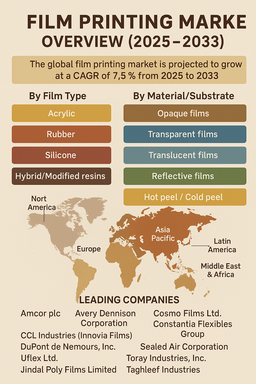
The global film printing market is projected to grow at a CAGR of 7.5% from 2026 to 2034, driven by rising demand for high-quality packaging, branding, and decorative applications across industries such as food & beverage, personal care, pharmaceuticals, and consumer goods. Film printing offers enhanced design flexibility, product differentiation, and functional protection, making it a critical part of modern packaging solutions. Increasing adoption of sustainable films, growing e-commerce activities, and the shift toward visually appealing, eco-friendly packaging are further fueling market growth. Technological advancements in digital, flexographic, and gravure printing techniques are improving cost efficiency, print quality, and customization, enabling manufacturers to cater to diverse end-user needs.
Rising Demand for Branded and Sustainable Packaging
The growing emphasis on brand visibility, consumer convenience, and eco-friendly packaging solutions is significantly driving the adoption of printed films. Companies are using advanced film printing techniques to deliver packaging that combines durability with visual appeal, offering greater shelf impact and consumer engagement. Sustainable packaging trends are accelerating the demand for recyclable, bio-based, and lightweight films, while regulatory pressures are pushing manufacturers to reduce plastic waste and adopt environmentally responsible printing technologies. This transformation is reshaping industry practices and opening new opportunities for innovative substrates and inks.
Challenges: Sustainability Concerns and Raw Material Volatility
Despite the strong growth outlook, the market faces challenges linked to sustainability, raw material price volatility, and recycling infrastructure limitations. Traditional petroleum-based films contribute to environmental concerns, pushing regulators and consumers to demand greener alternatives. Price fluctuations of polymers and resins create supply chain uncertainties for manufacturers. Additionally, the technical complexity of recycling multi-layered or printed films presents further challenges. However, rising investments in sustainable raw materials, innovations in water-based and UV-curable inks, and government-backed initiatives for circular packaging solutions are expected to address these issues and sustain growth momentum.
Market Segmentation by Film Type
By film type, acrylic films are widely used for their excellent printability, durability, and protective features, making them popular in packaging and decorative applications. Rubber-based films are valued for flexibility and resilience in specialty applications. Silicone films are increasingly adopted for their heat resistance and release properties, while hybrid and modified resin films provide customized performance characteristics for niche markets. Other film types continue to find application in specific industries requiring unique performance profiles.
Market Segmentation by Material/Substrate
By material or substrate, opaque films dominate the market as they provide strong branding visibility, barrier properties, and protection for packaged goods. Transparent films are expanding rapidly in food and personal care packaging, allowing product visibility and appealing aesthetics. Translucent films are used in applications where partial visibility and decorative appeal are important. Reflective films are gaining traction in high-impact marketing and specialty packaging. Hot peel and cold peel substrates are important in transfer applications, particularly in textile and specialty product printing.
Regional Insights
In 2025, Asia Pacific led the global film printing market, supported by strong packaging demand in China, India, and Southeast Asia, alongside expanding e-commerce and retail sectors. North America followed, driven by innovation in sustainable packaging and increasing adoption of advanced printing technologies. Europe maintained a significant market position with a strong focus on eco-friendly packaging, recycling regulations, and premium consumer goods. Latin America is witnessing growth through expanding FMCG and food packaging demand, while the Middle East & Africa are gradually adopting film printing solutions, supported by urbanization and modernization of retail sectors.
Competitive Landscape
The 2025 film printing market was led by global packaging and specialty film manufacturers. Amcor plc, Avery Dennison Corporation, Cosmo Films Ltd., Constantia Flexibles Group, CCL Industries (Innovia Films), DuPont de Nemours, Inc., Mondi Group, Sealed Air Corporation, and Uflex Ltd. remain major players with diversified film portfolios and global distribution networks. Toray Industries, Inc., Jindal Poly Films Limited, and Taghleef Industries are expanding their roles through investments in sustainable packaging and film innovation. Huhtamaki Oyj and SWM International continue to strengthen their presence with tailored solutions for food packaging, consumer products, and specialty applications. Competitive differentiation is increasingly being defined by sustainability initiatives, lightweight and recyclable film solutions, technological innovations in printing, and collaborations with brand owners to deliver value-added packaging solutions.
Historical & Forecast Period
This study report represents analysis of each segment from 2024 to 2034 considering 2025 as the base year. Compounded Annual Growth Rate (CAGR) for each of the respective segments estimated for the forecast period of 2026 to 2034.
The current report comprises of quantitative market estimations for each micro market for every geographical region and qualitative market analysis such as micro and macro environment analysis, market trends, competitive intelligence, segment analysis, porters five force model, top winning strategies, top investment markets, emerging trends and technological analysis, case studies, strategic conclusions and recommendations and other key market insights.
Research Methodology
The complete research study was conducted in three phases, namely: secondary research, primary research, and expert panel review. key data point that enables the estimation of Film Printing Market By Film Type, By Material/Substrate, By Printing Technology, By Application - Growth, Share, Opportunities & Competitive Analysis, 2026 - 2034 market are as follows:
Market forecast was performed through proprietary software that analyzes various qualitative and quantitative factors. Growth rate and CAGR were estimated through intensive secondary and primary research. Data triangulation across various data points provides accuracy across various analyzed market segments in the report. Application of both top down and bottom-up approach for validation of market estimation assures logical, methodical and mathematical consistency of the quantitative data.
| ATTRIBUTE | DETAILS |
|---|---|
| Research Period | 2024-2034 |
| Base Year | 2025 |
| Forecast Period | 2026-2034 |
| Historical Year | 2024 |
| Unit | USD Million |
| Segmentation | |
Film Type
|
|
Material/Substrate
|
|
Printing Technology
|
|
Application
|
|
|
Region Segment (2024-2034; US$ Million)
|
Key questions answered in this report


