
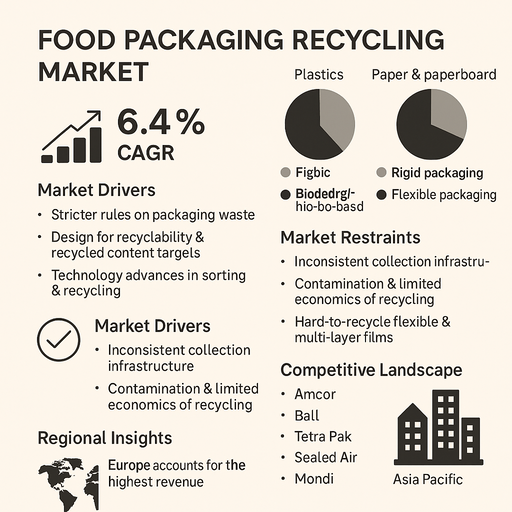
The food packaging recycling market is growing at a 6.4% CAGR as brand owners, retailers, and regulators push to recover more packaging waste and move toward circular packaging models. Collection and recycling systems are expanding from focus on bottles and cans to include flexible pouches, trays, and multilayer formats. Within materials, plastics and paper & paperboard currently account for the largest share of recycling activity due to their high usage in food packaging, while biodegradable and bio-based materials are expected to post the highest CAGR as new regulations and brand pledges encourage compostable and recyclable designs. By packaging format, rigid packaging generates the highest revenue today, whereas flexible packaging is projected to grow the fastest as new sorting, washing, and chemical recycling solutions are deployed.
Market Drivers
Growth is driven by stricter rules on packaging waste, extended producer responsibility schemes, and national targets for recycling and recycled content. Food and beverage brands are under pressure to reduce virgin material use, design packaging for recyclability, and increase post-consumer recycled content in bottles, trays, and films. Deposit return systems, curbside collection upgrades, and source-separation programs raise feedstock availability and improve material quality. Technology advances in near-infrared sorting, hot-wash lines, de-inking, and chemical recycling increase recovery rates for mixed plastics and multi-material structures that were previously hard to recycle. Retailers and quick-service food chains are piloting closed-loop systems, reusable packaging, and take-back schemes that further support demand for recycled materials.
Market Restraints
Adoption is constrained by inconsistent collection infrastructure, contamination of post-consumer waste streams, and limited economics in regions with low landfill costs or weak regulation. Mechanical recycling can face quality loss, odour issues, and food-contact limits for some streams, which restricts use in direct food-contact applications. Many flexible and multi-layer films are still hard to sort and recycle at scale, increasing dependence on downcycling or energy recovery. Price volatility of recycled resins, paper, and metals compared with virgin materials adds planning risk for converters and brands. In emerging markets, informal collection systems, limited funding, and low consumer awareness delay roll-out of modern recycling plants and traceable supply chains.
Market by Material Type
Plastic dominates food packaging volumes and is a central focus of recycling investments, including PET bottles, HDPE containers, and increasingly PP tubs and flexible films; within material types plastic currently generates the highest revenue in the recycling market. Paper and paperboard benefit from high collection rates for cartons, corrugated cases, and foodservice packaging, with mills upgrading to handle barrier-coated and multi-layer structures. Metal packaging, especially aluminium beverage cans and steel food cans, offers high recycling rates and strong scrap value, supporting a mature closed-loop system. Glass recycling remains important for jars and bottles in markets with established collection networks, but faces competition from lighter-weight formats. Biodegradable and bio-based materials, including compostable films, bio-based plastics, and fibre-based solutions with functional coatings, are at an early stage but gain traction in new regulations and brand pilots; within material types biodegradable and bio-based materials are expected to record the highest CAGR as standards, labelling, and composting infrastructure improve. The “Others” category includes mixed-material laminates, specialty barriers, and emerging materials that move slowly toward recyclability through design changes and new recycling routes.
Market by Packaging Format
Rigid packaging, including bottles, jars, trays, tubs, and metal cans, contributes the highest revenue today thanks to established collection schemes, clear material streams, and proven end markets for recycled PET, HDPE, glass, and metals; within packaging formats rigid packaging currently generates the highest revenue. Flexible packaging, such as pouches, sachets, wraps, and films, has historically been under-recycled but is now the focus of many innovation programs and alliances. New mono-material designs, improved sorting, and mechanical and chemical recycling projects help unlock value from flexible waste, making this the fastest-growing segment; within packaging formats flexible packaging is expected to post the highest CAGR. The “Others” segment covers secondary and tertiary packaging formats such as intermediate bulk containers, crates, and transport packaging, where reuse and recycling models are expanding in food supply chains.
Regional Insights
Europe accounts for the highest revenue, supported by strict packaging and waste regulations, extended producer responsibility schemes, and binding recycling and recycled-content targets for plastic packaging. Collection systems, deposit return schemes, and advanced sorting plants give Europe a strong base for high-quality feedstock. Asia Pacific is expected to record the highest CAGR, driven by rapid growth in packaged food consumption, national plastic waste reduction policies, and new investments in recycling infrastructure in China, Japan, South Korea, India, and Southeast Asia. North America continues to upgrade curbside programs, materials recovery facilities, and bottle-to-bottle recycling, with growing interest in flexible packaging recovery and chemical recycling routes. Latin America and the Middle East & Africa are at earlier stages but show rising activity through urban waste management projects, beverage bottle collection programs, and export-oriented recycled material supply chains.
Competitive Landscape
Amcor plc develops recyclable and recycled-content food packaging formats across rigid and flexible portfolios, working with retailers and brands on design-for-recycling guidelines, mono-material structures, and closed-loop projects. Ball Corporation plays a key role in metal packaging recycling through aluminium and steel food and beverage cans, leveraging high recycling rates, strong scrap value, and can-to-can circularity. Tetra Pak supports beverage carton collection and recycling through partnerships with mills, recyclers, and municipalities, investing in technologies to separate and recover fibres, polymers, and aluminium layers. Sealed Air Corporation focuses on high-performance flexible packaging and protective solutions, advancing recyclable films, recycled-content resins, and collection pilots for food, e-commerce, and foodservice channels. Mondi Group expands paper-based and flexible packaging that can be recycled in existing paper and plastics streams, with emphasis on lightweight, mono-material designs and fibre solutions replacing mixed materials. Other players include global and regional converters, beverage and food brands, waste management companies, and recycling technology providers; companies that secure stable access to post-consumer feedstock, build strong recycler partnerships, and deliver certified recycled-content solutions are positioned to lead current revenue, while players scaling flexible packaging recycling and bio-based materials are set for the highest CAGR.
Historical & Forecast Period
This study report represents analysis of each segment from 2024 to 2034 considering 2025 as the base year. Compounded Annual Growth Rate (CAGR) for each of the respective segments estimated for the forecast period of 2026 to 2034.
The current report comprises of quantitative market estimations for each micro market for every geographical region and qualitative market analysis such as micro and macro environment analysis, market trends, competitive intelligence, segment analysis, porters five force model, top winning strategies, top investment markets, emerging trends and technological analysis, case studies, strategic conclusions and recommendations and other key market insights.
Research Methodology
The complete research study was conducted in three phases, namely: secondary research, primary research, and expert panel review. key data point that enables the estimation of Food Packaging Recycling Market By Material Type, By Packaging Format, By Recycling Process, By End Use - Global Market Analysis & Forecast, 2025 to 2033 market are as follows:
Market forecast was performed through proprietary software that analyzes various qualitative and quantitative factors. Growth rate and CAGR were estimated through intensive secondary and primary research. Data triangulation across various data points provides accuracy across various analyzed market segments in the report. Application of both top down and bottom-up approach for validation of market estimation assures logical, methodical and mathematical consistency of the quantitative data.
| ATTRIBUTE | DETAILS |
|---|---|
| Research Period | 2024-2034 |
| Base Year | 2025 |
| Forecast Period | 2026-2034 |
| Historical Year | 2024 |
| Unit | USD Million |
| Segmentation | |
Material Type
|
|
Packaging Format
|
|
Recycling Process
|
|
End Use Industry
|
|
|
Region Segment (2024-2034; US$ Million)
|
Key questions answered in this report


