Digital transformation across the global food supply chain is strengthening transparency, safety, and regulatory compliance from farm to consumer.
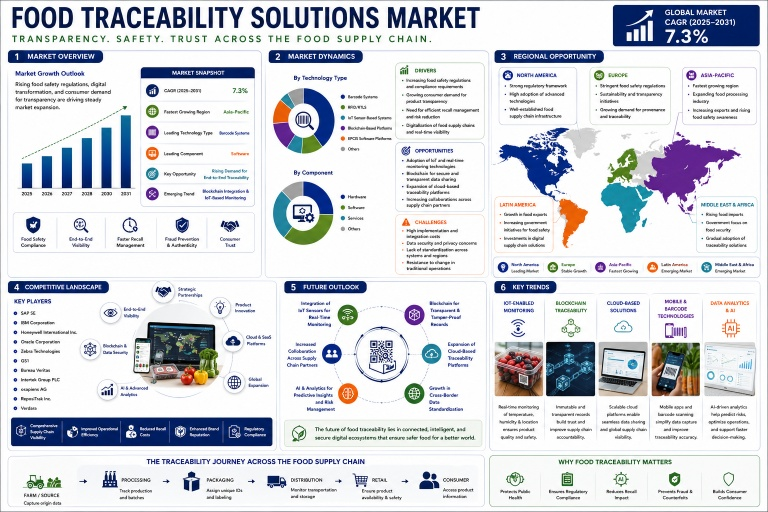
The global food traceability solutions market is experiencing steady growth as food manufacturers, processors, distributors, and retailers increasingly adopt advanced technologies to improve product visibility and supply chain transparency. Growing concerns regarding food safety, product recalls, counterfeit products, and changing regulatory requirements are encouraging organizations to implement end-to-end traceability solutions. These technologies enable real-time monitoring, faster recall management, and improved consumer confidence throughout the food value chain. As governments continue to strengthen food safety regulations and consumers demand greater transparency, the market is projected to register a CAGR of 7.3% during the forecast period.
Key Growth Driver
Increasing food safety regulations and demand for supply chain transparency are driving market expansion worldwide.
Governments and food regulatory agencies are implementing stricter traceability standards to improve food safety, reduce contamination risks, and ensure rapid product recall capabilities. At the same time, consumers are increasingly seeking information regarding product origin, ingredients, sustainability practices, and manufacturing processes. Advanced traceability solutions help businesses improve inventory management, maintain regulatory compliance, minimize financial losses from recalls, and strengthen brand reputation, thereby supporting widespread market adoption.
Segment Highlight
Technology innovation and digital supply chain integration continue to expand traceability capabilities across the food industry.
Based on technology type, Barcode Systems continue to account for a significant market share due to their affordability, ease of implementation, and widespread use across food manufacturing and retail operations. RFID/RTLS solutions are witnessing growing adoption by enabling automated product identification and real-time asset tracking. IoT Sensor-Based Systems are improving visibility by continuously monitoring environmental conditions such as temperature and humidity during transportation and storage. Blockchain-Based Platforms are gaining momentum by providing secure, tamper-resistant transaction records that enhance trust across supply chain participants. EPCIS Software Platforms support standardized data sharing among trading partners, while other emerging technologies continue to enhance end-to-end traceability capabilities.
By component, Software represents a substantial share of the market owing to increasing deployment of cloud-based traceability platforms, analytics tools, and compliance management solutions. Hardware remains essential for data capture through scanners, RFID readers, sensors, and labeling equipment. Services, including consulting, implementation, system integration, training, and maintenance, continue to support successful technology deployment across food supply chains, while other supporting components contribute to overall operational efficiency.
Regional Opportunity
North America maintains market leadership, while Asia-Pacific is emerging as a high-growth region for digital food traceability solutions.
North America holds a leading position in the Food Traceability Solutions Market due to strong regulatory frameworks, advanced digital infrastructure, high adoption of supply chain technologies, and increasing investments in food safety initiatives. Europe continues to witness steady growth supported by stringent food safety regulations, sustainability initiatives, and growing demand for transparent food sourcing. Meanwhile, Asia-Pacific is expected to register significant growth driven by expanding food processing industries, increasing exports, rising food safety awareness, rapid digitalization, and supportive government initiatives across China, India, Japan, and Southeast Asian countries.
Competitive Landscape
Industry participants are focusing on cloud platforms, automation, AI-driven analytics, and end-to-end supply chain visibility.
Leading companies are investing in integrated traceability platforms, real-time monitoring technologies, blockchain integration, IoT-enabled tracking systems, and advanced analytics to improve supply chain efficiency and regulatory compliance. Strategic collaborations with food manufacturers, logistics providers, retailers, and certification organizations continue to strengthen market competitiveness. Vendors are also emphasizing scalable cloud solutions, interoperability, cybersecurity, and predictive analytics to address the evolving requirements of global food supply chains.
Key companies operating in the market include SAP SE, IBM Corporation, Honeywell International Inc., Oracle Corporation, Zebra Technologies, GS1, Bureau Veritas, Intertek Group PLC, osapiens AG, ReposiTrak Inc., and Verdara.
Historical & Forecast Period
This study report represents analysis of each segment from 2024 to 2034 considering 2025 as the base year. Compounded Annual Growth Rate (CAGR) for each of the respective segments estimated for the forecast period of 2026 to 2034.
The current report comprises of quantitative market estimations for each micro market for every geographical region and qualitative market analysis such as micro and macro environment analysis, market trends, competitive intelligence, segment analysis, porters five force model, top winning strategies, top investment markets, emerging trends and technological analysis, case studies, strategic conclusions and recommendations and other key market insights.
Research Methodology
The complete research study was conducted in three phases, namely: secondary research, primary research, and expert panel review. key data point that enables the estimation of Food Traceability Solutions market are as follows:
Market forecast was performed through proprietary software that analyzes various qualitative and quantitative factors. Growth rate and CAGR were estimated through intensive secondary and primary research. Data triangulation across various data points provides accuracy across various analyzed market segments in the report. Application of both top down and bottom-up approach for validation of market estimation assures logical, methodical and mathematical consistency of the quantitative data.
| ATTRIBUTE | DETAILS |
|---|---|
| Research Period | 2024-2034 |
| Base Year | 2025 |
| Forecast Period | 2026-2034 |
| Historical Year | 2024 |
| Unit | USD Million |
| Segmentation | |
Technology Type
|
|
Component
|
|
End User
|
|
|
Region Segment (2024-2034; US$ Million)
|
Frequently Asked Questions
Q1. What is driving the growth of the Food Traceability Solutions Market?
The market is primarily driven by increasing food safety regulations, growing consumer demand for product transparency, rising adoption of digital supply chain technologies, and the need for efficient product recall management.
Q2. What is the expected growth rate of the Food Traceability Solutions Market?
The global Food Traceability Solutions Market is projected to expand at a CAGR of 7.3% during the forecast period.
Q3. What are food traceability solutions?
Food traceability solutions are technologies and systems that enable organizations to track food products throughout the supply chain, from raw material sourcing and production to distribution and retail, ensuring transparency, safety, and regulatory compliance.
Q4. Which technology segment accounts for a significant market share?
Barcode Systems account for a significant market share due to their cost-effectiveness, ease of deployment, and extensive adoption across food manufacturing, warehousing, and retail operations.
Q5. Why are blockchain-based platforms gaining popularity in food traceability?
Blockchain technology provides secure, transparent, and tamper-resistant records, improving supply chain visibility, reducing fraud risks, and strengthening trust among food producers, distributors, retailers, and consumers.
Q6. Which component segment leads the market?
The Software segment holds a substantial market share because organizations increasingly rely on cloud-based traceability platforms, compliance management systems, analytics tools, and supply chain monitoring applications.
Q7. Which region is expected to witness the fastest market growth?
Asia-Pacific is anticipated to emerge as a high-growth region due to expanding food production, increasing exports, rapid digital transformation, and strengthening government food safety regulations.
Q8. What trends are influencing the Food Traceability Solutions Market?
Major trends include blockchain integration, IoT-enabled monitoring, cloud-based traceability platforms, AI-powered analytics, real-time supply chain visibility, and increasing adoption of standardized data-sharing platforms.
Q9. Who are the leading companies operating in the Food Traceability Solutions Market?
Major companies include SAP SE, IBM Corporation, Honeywell International Inc., Oracle Corporation, Zebra Technologies, GS1, Bureau Veritas, Intertek Group PLC, osapiens AG, ReposiTrak Inc., and Verdara.
Q10. What opportunities are expected to shape the future of the market?
Growing investments in smart supply chains, increasing adoption of digital food safety solutions, expansion of cloud-based traceability platforms, rising demand for sustainable sourcing, and continued advancements in IoT, blockchain, and AI technologies are expected to create significant growth opportunities throughout the forecast period.