
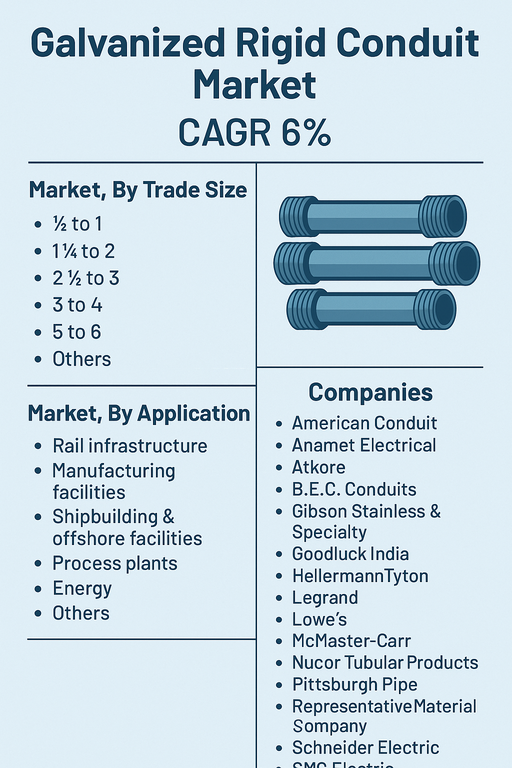
The Galvanized Rigid Conduit (GRC) market is projected to grow at a Compound Annual Growth Rate (CAGR) of 6.0% during the forecast period 2026 to 2034. GRCs are widely used in commercial, industrial, and infrastructure settings to protect electrical wiring from mechanical damage, moisture, and corrosive environments. Their rugged structure, combined with fire resistance and long service life, makes them essential for mission-critical installations across sectors such as energy, transportation, shipbuilding, and manufacturing. With growing infrastructure modernization, industrial safety regulations, and electrification initiatives worldwide, demand for GRC is expected to steadily increase.
Market Drivers
Expansion of Electrification in Industrial and Infrastructure Projects
Governments and private sectors are significantly investing in infrastructure upgrades, urban rail projects, and renewable energy installations. These developments demand robust electrical systems, where galvanized rigid conduits are vital for ensuring secure and durable protection of wiring networks. In 2025, several large-scale rail transit and highway tunnel electrification projects in the U.S., India, and Southeast Asia contributed to market expansion.
Rising Demand for Corrosion-Resistant Electrical Protection
The inherent corrosion resistance of galvanized rigid conduits, especially hot-dip galvanized steel, makes them suitable for harsh environments such as coastal regions, chemical plants, and offshore facilities. With growing awareness of workplace safety standards and the need for long-term infrastructure sustainability, industries are increasingly favoring GRCs over flexible conduits or PVC alternatives in critical installations.
Growth in Commercial and Industrial Construction
The post-pandemic recovery of the construction sector, especially in emerging economies, is accelerating demand for fire-rated, heavy-duty electrical containment systems. Smart buildings, manufacturing plants, and logistics centers are adopting galvanized steel conduit systems for both power and low-voltage wiring applications, further fueling market penetration.
Market Restraint
Weight and Installation Cost Challenges
One of the primary limitations associated with galvanized rigid conduits is their higher weight compared to other conduit types like EMT (Electrical Metallic Tubing) or plastic alternatives. This results in increased shipping costs and requires more labor-intensive installation processes. For projects with tight budget constraints or minimal physical protection requirements, these factors may deter adoption in favor of lighter, less durable alternatives.
Market Segmentation by Trade Size
In 2025, the ½ to 1 inch segment accounted for the highest revenue share due to its widespread use in commercial buildings, light industrial wiring, and control panel installations. This size range offers optimal flexibility and performance for typical wire runs, making it a standard choice in mainstream construction projects.
Meanwhile, the 3 to 4 inch segment is expected to exhibit the highest CAGR from 2026 to 2034, driven by growth in industrial and infrastructure applications. These larger trade sizes are increasingly deployed in process plants, energy facilities, and metro systems where higher cable capacity and mechanical protection are essential.
Market Segmentation by Application
In 2025, Manufacturing Facilities emerged as the leading application segment, driven by automation, retrofitting of legacy electrical systems, and adherence to national electrical codes. Plants in automotive, food processing, and heavy machinery sectors increasingly prefer galvanized rigid conduit systems for durability and compliance. The Rail Infrastructure segment is forecast to grow at the fastest pace during 2026–2034, supported by increasing investments in metro systems, high-speed rail corridors, and electrified freight lines. The use of galvanized steel conduits for power distribution and signaling cables ensures enhanced safety and resilience in high-vibration and weather-exposed environments.
Geographic Trends
North America held the largest market share in 2025, primarily due to mature safety regulations, high construction standards, and ongoing upgrades of electrical infrastructure across the U.S. and Canada. The region’s extensive manufacturing base and focus on grid resilience also contribute to consistent GRC demand. Asia Pacific is expected to witness the highest CAGR through 2034. Urbanization, rising energy demand, and industrial expansion in China, India, Indonesia, and Vietnam are creating strong momentum for rigid conduit systems. Governments in these regions are also encouraging local manufacturing of electrical components under industrial development policies, further promoting domestic consumption. Europe maintains stable demand, especially in Germany, the UK, and France, where strict regulatory frameworks and decarbonization goals are driving investment in efficient and sustainable building services. Meanwhile, Middle East & Africa (MEA) is becoming a key market for offshore and petrochemical GRC applications, fueled by energy diversification and infrastructure development programs.
Competitive Trends
The galvanized rigid conduit market features a diverse set of players ranging from vertically integrated steel manufacturers to niche electrical hardware suppliers. Key companies include:
American Conduit
Anamet Electrical
Atkore
B.E.C. Conduits
Gibson Stainless & Specialty
Goodluck India
HellermannTyton
Legrand
Lowe's
McMaster-Carr
Nucor Tubular Products
Pittsburgh Pipe
Representative Material Company
Schneider Electric
SMC Electric
Techno Flex
Weifang East Steel Pipe
Yale Electrical Supply
Zekelman Industries
In 2025, market leaders focused on expanding their galvanized product lines, integrating smart labeling and tracking systems for inventory optimization, and investing in corrosion-resistant coatings. Product certifications (e.g., UL, ANSI C80.1) remained a key differentiator in competitive bidding.
From 2026 to 2034, the market is expected to see strategic consolidation, especially in North America and Europe, as companies aim to vertically integrate operations and improve economies of scale. Further, technological enhancements such as pre-threaded conduit, push-fit couplings, and modular accessories will become critical for gaining installation efficiency and meeting contractor demand.
Historical & Forecast Period
This study report represents analysis of each segment from 2024 to 2034 considering 2025 as the base year. Compounded Annual Growth Rate (CAGR) for each of the respective segments estimated for the forecast period of 2026 to 2034.
The current report comprises of quantitative market estimations for each micro market for every geographical region and qualitative market analysis such as micro and macro environment analysis, market trends, competitive intelligence, segment analysis, porters five force model, top winning strategies, top investment markets, emerging trends and technological analysis, case studies, strategic conclusions and recommendations and other key market insights.
Research Methodology
The complete research study was conducted in three phases, namely: secondary research, primary research, and expert panel review. key data point that enables the estimation of Galvanized Rigid Conduit Market By Trade Size, By Application, By End Use - Growth, Share, Opportunities & Competitive Analysis, 2026 - 2034 market are as follows:
Market forecast was performed through proprietary software that analyzes various qualitative and quantitative factors. Growth rate and CAGR were estimated through intensive secondary and primary research. Data triangulation across various data points provides accuracy across various analyzed market segments in the report. Application of both top down and bottom-up approach for validation of market estimation assures logical, methodical and mathematical consistency of the quantitative data.
| ATTRIBUTE | DETAILS |
|---|---|
| Research Period | 2024-2034 |
| Base Year | 2025 |
| Forecast Period | 2026-2034 |
| Historical Year | 2024 |
| Unit | USD Million |
| Segmentation | |
Trade Size
|
|
Application
|
|
End Use
|
|
|
Region Segment (2024-2034; US$ Million)
|
Key questions answered in this report


